
Most people assume building a real estate portfolio is something you do after you're already wealthy. That's the wrong way to think about it. The real question of why build a real estate portfolio comes down to one thing: creating income that doesn't require you to trade time for money indefinitely. You don't need to be rich to start. You need a system, the right information, and the discipline to follow through. This article breaks down the core reasons, proven strategies, and practical steps to help you build something that actually lasts.
Table of Contents
- Key takeaways
- Why build a real estate portfolio: the real financial case
- Proven strategies for building a real estate portfolio
- Managing your portfolio for long-term growth
- Real estate vs. other investments: what sets it apart
- My honest take on why most investors don't scale
- Start building your portfolio the right way
- FAQ
Key takeaways
| Point | Details |
|---|---|
| Passive income from day one | Even a single rental property can generate monthly cash flow while you work toward financial independence. |
| Use proven scaling frameworks | The BRRRR strategy lets you recycle capital and grow your portfolio without needing fresh cash every time. |
| Cash flow beats appreciation chasing | Prioritizing income over speculative price growth gives you resilience when markets shift. |
| Diversification protects you | Spreading across property types and geographies reduces the impact of any single market downturn. |
| Systems drive long-term success | Automating management and standardizing operations is what separates scalable portfolios from accidental landlords. |
Why build a real estate portfolio: the real financial case
Most wealth-building conversations start with stocks. Real estate rarely gets its due credit until people actually run the numbers. Here's what makes a portfolio of properties genuinely different from other investments.
Multiple income streams from a single asset class. A duplex generates rent from two units. A small portfolio of four single-family homes can replace a full-time income. You're not just collecting one check. You're building a machine that produces income month after month, often with tenants paying down your mortgage at the same time.
The benefits of real estate investing go well beyond monthly rent. Here's what a diversified portfolio delivers:
- Equity growth through mortgage paydown and property appreciation over time
- Tax advantages including depreciation deductions, the ability to defer gains through 1031 exchanges, and write-offs on expenses
- Inflation protection because rents and property values tend to rise as the dollar loses purchasing power
- Financial independence through replacing or exceeding your working income with passive cash flow
- Portfolio diversification that reduces overall volatility compared to holding only stocks and bonds
"Property wealth-building is a system, not luck or sentiment. Focusing on how hard your money works beats watching price alone." — Tan Zhi Wei
The historical performance data backs this up. Real estate portfolios yield 8%+ annual returns, and REITs have averaged 12.3% over 25 years. That's not speculation. That's a documented track record.
Pro Tip: Don't wait for the "perfect" market. The best time to start building wealth through real estate is when you have a clear strategy, not when conditions feel ideal.

Proven strategies for building a real estate portfolio
Knowing why to invest is only half the battle. The how matters just as much, and most beginners skip the strategy phase entirely. That's where portfolios stall out.
Here are the most reliable frameworks investors use to scale from one property to many:
-
Start with a clear investment thesis. Define what you're buying, where, why, and at what price. Filtering properties with data-backed criteria removes emotional bias and keeps you from chasing deals that don't pencil out.
-
Apply the BRRRR strategy. Buy, Rehab, Rent, Refinance, Repeat. Investors using this method buy distressed properties 20-40% below after-repair value, force equity through renovation, then pull capital out via refinancing to fund the next deal. It's how you scale without needing a fresh down payment every time.
-
Diversify across property types and markets. Don't put all your capital into one city or one property class. Single-family, multifamily, and short-term rentals each behave differently across market cycles.
-
Choose cash flow over appreciation chasing. Income-first portfolios better withstand rising expenses and market downturns. Banking on price appreciation alone is speculation.
-
Budget for capital expenditures from the start. Roofs, HVAC systems, and plumbing don't care about your timeline. Allocating 5-10% of rents for CapEx is a non-negotiable part of real estate portfolio management.
-
Avoid overleveraging. Taking on too much debt relative to cash flow is the most common way new investors lose everything when markets shift.
Here's a quick comparison of two core investment approaches:
| Strategy | Cash flow focus | Appreciation focus |
|---|---|---|
| Primary goal | Monthly income | Long-term price growth |
| Risk level | Lower | Higher |
| Market resilience | Strong | Vulnerable in downturns |
| Best for | Financial independence | Wealth accumulation over decades |
| Requires | Conservative underwriting | Market timing and patience |
Pro Tip: When you're starting out, pick one market and one property type. Master it before you expand. Beginners who start with little capital and focused strategies outperform those who try to do everything at once.
Managing your portfolio for long-term growth
Buying properties is the exciting part. Managing a portfolio for compounding growth over years? That's where most people check out. Don't let that be you.
Real estate portfolio growth requires you to track the right numbers consistently. Here are the metrics that actually matter:
- Cash-on-cash return: How much income you receive relative to the cash you invested. Aim for 8-12% minimum in most markets.
- Net operating income (NOI): Total rental income minus operating expenses, before mortgage payments. This tells you how a property performs independent of financing.
- Vacancy rate: High vacancy destroys cash flow fast. Track it by property and by market.
- Debt service coverage ratio (DSCR): Your NOI divided by your mortgage payment. Lenders want to see 1.25 or higher. So should you.
- Portfolio-wide equity: How much you could access via refinancing to fund future acquisitions.
Automation is not optional at scale. Standardizing renovation materials and delegating property management early reduces your costs and frees you to focus on acquisition decisions rather than day-to-day problems. This is the shift from landlord to investor.
Financing strategy matters as you grow. As of 2026, investment property loan rates sit at 6.6-7.5%. That means the spread between your cost of capital and your rental yield has to be carefully managed. Refinancing at the right moment can free up capital to redeploy without selling assets, a core principle of real estate portfolio management.
Market cycles are real. Portfolios that survive downturns share one trait: they were built with enough cash flow buffer to absorb rising costs and temporary vacancies. Patient investors focused on structural trends consistently outperform those chasing short-term gains.
Real estate vs. other investments: what sets it apart
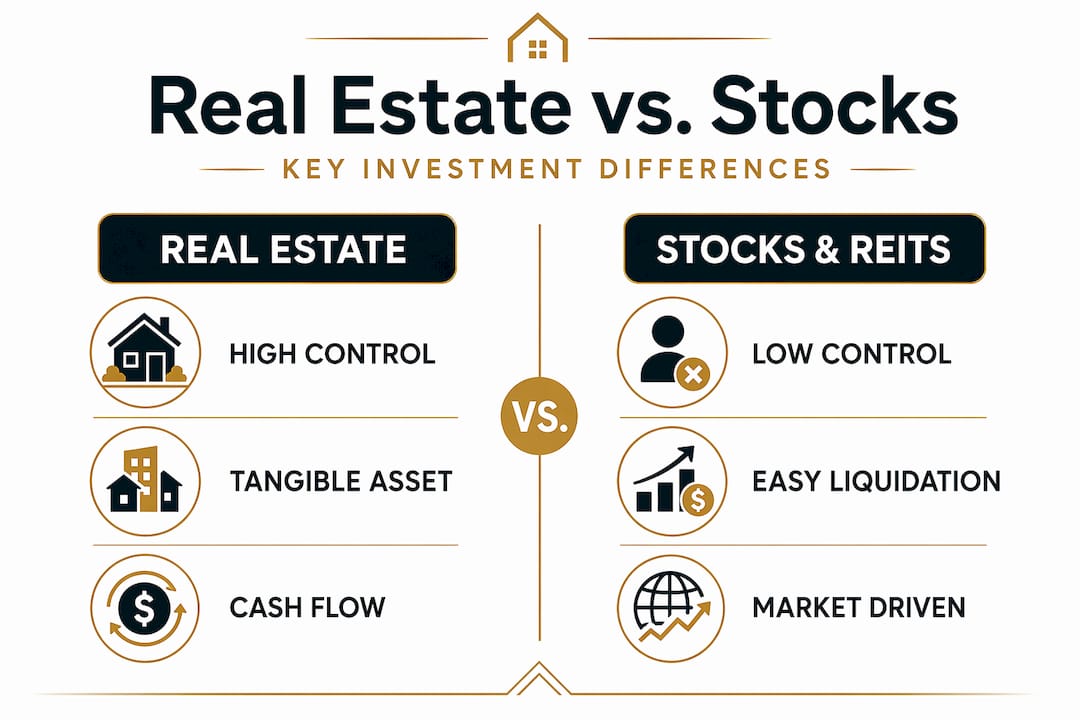
You could put your money in index funds, bonds, or REITs. Those are valid options. But a direct real estate portfolio offers a different set of advantages that no other asset class replicates.
| Factor | Direct real estate | Stocks/ETFs | REITs |
|---|---|---|---|
| Control over value | High (renovate, reposition) | None | None |
| Tax benefits | Depreciation, 1031 exchange | Limited | Dividends taxed as ordinary income |
| Inflation hedge | Strong (rent growth + appreciation) | Moderate | Moderate |
| Liquidity | Low | High | High |
| Leverage | Accessible | Limited | Limited |
| Correlation to markets | Low | High | Moderate |
The low correlation point deserves attention. Private real estate reduces portfolio volatility by not moving in lockstep with the stock market. When equities crash, your rental income doesn't automatically stop. That's a real distinction.
The control element is what attracts serious wealth builders. You can force appreciation through a kitchen renovation, raise rents to market rates when a lease ends, or reposition a property to a higher-use case. None of that is possible when you own shares in a fund.
The tradeoffs are real too. Real estate is illiquid. You can't sell one bedroom in a pinch. That's why understanding how real estate generates income before you commit capital matters so much. Know the risks. Then decide with clear eyes.
The importance of real estate diversification within a portfolio extends beyond property types. Geographic spread, tenant mix, and lease structures all reduce your exposure to any single point of failure. That's what maximizing returns in real estate really looks like: reducing risk while optimizing income.
My honest take on why most investors don't scale
I've watched a lot of beginners buy their first property with total excitement, then stall out at one or two. The reason is almost never money. It's almost always mindset and systems.
What I've learned is that the investors who scale consistently don't fall in love with their properties. They treat them like units of income production. They track numbers weekly, not annually. They identify which properties are carrying dead weight and act on that information without sentiment.
In my experience, the biggest mistake people make is holding a "sleeper" property, one that barely breaks even, hoping appreciation will save them. Meanwhile, that capital could be redeployed into something that actually produces cash flow. The math on that decision is painful when you finally run it.
I've also seen what happens when people try to do everything themselves for too long. Self-managing two properties is manageable. Self-managing eight is a second job. The shift to delegating and scaling through standardized systems is uncomfortable at first. It also multiplies what you can achieve.
My honest advice: decide upfront that you're building a portfolio, not buying a property. That single reframe changes every decision you make from day one.
— David
Start building your portfolio the right way
If you've been waiting to feel ready, this is your sign to stop waiting. Realestatecourse gives you a step-by-step training program built specifically for beginners who want to start building wealth through real estate with little to no starting capital.

You get instant access to practical lessons, checklists, and a personalized execution plan, all for a one-time investment of $19.99. No fluff. No theory. Just real methods that work from day one. Whether you're just learning how to create a real estate portfolio or ready to scale beyond your first deal, Realestatecourse gives you the foundation to do it with confidence. Take the first step toward financial independence today.
FAQ
Why build a real estate portfolio instead of buying just one property?
A single property concentrates all your risk in one location and one tenant. A portfolio spreads that risk, increases total income, and gives you more leverage to refinance and grow.
How do beginners start building a real estate portfolio with little money?
The BRRRR strategy and house hacking are two practical entry points that require minimal upfront capital. Starting with a clear thesis and focusing on cash flow first helps beginners build without overextending.
What is the best real estate investment strategy for long-term growth?
A cash-flow-first strategy backed by disciplined underwriting consistently outperforms speculation. Patient investors focused on structural trends and income sustainability build the most durable portfolios over time.
How many properties do you need for a real estate portfolio?
There's no fixed number. Many investors achieve financial independence with four to six well-chosen properties generating net positive cash flow. Quality and cash flow consistency matter more than quantity.
How does real estate diversification protect your portfolio?
Holding different property types across multiple markets means no single vacancy, local downturn, or tenant issue can collapse your income. The importance of real estate diversification is that it keeps your overall returns stable even when individual assets underperform.