
Most people assume real estate investing requires a large down payment, a perfect credit score, and a bank willing to approve a 30-year mortgage. That belief stops thousands of potential investors before they ever start. What is creative real estate investing? It is the practice of acquiring properties through alternative financing methods that bypass traditional bank requirements entirely. These strategies let you control real estate with little to no cash upfront, faster closings, and terms you actually negotiate. This guide breaks down exactly how it works, which strategies matter most, and how you can start building a portfolio without a big bankroll.
Table of Contents
- Key Takeaways
- What is creative real estate investing, exactly?
- Key creative real estate investing strategies
- Legal and compliance considerations
- How to start investing creatively with limited capital
- My honest take on creative real estate investing
- Start learning creative real estate investing today
- FAQ
Key Takeaways
| Point | Details |
|---|---|
| No bank required | Creative financing in real estate lets you acquire property without traditional mortgage approval or large down payments. |
| Multiple entry strategies | Seller financing, subject-to deals, lease options, and house hacking each offer distinct low-capital entry paths. |
| Legal compliance matters | New federal rules in 2026 affect entity-based transfers; always work with a qualified real estate attorney. |
| Speed is a real advantage | Creative deals often close in 7 to 14 days versus 30 to 60 days for conventional loans. |
| Education accelerates results | Learning proper deal structure and negotiation skills dramatically reduces costly beginner mistakes. |
What is creative real estate investing, exactly?
Creative real estate investing means using alternative financing and deal structures to acquire property without relying on a traditional bank mortgage. Instead of going to a lender, you work directly with sellers, use existing loan agreements, or structure lease-purchase contracts that give you control of a property with far less upfront capital.
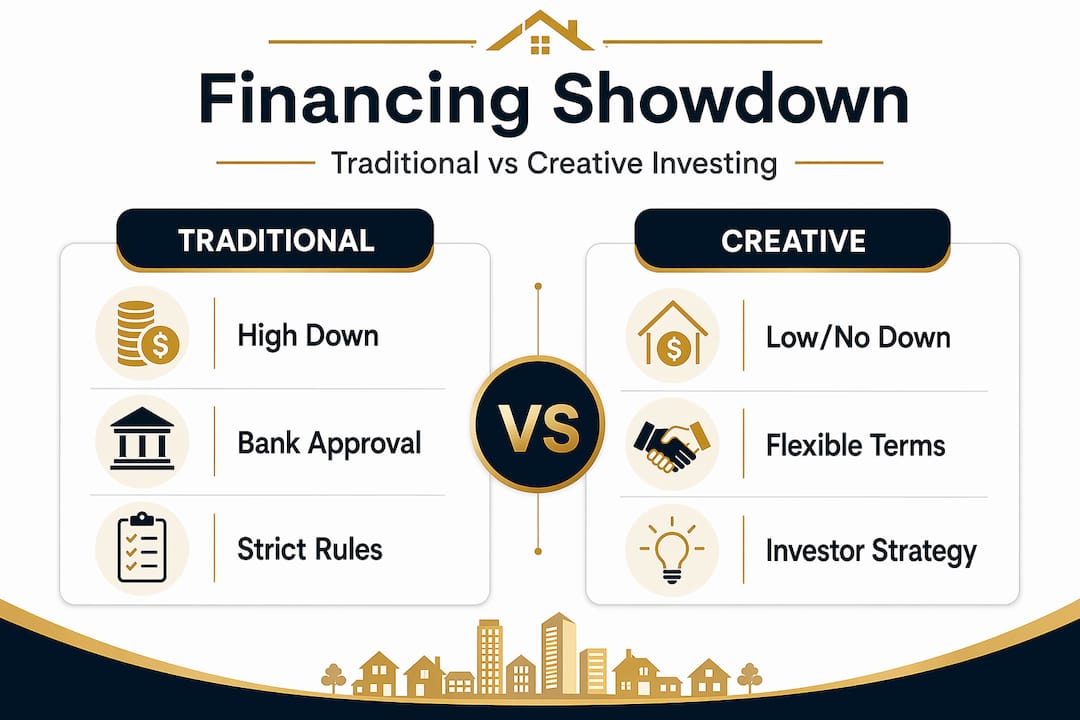
The difference from conventional investing is significant. With a traditional purchase, you need strong credit, a sizable down payment, and weeks of underwriting. Creative deals close in 7 to 14 days versus 30 to 60 days for traditional loans, and down payments often range from $0 to $5,000 instead of the typical 3% to 25%.
The benefits of creative real estate investing go beyond just speed and low capital. You can access deals that conventional buyers cannot touch. Distressed properties, sellers facing foreclosure, and landlords who are burned out often cannot wait for bank timelines. You can. That positions you to negotiate favorable terms and find opportunities that others walk right past.
Here is a quick comparison of how the two approaches differ:
| Factor | Traditional financing | Creative financing |
|---|---|---|
| Down payment | 3% to 25% of purchase price | $0 to $5,000 (often negotiated) |
| Approval time | 30 to 60 days | 7 to 14 days |
| Credit requirements | Strict (usually 620+) | Flexible or not required |
| Lender involvement | Required | None or minimal |
| Negotiation flexibility | Limited | High |
| Deal types accessible | Standard market listings | Distressed, off-market, motivated sellers |
Pro Tip: Creative investing does not mean cutting corners. The deals are real, the titles transfer legally, and the documentation must be solid. Think of it as negotiating the financing terms rather than skipping them.
Key creative real estate investing strategies
This is where theory becomes practice. There are four strategies that beginners consistently use to enter the market with limited capital. Each works differently, and each suits different situations.
Seller financing
Seller financing means the property owner acts as the bank. Instead of you getting a mortgage from a lender, the seller agrees to receive monthly payments directly from you. You agree on a purchase price, interest rate, and repayment term together.
Seller financing deals have grown 9% between 2023 and 2025, showing that more sellers and buyers are choosing this path. Why? Sellers often get a better return on their equity than leaving money in a savings account. Buyers get flexible terms that banks refuse to offer. Seller financing terms can include deferred payments, longer loan structures, or interest rates below current bank rates, all negotiated directly between the two parties.
This strategy works especially well with sellers who own their property free and clear. No underlying mortgage means no complications with a lender's due-on-sale clause.
Subject-to deals
A subject-to deal means you buy a property and take ownership of the deed, but the seller's existing mortgage stays in their name. You make the monthly payments on that existing loan while you own and control the property.
Subject-to deals are legal in all 50 states when properly documented with valid purchase agreements and deeds. They work best with motivated sellers who need a fast exit and cannot wait for a buyer to get bank financing.
The core benefit is clear: you get into a property without qualifying for a new loan. The risks are real too. Subject-to deals require careful attention to due-on-sale clause risks, which means the lender can technically demand full repayment if they discover ownership has changed. Smart investors maintain a refinancing plan or a sale timeline to manage that exposure.
Lease options
A lease option gives you the right to rent a property now and buy it later at a price you lock in today. You pay the seller an option fee upfront (often a few thousand dollars) and rent the property for a set period, typically one to three years. At the end, you can buy it or walk away.
This strategy is useful in two ways. As a buyer, you control a property and its appreciation while you build credit or savings toward a purchase. As an investor, you can use lease options to build a pool of buyers for properties you control, profiting from the spread between your rent payment and the rent you collect.
House hacking
House hacking is the most accessible starting point for most beginners. You buy a multifamily property (a duplex, triplex, or fourplex), live in one unit, and rent out the others. The rental income from your tenants covers most or all of your mortgage payment.

House hacking allows investors to build equity and live for little to no monthly housing cost, using FHA loans with as little as 3.5% down or conventional loans starting at 5%. That is a far lower barrier than most people realize. Learn more about making money with little capital through this exact approach.
Here is a summary of all four strategies:
| Strategy | Best used when | Key advantage | Main risk |
|---|---|---|---|
| Seller financing | Seller owns property free and clear | Flexible terms, no bank needed | Seller must agree; balloon payments |
| Subject-to | Seller needs fast exit, has existing loan | No new financing required | Due-on-sale clause exposure |
| Lease option | Buyer needs time; investor wants control | Locks in price, low upfront cost | Option fee is non-refundable |
| House hacking | First-time investor, W-2 income | Tenants offset mortgage; low down | Must live on-site initially |
Pro Tip: Start with house hacking if you have a steady income and want the lowest-risk entry point. Seller financing and subject-to deals tend to reward investors who already understand negotiation and deal structure.
Legal and compliance considerations
Creative property investing methods come with real legal responsibilities. Understanding the rules protects you from costly mistakes.
The most significant recent development is the FinCEN Reporting Rule that requires reporting all non-financed transfers to legal entities or trusts, with violation penalties reaching $286,184 per case. If you plan to hold properties in an LLC or trust (which many investors do for liability protection), this rule affects you directly starting in 2026.
Here are the key legal points every creative investor needs to know:
- Due-on-sale clauses: In subject-to deals, the lender can demand full loan repayment if they discover the property was transferred. This rarely happens in practice, but you must have an exit strategy ready.
- Proper documentation: Every creative deal needs a legitimate purchase agreement and deed. Handshake deals create legal exposure for both parties.
- Attorney involvement: Education and professional legal support are critical to successfully structuring creative deals. Never skip the attorney step to save a few hundred dollars.
- Entity structuring: Buying through an LLC adds liability protection but now triggers federal reporting requirements under FinCEN. Weigh the tradeoffs before structuring each deal.
"The right attorney is not an expense. They are the difference between a deal that holds up and one that falls apart in court."
Pro Tip: Build a relationship with a real estate attorney before you need one. Find someone who specifically understands creative financing deals, not just standard residential closings. It changes everything.
Understanding your contractual obligations in creative deals is not optional. It is the foundation of doing this right.
How to start investing creatively with limited capital
Knowing the strategies is only half the work. Here is how you actually put this into practice.
Step 1: Identify motivated sellers. These are people who need to sell fast. Target pre-foreclosure lists, probate properties, out-of-state landlords, and properties sitting on the market well past average days-on-market for your area.
Step 2: Build your professional team. You need:
- A real estate attorney familiar with creative financing
- A title company that handles non-traditional closings
- A local property inspector you can call quickly
- A network of other investors who can refer off-market deals
Step 3: Learn to negotiate the right way. Creative financing in real estate lives or dies on your ability to have honest conversations with sellers about their situation. You are solving a problem for them, not taking advantage of them. The best deals happen when both sides win.
Step 4: Prioritize your first deal type. If you have a steady income and want to use a low down payment loan, start with house hacking. If you have negotiation confidence and find a seller who owns free and clear, pursue seller financing. Match the strategy to your current strengths.
Step 5: Scale with systems. Once your first deal is cash-flowing, build habits that scale your portfolio. Track your leads, document your deal criteria, and keep refining your outreach process.
Real estate crowdfunding is another alternative real estate strategy worth mentioning. Experts advise starting small (5% to 10% of your portfolio) and choosing large, established platforms, since these deals carry illiquidity risks that most beginners underestimate. For most people starting out, direct creative deals offer more control and better learning.
Pro Tip: Your first deal will take longer than you expect. That is normal. The goal is not to close fast; it is to close right and learn from every step of the process.
My honest take on creative real estate investing
I have watched hundreds of beginners get stuck in the same trap: they wait until they have enough money to invest the "normal" way. They never start.
What I have seen over and over is that the people who do start with creative strategies are often better investors in the long run. They learn negotiation from day one. They understand deal structure in ways that buyers who simply sign bank paperwork never do. They learn to read sellers, spot overlooked properties, and think in terms of solutions.
The biggest mistake I see beginners make is treating creative investing as a shortcut rather than a skill set. It is not a hack. Subject-to deals require you to understand mortgage responsibility. Seller financing requires you to draft solid agreements. House hacking requires you to be a landlord from day one. None of it is passive at the beginning.
The other mistake is going it alone. Creative investing insights consistently point to education and a strong professional team as the real differentiators between investors who scale and those who stall after their first deal.
My genuine advice: treat the first year like an apprenticeship. Learn every deal type. Close one deal. Learn from it. Then build from there. Creative real estate is a sustainable path to wealth. But it rewards the patient and prepared, not the impatient and overconfident.
— David
Start learning creative real estate investing today
If this article made you realize that creative property investing methods are within reach, the next step is getting structured training that shows you exactly how to execute.

Realestatecourse offers a beginner-friendly program built specifically for people starting with little to no capital. The curriculum covers seller financing, house hacking, subject-to deals, and step-by-step deal execution. No fluff, no theory overload. Just the practical skills you need to find deals, structure them correctly, and start building real income from real estate.
For a one-time cost of $19.99, you get instant access to all modules, checklists, and a personalized execution plan. You can start the same day you enroll. If you are serious about getting started in real estate without a large bankroll, this is the most direct path available. The people who build portfolios are the ones who stop waiting and start learning.
FAQ
What is the simplest creative real estate strategy for beginners?
House hacking is the most accessible starting point. You buy a small multifamily property, live in one unit, and let tenants in the other units cover most or all of your mortgage payment using FHA loans with as little as 3.5% down.
Is creative financing in real estate legal?
Yes. Strategies like seller financing, subject-to deals, and lease options are all legal when properly documented. Subject-to deals are legal in all 50 states, but require valid purchase agreements, proper deed transfers, and attention to due-on-sale clause risks.
How much money do I need to start investing creatively?
Creative deals often require as little as $0 to $5,000 upfront, compared to the 3% to 25% down payments required for traditional mortgages. The exact amount depends on the strategy and deal terms you negotiate.
What is the biggest risk in creative real estate investing?
Improper documentation and skipping legal counsel are the top risks. In subject-to deals specifically, the due-on-sale clause can create exposure if the lender discovers the ownership transfer. Always work with a real estate attorney experienced in creative financing.
Does the new FinCEN rule affect creative real estate investors?
Yes. The 2026 FinCEN Residential Real Estate Reporting Rule requires reporting all non-financed property transfers to legal entities or trusts, with penalties up to $286,184 per violation. Investors using LLCs or trusts for creative deals must comply with this rule.