
Most small investors don't fail because they lack ambition. They fail because they treat every deal like the first one they've ever done. They hustle, scramble, and make decisions from memory rather than from a proven process. The result is chaos, burnout, and inconsistent results. Building real, repeatable income through real estate isn't about working harder. It's about working from a system. This guide breaks down what systematization means, why it matters even when you're starting small, and exactly how to put it into practice today.
Table of Contents
- What is systematization in real estate?
- Why systematization matters for small investors
- Reducing risk: Systematized due diligence and checks
- How to get started: Simple frameworks for beginners
- Why most new investors miss the real power of systems
- Next steps: Learn, automate, and grow
- Frequently asked questions
Key Takeaways
| Point | Details |
|---|---|
| Systems create repeatable results | Documented processes make income generation achievable even for beginners. |
| Reduces risk and costly errors | Structured checklists prevent mistakes in due diligence and deal assessment. |
| Enables time leverage and scale | Automation allows investors with limited capital to compete and grow. |
| Start simple and evolve | Avoid overwhelm by beginning with one key process and refining over time. |
What is systematization in real estate?
After outlining the importance of systematization, let's define what it actually means for real estate investors.
A lot of people confuse habits with systems. Habits are personal routines. They live in your head and disappear when life gets busy. Systems are different. A system is a documented, written process that anyone can follow, repeat, and improve over time. That distinction matters a lot when you're trying to scale.
Systematizing real estate makes outcomes repeatable, scalable, and less dependent on any single person by turning "tribal knowledge" into written, repeatable procedures. In plain terms: if the process only exists in your memory, it's not a system yet.
Here are the three core elements of any solid real estate system:
- Documentation: Every step is written down in a checklist, template, or workflow.
- Repeatability: The process produces a consistent outcome each time it's followed.
- Delegation potential: Someone else can eventually follow the same process and get the same result.
To understand why this matters, look at the comparison below:
| Approach | How decisions are made | Speed | Error rate | Scalability |
|---|---|---|---|---|
| Ad-hoc | Memory and instinct | Slow and inconsistent | High | Very low |
| Systematized | Written checklists and templates | Fast and predictable | Low | High |
The difference is stark. When you're building essential habits as a new investor, pairing those habits with documented systems turns individual actions into a repeatable engine. And if you're still getting your footing, understanding real estate investing basics is the foundation you build every system on top of.
Why systematization matters for small investors
With the concept defined, it's crucial to understand how systematization directly impacts small and side-hustle investors.
You might think systems are for large property management companies or full-time investors with teams. They're not. Systems are actually the most powerful tool available to someone who is doing this part-time, with limited capital, and juggling other responsibilities.
Systematization is a time-leverage strategy for small and side-hustle investors. It enables automation and outsourcing at the right stage so you can scale without burning out. Think about what that actually means in practice. Instead of manually researching every deal from scratch, a system lets you pre-screen opportunities with a repeatable checklist. Instead of drafting emails from memory, you use templates. Instead of tracking everything in your head, you use a spreadsheet or simple software.

The numbers back this up. Systems can materially improve speed and economics by shrinking manual data work and enabling faster decision cycles. One investment firm documented significant gains after building standardized workflows for deal intake and analysis. They didn't hire more people. They just structured the work better.
Here's what that looks like for a small investor:
- Deal sourcing: Automated alerts and saved searches replace daily manual browsing.
- Initial screening: A simple scoring sheet lets you evaluate opportunities in minutes, not hours.
- Follow-up: Templated outreach messages mean you stay in contact with sellers without starting from scratch each time.
- Offer tracking: A basic spreadsheet logs every offer, its status, and the outcome so you learn from each one.
- Closing prep: A documented checklist ensures nothing falls through the cracks before closing day.
If you're figuring out making money with little capital, systems are what make your limited hours count. And as you develop, building skills for new investors alongside your systems means you level up on both fronts simultaneously.
Pro Tip: Don't over-engineer your systems at the start. One solid, well-used checklist beats five complicated workflows that you never actually follow. Build what you will use, then expand.
Reducing risk: Systematized due diligence and checks
Systematic approaches don't just boost efficiency. They play a critical role in protecting you from costly errors.
One of the most expensive mistakes you can make as a real estate investor is committing capital before you've verified your assumptions. It happens all the time. An investor gets excited about a deal, skips a step in their review, and ends up surprised by a code violation, a bad tenant situation, or inaccurate rent projections. A system catches those problems before they cost you money.
Systems reduce costly misses in due diligence by forcing a structured review of financial, legal, physical, and market assumptions before capital is committed. A checklist doesn't get tired. It doesn't skip steps because you're excited about a deal. It holds the line every single time.
Here are the key steps in a systematized due diligence process:
- Verify ownership and title status. Confirm who owns the property and that no liens or disputes cloud the title.
- Run the numbers independently. Use your own income and expense estimates, not the seller's projections.
- Review all leases and rental agreements. Understand current tenant terms, rent amounts, and lease expiration dates.
- Order a property inspection. Document all physical conditions and estimate repair costs from a licensed professional.
- Check zoning and permits. Confirm the property is legally used as represented and all past work was permitted.
- Assess the local market. Compare rents, vacancy rates, and comparable sales in the immediate area.
- Review local regulations. Understand landlord-tenant laws, rental licensing requirements, and short-term rental restrictions if applicable.
- Confirm financing terms. Lock in your numbers before removing contingencies so you know exactly what the deal costs you.
This is exactly the kind of deep research for investing that separates investors who close good deals from those who close bad ones. Equally important is knowing your contract essentials so your legal protections are in place at every stage.
Pro Tip: Assign a specific owner to each checklist item and set a deadline. When no one owns a step, it tends to get skipped. Accountability turns a checklist from a good idea into a real safeguard.
How to get started: Simple frameworks for beginners
Knowing the risks and benefits, the next step is practical. Here's how you can start systematizing your own investing even on a small scale.
Starting doesn't require expensive software or a team. You need one documented process. That's it. Pick the part of your investing that feels most chaotic or inconsistent and build a simple checklist for it. Most beginners benefit most from either an acquisition checklist or a deal review workflow.
An acquisition checklist answers: "What do I need to confirm before I make an offer?" A deal review workflow answers: "How do I evaluate whether this opportunity is worth pursuing?" Both can start as a simple one-page document.
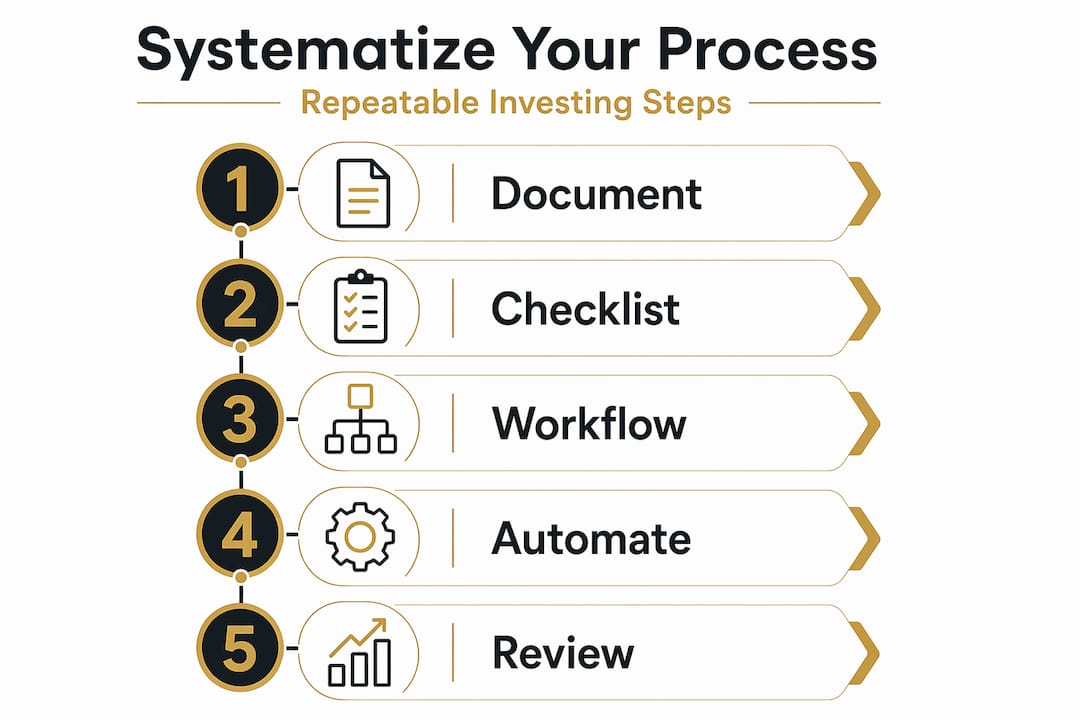
Over-engineering your systems too early causes overwhelm. The guidance is clear: start with a simple framework or checklist rather than attempting to systematize everything at once. Paralysis is real. The investor who builds one working checklist will always outperform the one who spent three months designing the perfect system they never launched.
Here's how to build your first system step by step:
- Choose one process. Acquisition checklist, offer tracking, or deal analysis. Pick just one.
- Write it down. List every step you currently take from memory. Don't skip anything.
- Test it on your next deal. Follow the checklist exactly and note what's missing.
- Update it after each use. The checklist gets better with every deal you run through it.
- Add a monthly review. Set aside 30 minutes each month to evaluate what's working and what needs adjusting.
That last point is critical. Systems without accountability become wish lists. The operating cadence matters. Monthly, quarterly, and annual reviews keep your systems alive and relevant. A checklist that hasn't been updated in a year is already outdated.
If you're exploring tips for investing with little capital, pairing those strategies with basic systems multiplies their impact. And understanding the benefits for beginners makes it easier to stay motivated while you're building these processes.
Your goal is not a perfect system. Your goal is a system that works, gets used, and improves over time. Adapt every framework to your real situation, not to what a textbook says investing should look like. Real markets, real deals, and your real schedule all shape what your system needs to be.
Why most new investors miss the real power of systems
Here's the uncomfortable truth: most beginners think systems are for big operations. They picture systems as something a property management company with 500 units uses, not something relevant to someone working a side hustle and looking at their third potential deal.
That belief is exactly what holds most small investors back.
Systems are not a luxury for big players. They are a lifeline for solo investors. When you're the one sourcing deals, analyzing numbers, negotiating, coordinating inspections, and managing paperwork, you need structure more than anyone. Every step you have to reinvent from memory is energy you're not spending on finding the next deal.
Here's what most people miss: systematization doesn't just save time. It creates portfolio-worthy, recurring results with less capital and less stress. When your process is documented, you can spot where you're losing money or time. You can improve that specific step. You can eventually hand it off to a virtual assistant or a partner while you focus on higher-value work.
Without systems, every deal is a grind. You make the same decisions over and over, often differently each time, and you burn out before you hit any real momentum. The investors who build lasting portfolios are almost never the ones who worked the hardest. They're the ones who built the best repeatable process and stuck with it.
Start with a beginner contract guide so you understand the legal documents you'll encounter repeatedly. Then build your first checklist around the part of the process that costs you the most time right now. That's your starting point. That's where the leverage is.
The real power of systems isn't efficiency. It's freedom. Freedom to take on more deals, work fewer chaotic hours, and build something that doesn't depend entirely on you showing up at full capacity every single day.
Next steps: Learn, automate, and grow
You now understand what systematization is, why it matters, and how to start. The next move is getting structured training that turns these concepts into real action.

At Real Estate Course, you get step-by-step modules that walk you through finding deals, analyzing opportunities, and building systems that produce repeatable income. The course covers everything from the fundamentals to execution, with action checklists and a tailored plan built specifically for beginners. There's no fluff, no theory overload, just practical real methods you can apply right away. For a one-time cost of $19.99, you get instant access to everything you need to stop reinventing the wheel on every deal and start building a system that works for you.
Frequently asked questions
What is a real estate system and why is it important?
A real estate system is a documented, repeatable process that makes investing more efficient, scalable, and less reliant on any one person. Systematizing real estate turns informal "tribal knowledge" into written procedures that produce consistent results.
How do systems reduce risk for real estate investors?
Systems enforce structured reviews and checklists that catch mistakes before capital is committed. Structured due diligence requires verification of financial, legal, physical, and market assumptions on every deal.
When should a beginner start systematizing their real estate investing?
Start as soon as you have one repeatable process, even if it's just a simple acquisition checklist. Over-engineering too early causes overwhelm, so build one working framework and expand from there.
Can systematization help save time for part-time investors?
Yes. Automation and standardized workflows allow part-time investors to handle more deals with less manual effort, making it possible to scale without adding more hours to your week.