
Nearly 40% of first-time real estate investors lose money because they skip research and overestimate returns. That number is not a scare tactic. It reflects a pattern that repeats itself constantly. Real estate can absolutely build wealth, but only when you treat it like a business, not a lottery ticket. This article breaks down exactly how disciplined research protects your money and helps you spot profitable opportunities others miss. You will learn the core research pillars, how to read market data, and the most common mistakes that drain beginners dry before they ever get started.
Table of Contents
- The stakes: Why research is critical for real estate success
- Core research pillars: What every investor must analyze
- How market analysis reveals profitable opportunities
- Avoiding common pitfalls: Research mistakes that cost investors
- Our take: Why disciplined research beats market hype
- Get started: The next step to becoming a research-driven investor
- Frequently asked questions
Key Takeaways
| Point | Details |
|---|---|
| Due diligence matters | Thorough research protects you from costly mistakes and highlights real opportunities. |
| Location drives returns | Studying micro-markets is more valuable than relying on national trends or hype. |
| Use data, not emotion | Success comes from strategy, checklists, and stress-tested numbers instead of gut feelings. |
| Skills can be learned | Investors can build their research abilities and confidence with structured tools and training. |
The stakes: Why research is critical for real estate success
Real estate deals are not small bets. Most involve five to seven figures of committed capital, often backed by debt. One bad decision can set you back years. That is why high financial stakes, market variability, and hidden risks make research non-negotiable before you sign anything.
"The biggest mistake new investors make is assuming the deal will work. Disciplined investors prove it will work before they commit."
Local markets can shift fast. A neighborhood that looked strong six months ago might be bleeding tenants today due to a factory closing or new zoning changes. You cannot see those shifts if you are only looking at surface-level numbers.
Here are the hidden risks that research helps you catch early:
- Legal issues: Unpermitted additions, zoning violations, or unclear title ownership
- Physical issues: Foundation problems, aging roofs, or faulty electrical systems not visible on a walkthrough
- Financial issues: Inflated seller projections, artificially low vacancy rates, or undisclosed liens
- Market issues: Declining population, shrinking job base, or oversupply of rental units in the area
38% of first-time investors lose money from poor research. That is not bad luck. That is skipped steps.
The good news is that most of these pitfalls are completely avoidable. Research does not require a finance degree. It requires a repeatable process and the discipline to follow it every time. Building a habit of avoiding common investing mistakes before they happen is what separates investors who build wealth from those who chase their losses.
The more you know going in, the less you lose on the way out.
Core research pillars: What every investor must analyze
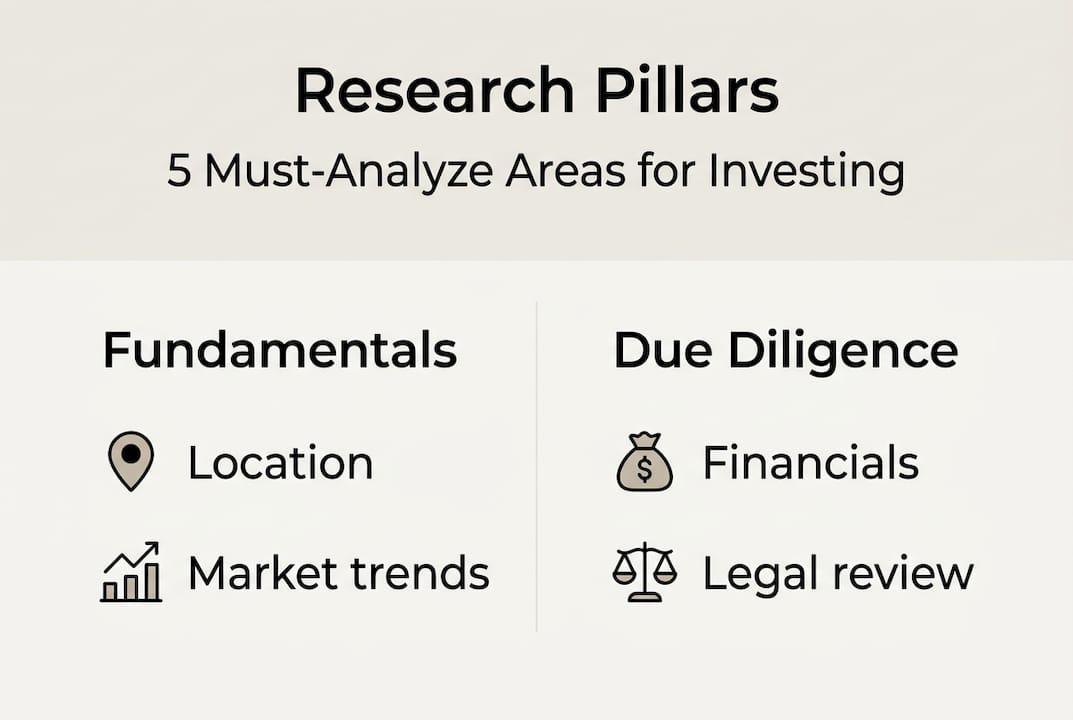
Once you understand what is at stake, the next step is knowing exactly where to focus your research. There are five key areas that determine whether a deal is worth pursuing or worth walking away from.
Key research areas every investor needs to analyze include location, property valuation, cash flow projections, construction or renovation costs, and long-term market evolution.
Here is how to work through each one:
- Location analysis: Study population trends, job growth, school ratings, walkability scores, and proximity to employers. A strong location holds value even in slow markets.
- Property valuation: Pull recent comparable sales (called comps) within a one-mile radius. Never rely on the asking price alone.
- Cash flow projections: Calculate gross rent, then subtract vacancy allowance, property taxes, insurance, repairs, and property management fees. What remains is your real return.
- Construction and renovation costs: Get contractor bids before you make an offer, not after. Surprises in this category kill deals fast.
- Market forecasts: Look at 3 to 5 year supply pipelines, planned infrastructure, and economic development projects in the area.
| Research area | Key question to answer | Tool or resource |
|---|---|---|
| Location | Is demand growing or shrinking? | Census data, local economic reports |
| Valuation | Am I paying fair market value? | MLS comps, Zillow, Redfin |
| Cash flow | Will the property cash flow positively? | Rental income minus all expenses |
| Renovation costs | What is the true rehab budget? | Contractor quotes, cost estimators |
| Market forecast | Where is this market headed? | City planning documents, investor forums |
A solid due diligence checklist covers financial review, physical inspection, legal and title review, market trends, tenant analysis, and insurance assessment.

Pro Tip: Always stress-test your numbers with worst-case assumptions. If the deal only works when everything goes right, it is not a good deal.
How market analysis reveals profitable opportunities
With your research pillars in place, you can start using data to find deals others miss. This is where market analysis becomes a real advantage.
The most effective approach combines macro and micro analysis. Macro analysis covers migration patterns, job growth, supply pipeline, and affordability, while micro analysis drills into specific neighborhoods, comparable sales, absorption rates, and cap rate comparisons.
Macro factors to track:
- Net population migration (are people moving in or leaving?)
- Job creation and major employer announcements
- New housing permits and construction pipeline
- Median income growth versus rent growth
Micro factors to track:
- Recent comparable sales within 90 days
- Average days on market for listings
- Rental vacancy rates by zip code
- Price-to-rent ratio (purchase price divided by annual rent)
Three types of markets deserve special attention. Gateway markets (like New York or Los Angeles) offer stability but come with high entry prices and compressed returns. Secondary markets (like Nashville or Austin) often offer better cash flow with solid growth potential. Tertiary markets (smaller cities or rural areas) can deliver high yields but carry more risk if the local economy shifts.
| Market type | Typical cap rate | Risk level | Best for |
|---|---|---|---|
| Gateway | 3.5% to 4.5% | Lower | Long-term appreciation |
| Secondary | 5% to 6.5% | Moderate | Balanced growth and cash flow |
| Tertiary | 7% to 9%+ | Higher | Yield-focused investors |
For reference, the U.S. average cap rate is 5.48% in 2026, with average vacancy sitting at 7.83%. Use these as your baseline benchmarks when comparing any deal.
Pro Tip: Never rely on a single data source. Blend MLS data, census reports, and local market trackers to build a fuller picture and avoid blind spots.
Avoiding common pitfalls: Research mistakes that cost investors
Knowing what to research is one thing. Knowing what mistakes to avoid is just as important. Most first-year losses are not random. They follow predictable patterns.
Here are the most common research mistakes new investors make:
- Overleveraging: Taking on too much debt relative to income leaves no cushion when vacancies rise or repairs hit.
- Underestimating expenses: Many beginners forget to account for property management fees, capital expenditures, and seasonal vacancies. The 50% rule is a useful shortcut: assume 50% of gross rent goes to expenses before debt service.
- Emotional buying: Falling in love with a property clouds judgment. Decisions should be based on numbers, not aesthetics.
- No exit strategy: Every deal needs a plan B. What happens if you cannot rent it? Can you sell quickly without a loss?
"In a high-rate environment, due diligence is not optional. Every assumption you skip becomes a liability you absorb."
Experts agree that stress-testing projections and building a support team of a CPA, real estate attorney, and experienced mentor is essential, especially now. Relying on national averages instead of micro-market data is one of the most expensive oversights a new investor can make.
Start with real estate investing on a budget so your first deal is built on real numbers, not wishful thinking.
Pro Tip: Before closing any deal, ask yourself: "Would I still buy this if vacancy ran at 10% for six months?" If the answer is no, rework the numbers or walk away.
Our take: Why disciplined research beats market hype
Here is what most investing content will not tell you. The investors who consistently win are rarely the ones who moved fastest or got the hottest tip. They are the ones who got bored doing the work everyone else skipped.
Market hype feels exciting. A neighbor tells you a neighborhood is blowing up. A podcast says one city is the next big thing. You feel urgency. But urgency built on hype is how people overpay, underanalyze, and get stuck holding properties that never perform.
The real edge in real estate comes from being methodical when others are reactive. It means pulling comps when others are taking seller projections at face value. It means running expense scenarios when others are calculating only the best case.
We have seen beginners succeed not because they had capital or connections, but because they followed a research framework consistently. Data does not guarantee results, but it eliminates the most avoidable losses. And in real estate, avoiding bad deals is just as valuable as finding great ones. Build the habit early, and it will protect you for years.
Get started: The next step to becoming a research-driven investor
You now have a clear picture of what separates investors who build lasting income from those who stumble on avoidable mistakes. The next move is applying this knowledge with structure.

At realestatecourse.net, our real estate investing training walks you through each research pillar step by step, using real-world scenarios designed for beginners. You do not need prior experience or a large budget to start. For a one-time cost of $19.99, you get instant access to action checklists, guided modules, and a tailored execution plan that turns research theory into confident, practical decisions. Start building your framework today.
Frequently asked questions
What is the most important type of research for real estate investing?
Location analysis is the most critical factor, followed closely by accurate property valuation and realistic cash flow projections. Getting these three right dramatically improves your odds of a profitable deal.
How do experts evaluate a real estate market's profitability?
They combine macro analysis including migration, jobs, and supply with hyper-local data like recent comparable sales, rent trends, and vacancy rates to get the full picture.
What are common research mistakes new investors make?
New investors often skip expense estimates, buy based on emotion, or fail to plan their exit. These gaps cause 38% of first-time losses and are completely avoidable with the right process in place.
How can research maximize investment income?
Research helps you identify undervalued assets by using comps, yield benchmarks, and macro trends to set realistic rent targets and avoid overpaying in poor locations.