
Most beginners think the role of real estate agents begins and ends with showing houses. You schedule a tour, they unlock the door, and that's the job. The reality is almost nothing like that. Real estate agents coordinate a complex chain of events involving negotiations, legal disclosures, inspections, appraisals, and closing paperwork, all at once. If you're an aspiring investor trying to generate income through real estate, understanding what agents actually do changes how you work with them, and that difference directly affects your results.
Table of Contents
- What real estate agents do for buyers and sellers
- Beyond showings: operational and research roles of real estate agents
- Agents as transaction coordinators and network hubs
- Understanding agent types, legal duties, and brokerage roles
- How real estate agents earn money: commissions and costs explained
- Why aspiring real estate investors should view agents as strategic partners, not just facilitators
- Start building your real estate knowledge and partnerships today
- Frequently asked questions
Key Takeaways
| Point | Details |
|---|---|
| Agents coordinate transactions | Real estate agents manage multiple tasks like negotiation, inspections, and paperwork to streamline buying or selling processes. |
| Different agent roles | Buyers' agents and sellers' agents perform distinct duties tailored to their clients’ needs, from marketing to contract negotiation. |
| Agents connect key professionals | They act as hubs linking buyers, sellers, lenders, inspectors, and title companies to facilitate smooth transactions. |
| Legal and fiduciary duties vary | Agency types and broker supervision affect agents’ responsibilities and client protections during deals. |
| Commissions vary by deal | Agents typically earn about 4.5% to 6% commission on the sale price, shared between buyer and seller agents depending on agreements. |
What real estate agents do for buyers and sellers
The scope of real estate agents responsibilities is wider than most beginners expect. Knowing this upfront helps you set realistic expectations and build better working relationships from the start.
Real estate agents act as a single point of coordination for key steps like finding homes, negotiating offers, scheduling appraisals and inspections, managing paperwork, and attending closing. The specific duties shift depending on whether they represent the buyer or seller.
For buyers, agents typically:
- Develop a targeted property list based on your budget and goals
- Schedule and coordinate showings across multiple listings
- Submit and negotiate offers on your behalf
- Arrange and attend home inspections
- Guide you through appraisal and financing timelines
- Review and explain all contract documents before signing
For sellers, agents typically:
- Price the home using comparable sales data (called "comps")
- List the property on the MLS (Multiple Listing Service), a shared database agents use to market homes
- Manage photography, staging recommendations, and advertising
- Field and negotiate incoming offers
- Handle required disclosures required by law
- Coordinate the closing process with the title company and buyer's agent
Understanding these two sides helps you spot where the real estate terms for beginners apply in real transactions and where your money actually goes.
Beyond showings: operational and research roles of real estate agents
Most people only see the visible part of an agent's work, the showings, the open houses, the phone calls. The research and administrative work happening behind the scenes is just as important, and often more valuable.

Agents perform administrative, research, and marketing duties such as market research, comparative analyses, photography coordination, open houses, and mortgage education for buyers. These tasks require consistent attention throughout the entire transaction.
Here's what that looks like in practice:
- Market analysis: Agents track median home prices, average days on market, and inventory levels. They use this data to advise you whether a price is reasonable or inflated.
- Contract management: Every offer, counteroffer, and addendum is a legal document. Agents track deadlines, collect signatures, and make sure nothing slips through.
- Client communication: A good agent keeps all parties informed, buyers, sellers, lenders, title companies, and inspectors, so no one is waiting on someone else without knowing why.
- Mortgage education: First-time buyers and new investors often don't fully understand pre-approval, loan types, or debt-to-income ratios. Agents explain these clearly before an offer is placed.
- Marketing execution: Seller agents manage online listings, social media posts, digital ads, flyers, and networking with other agents to find buyers faster.
This is where developing your own essential real estate skills as an investor pays off. The more you understand these tasks, the more clearly you can evaluate whether your agent is doing them well.
Pro Tip: When interviewing agents, ask specifically how they track market trends and what data sources they use. Vague answers are a red flag. Strong agents reference actual tools and specific statistics.
Agents as transaction coordinators and network hubs
Here's something most beginners never hear: a typical real estate transaction doesn't involve two or three people. It involves between 15 and 25 professionals working at the same time, including inspectors, lenders, title companies, appraisers, attorneys, and insurance agents.
Your real estate agent is the person holding all of that together.
Here's how the coordination typically flows:
- Offer accepted: The agent confirms all timelines with both buyer and seller agents.
- Inspection period: The agent books a licensed inspector, coordinates access, and reviews the report with you.
- Appraisal ordered: The agent works with the lender to schedule the appraisal and ensures the property is accessible.
- Title search: The agent follows up with the title company to confirm there are no liens or ownership disputes.
- Underwriting: The agent stays in contact with the lender to make sure the buyer's loan file stays on track.
- Clear to close: The agent confirms final figures with the title company and schedules the closing date.
Each of these steps has a hard deadline. Miss one and the entire deal can fall apart.
"Experienced agents bring a network that streamlines your path to closing."
This is exactly why real estate agent networking matters so much. An agent with trusted relationships in their local market can get an inspector booked in 24 hours when a rookie agent is still waiting on a callback three days later. That speed difference can cost you a deal.
Understanding agent types, legal duties, and brokerage roles
Not all agents are created equal in terms of legal authority and responsibility. Knowing the difference protects you and gives you more leverage in any transaction.
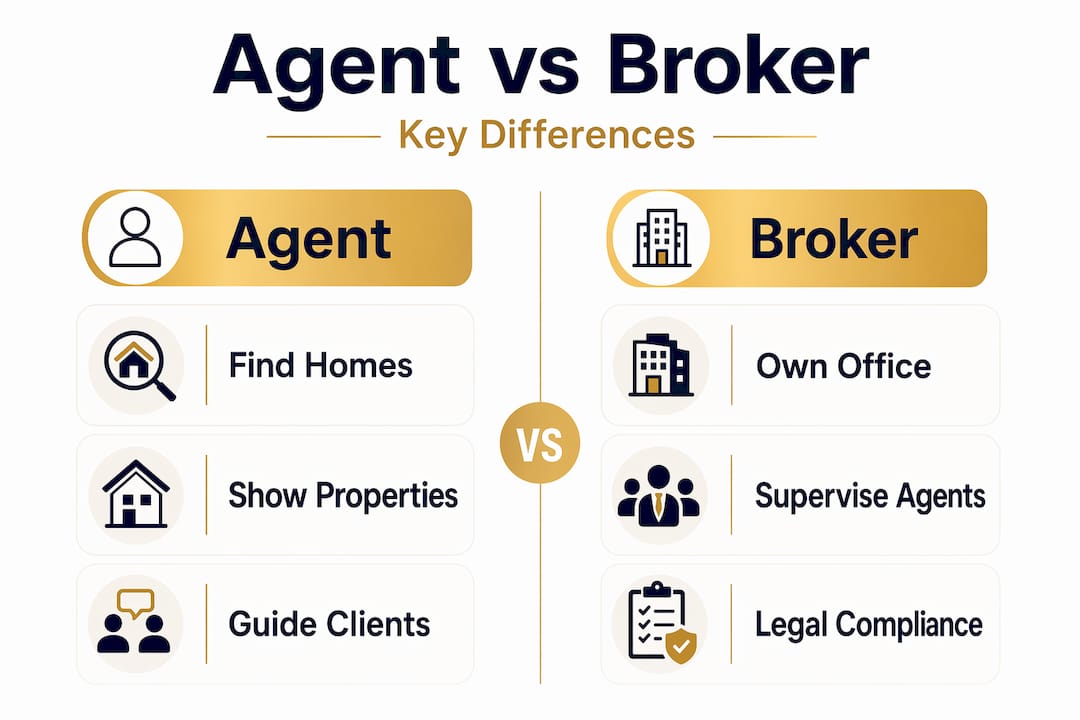
Brokers have advanced education, can own brokerages, supervise agents, and oversee legal compliance, while agents handle daily client coordination under broker supervision. Think of brokers as the licensed owners of a firm, and agents as the professionals working under that firm's authority.
Key distinctions to understand:
| Feature | Real estate agent | Real estate broker |
|---|---|---|
| License level | Standard state license | Advanced license, higher requirements |
| Can own a brokerage | No | Yes |
| Supervisory authority | None | Supervises agents |
| Works independently | No, works under a broker | Yes |
| Legal compliance role | Limited | Full responsibility |
Beyond the broker versus agent distinction, agency type changes what an agent can legally do for you. The three main types are:
- Buyer's agent: Represents your interests as the purchaser. Their fiduciary duty (legal obligation to act in your best interest) is to you.
- Seller's agent: Also called a listing agent, they represent the person selling the property.
- Dual agent: Represents both buyer and seller in the same transaction. This reduces the agent's ability to fully advocate for either side and is illegal in some states.
Understanding real estate contracts basics helps you read the agency disclosure document you'll receive at the start of any relationship with an agent.
Pro Tip: Before any negotiation begins, ask your agent to confirm in writing which party they represent. This one step protects your interests and sets the right tone for the entire transaction.
How real estate agents earn money: commissions and costs explained
Real estate agent compensation is often misunderstood, and that misunderstanding costs new investors money in planning.
Typical real estate commissions range from about 4.5% to 6% of the home's sale price in many U.S. markets. This commission is usually split between the buyer's and seller's agents, with each side earning a portion.
Key points on how commissions work:
- Commissions are almost always paid by the seller from the proceeds of the sale
- The buyer typically does not pay their agent directly out of pocket
- Agents only get paid when the transaction successfully closes
- Commission rates can sometimes be negotiated, especially for higher-priced properties
- Recent industry changes mean buyer's agent compensation is now more explicitly negotiated upfront
Here's a real example: On a $300,000 home with a 5% commission, $15,000 is paid at closing. That splits roughly $7,500 to the listing agent's brokerage and $7,500 to the buyer's agent's brokerage. Each agent may then split their share with their broker based on their agreement.
For investors planning how real estate generates income, knowing this cost upfront is essential. It affects your net profit on a flip, the closing cost estimates on a purchase, and your negotiation strategy on both sides of a deal.
Why aspiring real estate investors should view agents as strategic partners, not just facilitators
Here's an opinion most articles won't give you: the biggest mistake new investors make isn't picking the wrong market or missing a deal. It's treating their agent like a vendor instead of a partner.
Most beginners hand the agent a budget, wait for property suggestions, and react to whatever shows up. That's a passive approach in an active business. Successful investors do the opposite. They build a relationship with their agent before they need one, share their investment criteria clearly, and ask specific questions about the agent's network quality before committing.
What does "network quality" mean in practice? Ask an agent how they handle timing between an inspection, appraisal, underwriting, and closing when deadlines stack up. Ask how many lenders they work with regularly. Ask how they've handled a deal that almost fell apart. The answers tell you whether you're working with someone who manages transactions or someone who just moves paperwork.
Investors should evaluate agents by how well they coordinate across lenders, inspectors, and title companies to ensure smooth transactions. That coordination skill is where deals are saved or lost, not in the showing.
Think about it this way. Two investors are competing for the same off-market property. One has an agent who can get an inspection done in 48 hours and a pre-approval letter updated by end of day. The other is still waiting on callbacks. The first investor closes. The second one learns a lesson.
Building effective real estate habits includes knowing how to identify, evaluate, and keep a high-quality agent in your corner. That's not a soft skill. It's a direct income advantage.
Pro Tip: Tell your agent upfront that you're an investor focused on closing deals efficiently. Agents who work well with investors think differently than residential agents. Find the ones who speak your language.
Start building your real estate knowledge and partnerships today
Understanding the role of real estate agents is a great foundation. The next step is developing the skills to work alongside them effectively, and that's exactly what practical training is designed for.

At Real Estate Course, you get beginner-friendly, step-by-step training for just $19.99. One payment, instant access, no fluff. You'll learn negotiation basics, how to read contracts, how to find deals, and how to build the kind of investor mindset that makes every agent interaction more productive. You'll also find answers to common beginner questions in the course FAQ section, where real concerns get real answers.
Training gives you:
- Knowledge empowerment so you know what to ask and what to expect
- Better negotiation because you understand what agents can and can't do for you
- Risk reduction by understanding timelines, contracts, and closing requirements
- Faster deal closure when you show up as a prepared, informed investor
Frequently asked questions
What is the main role of a real estate agent in a property transaction?
Real estate agents are licensed professionals who coordinate key steps like home searches, negotiations, inspections, paperwork, and closing for buyers or sellers. They act as a central point of contact throughout the entire transaction.
How does a real estate agent help reduce risks for buyers and sellers?
Agents reduce risk by coordinating paperwork, deadlines, and professionals so nothing is missed or delayed. Their network of inspectors, lenders, and title companies keeps the transaction on track and within legal requirements.
What are the differences between a real estate agent and a broker?
A broker is a licensed professional with advanced education who can operate a brokerage and supervise agents, whereas agents focus on daily client coordination under that framework. Brokers carry greater legal responsibility for the transactions in their office.
How are real estate agents typically compensated?
Real estate commissions commonly range from 4.5% to 6% of the sale price and are usually split between the buyer's and seller's agents. Agents are typically paid only after the transaction closes successfully.
Why is it important for investors to confirm who an agent represents?
Agency type changes what an agent can do for you legally, so confirming representation in writing ensures you understand your negotiation leverage, protections, and the agent's fiduciary obligations before any offer is made.