
Most people think owning a home just means having their name on a piece of paper. That's the first big misconception beginners run into. A real estate title is actually a legal concept representing your ownership rights to a property, and it's completely separate from the deed, which is simply the document used to transfer those rights. Getting this distinction wrong can cost you thousands of dollars and serious legal headaches. This guide breaks down everything you need to know about real estate titles, step by step, in plain English, so you can move forward with confidence.
Table of Contents
- What is a real estate title?
- How title is verified: The title search process
- Common title issues and how to resolve them
- Ways to hold title: What beginners should know
- Title transfer: From deed to ownership
- What most guides miss about real estate titles
- Get empowered: Start your real estate journey today
- Frequently asked questions
Key Takeaways
| Point | Details |
|---|---|
| Title vs. deed | Title is legal ownership while a deed is the document that transfers those rights. |
| Title defects are common | Most real estate transactions require resolving multiple title issues to ensure clear ownership. |
| Title search and insurance | A thorough title search and insurance protect buyers from hidden claims or disputes. |
| Ways to hold title matter | How you hold title affects inheritance, taxes, decision-making, and legal protection. |
| Professional help lowers risk | Relying on experts prevents costly mistakes and post-purchase headaches in property deals. |
What is a real estate title?
A real estate title is not a physical document you hold in your hand. It's a legal status. When you "have title" to a property, it means the law recognizes you as the rightful owner with a set of legally protected rights attached to that land or building.
Professionals describe this using the phrase "bundle of rights." That bundle includes five key rights:
- Possession: You have the right to occupy and use the property.
- Control: You decide what happens on the property within legal limits.
- Exclusion: You can keep others off the property.
- Enjoyment: You can use the property however you choose, as long as it's lawful.
- Disposition: You can sell, lease, or transfer the property to someone else.
Understanding these five rights helps you see why title is so much more than a signature on a form.
Now, here's the key distinction beginners often miss. The deed is the written document that moves title from one person to another. Think of it this way: the deed is the vehicle, and the title is the destination. You use the deed to transfer ownership, but the title is what proves you actually own it. As the law defines it, title represents ownership rights while the deed is the transfer document.
Title provides the legal foundation for all property rights. Without a clear title, your ownership can be challenged, restricted, or even stripped away.
Pro Tip: When you receive a preliminary title report before closing, read the section that describes your rights. Make sure nothing is listed that limits your right to use, sell, or lease the property as you intend.
How title is verified: The title search process
Before any property sale closes, a professional performs a title search. This process digs through public records to confirm who legally owns the property and whether there are any problems with that ownership.
Here's what a standard title search covers, step by step:
- Identify the current owner. The search starts with the seller and works backward through every previous owner.
- Review the chain of title. This is the complete historical record of ownership transfers going back decades, sometimes over 100 years.
- Check for encumbrances. These are legal claims or limitations on the property, such as unpaid debts, easements, or restrictions.
- Search tax records. Unpaid property taxes can become a lien that the new buyer inherits.
- Look for judgments and mortgages. If the seller has unpaid debts tied to the property, those must be cleared before you take ownership.
- Verify legal description accuracy. The property boundaries described in public records must match the actual land being sold.
Title searches examine public records including deeds, liens, mortgages, judgments, easements, and tax records to verify chain of title and identify defects. That covers a significant amount of ground, which is why searches take time and professional attention.

Here's a look at what title professionals typically review and what they find:
| Document type | Typical volume reviewed | Common defects found |
|---|---|---|
| Deeds | 5 to 20+ records | Missing signatures, incorrect names |
| Liens (tax, judgment) | 3 to 10 records | Unpaid balances, unreleased liens |
| Mortgages | 2 to 8 records | Unreleased prior mortgages |
| Easements | 1 to 5 records | Undisclosed access rights |
| Court judgments | 1 to 6 records | Creditor claims against owner |
| Tax records | 2 to 5 years reviewed | Delinquent property taxes |
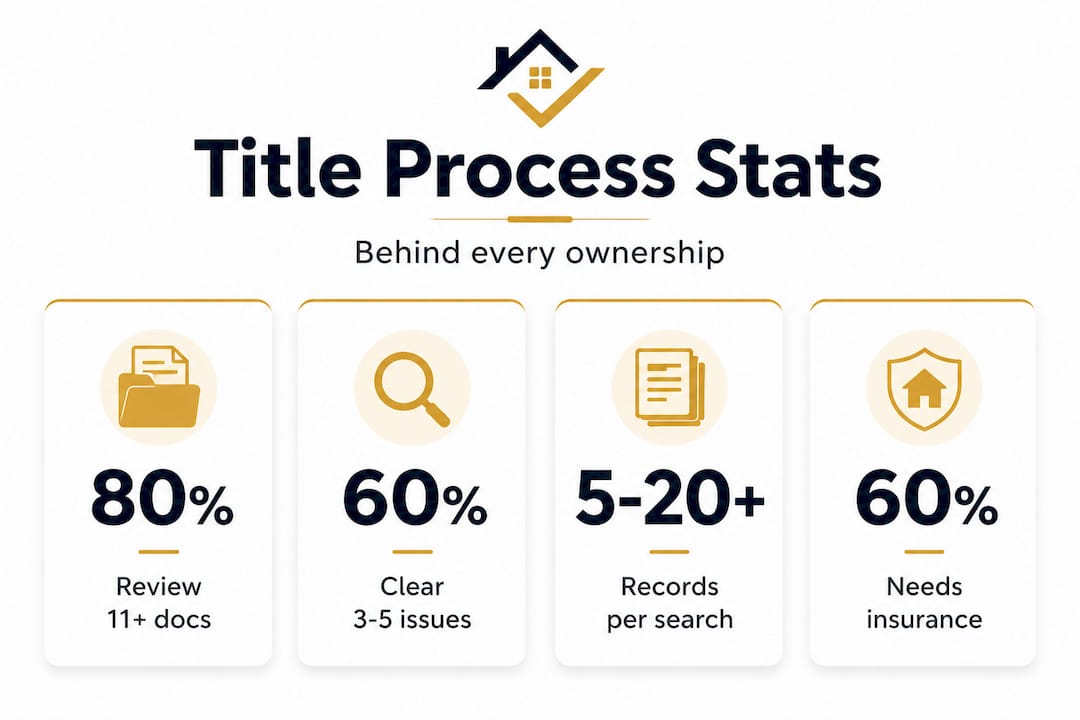
The volume is real. Over 80% of transactions review at least 11 documents, and 60% require clearing 3 to 5 issues before closing can happen.
Pro Tip: Don't wait until the last week before closing to address title issues. Start the title search as early as possible. Issues flagged early give you time to negotiate, resolve defects, and keep your closing date on track.
Common title issues and how to resolve them
Most beginners are surprised to learn that title problems are not rare. They show up in the majority of real estate transactions. Knowing what they look like helps you stay calm and move forward when they surface.
Here are the most common title defects professionals encounter:
- Tax liens: Unpaid property taxes attach to the property, not the person. A buyer can inherit the seller's tax debt if it's not caught.
- Mechanic's liens: Contractors who were never paid for work on the property can file a claim against it.
- Judgment liens: If a seller has a court judgment against them, creditors can attach that to the property.
- Unknown heirs: A previous owner may have died without a clear will, leaving potential heirs with a legal claim to the property.
- Clerical errors: A misspelled name, wrong property description, or missing document from years ago can cloud the title.
- Fraud and forgery: In some cases, someone fraudulently signed a deed or forged ownership documents.
- Unreleased mortgages: A loan paid off years ago that was never formally released still shows as a lien on the title.
- Easements and encroachments: A neighbor may have a legal right to cross part of your property, or a fence may be on the wrong side of a boundary line.
The statistics back this up. Nearly 60% of transactions require resolving 3 to 5 issues before closing, and title insurance claims for defects accounted for 35% of losses in 2023. This is not a rare edge case. It's standard practice to find and fix these problems.
The process of fixing title issues is called curative work. This could mean obtaining a lien release, filing a corrective deed, tracking down heirs to obtain a quitclaim deed, or resolving a court dispute. Experienced professionals handle this regularly, but it takes time.
In extreme cases, like suspected fraud or contested ownership, a court may need to step in. Title theft cases filed with the FBI reached 1,378 in 2023 with an average loss of $120,000, making it a rare but serious risk.
Pro Tip: Title insurance is your safety net. Owner's title insurance protects you financially if a hidden defect surfaces after you close. It's a one-time cost at closing that can save you from a very expensive problem down the road.
Ways to hold title: What beginners should know
Once you know a title is clean, the next question is: how do you want to hold it? The way you take ownership has real consequences for taxes, inheritance, and your ability to sell or refinance later.
Here's a comparison of the most common forms of holding title:
| Ownership type | Who it works for | Key feature | Inheritance pathway |
|---|---|---|---|
| Sole ownership | Single buyer | Full control | Passes through probate |
| Joint tenancy | Co-buyers (equal shares) | Right of survivorship | Automatically to surviving owner |
| Tenants in common | Investors or family buyers | Unequal shares allowed | Each share goes to heir or estate |
| Tenancy by the entirety | Married couples (select states) | Both must agree to sell | Automatic survivorship |
| Community property | Married couples (community property states) | Equal ownership of acquired assets | Half to surviving spouse |
| Trust or LLC | Investors, estate planners | Asset protection, privacy | Controlled by trust or operating agreement |
How you hold title affects your life in practical ways:
- Probate: Joint tenancy and tenancy by the entirety avoid probate. Tenants in common and sole ownership typically do not.
- Decision-making: In joint tenancy, all owners must agree on major decisions like selling or refinancing.
- Selling your share: Tenants in common can sell their share independently. Joint tenants cannot sell without the others.
- Protection from creditors: Tenancy by the entirety (in states that allow it) can protect the property from one spouse's personal creditors.
Here's how this plays out in real life:
A married couple buying their first home often chooses joint tenancy so the surviving spouse automatically inherits without going through probate. Two investors splitting a rental property might use tenants in common so each can sell their share separately or leave it to their own heirs. A family buyer trying to protect assets may place the property in a trust, giving them more control over how it's transferred over time.
This decision matters. Take time to discuss it with a real estate attorney or knowledgeable professional before you close.
Title transfer: From deed to ownership
When a property sale closes, ownership does not change hands the moment the buyer and seller shake hands. It happens through a formal process involving the deed. Here's how it works:
- Deed is drafted. A title company or attorney prepares the deed with the legal description of the property, the names of both parties, and the type of ownership being transferred.
- Deed is signed. The seller (called the grantor) signs the deed in front of a notary public, which makes it legally valid.
- Deed is delivered. The deed is formally handed over to the buyer (called the grantee). In most cases, this happens at the closing table.
- Deed is recorded. The deed is filed with the local county recorder's office. This step is critical and often overlooked by beginners.
Title transfer occurs via deed execution, delivery, and recording, and it ensures marketable title free of encumbrances.
Recording matters for several reasons:
- It gives public notice that you are the new owner.
- It establishes your legal priority over any future claims.
- It creates a permanent public record that protects you if someone contests ownership later.
- It officially updates the chain of title so future buyers can verify ownership history.
County recording is what turns a deed into protected ownership. Without it, your legal rights exist on paper but are invisible to the public, leaving you exposed to competing claims.
A clean, recorded title gives you peace of mind. It tells the world you own the property, no one else has a hidden claim, and you're free to use, sell, or lease it as you choose.
What most guides miss about real estate titles
Here's the honest truth: most beginner guides treat title as a formality. Sign the deed, close the deal, move in. But the professionals who work in this industry every day will tell you the real work happens before and after that moment, not during it.
The biggest mistakes beginners make happen after closing, not during it. They bought a property without reading the preliminary title report carefully. They assumed the title company handled everything. Then, six months later, a lien surfaces, or a neighbor produces an easement that cuts right through their planned addition. By then, fixing it costs far more than it would have upfront.
Curative work in transactions is standard practice, preventing post-closing claims, with professionals mitigating massive risk exposure annually. This isn't a rare exception. Title professionals spend more time resolving defects than they do processing paperwork.
The skills that actually protect you as a buyer are practical ones: reading a title report and understanding what each item means, knowing what questions to ask about encumbrances, and understanding what curative steps look like so you can follow along instead of just trusting blindly.
There's also a "penny wise, pound foolish" trap in this industry. Some buyers skip the owner's title insurance to save a few hundred dollars. Then a defect surfaces post-closing and they're looking at a legal battle that costs $5,000 to $15,000 or more. The upfront cost of doing title right, including the search, professional guidance, and insurance, is always cheaper than fixing problems after the fact.
Treat real estate title knowledge as a core skill, not a formality. The buyers who understand it make smarter offers, close cleaner deals, and protect their investment long-term.
Get empowered: Start your real estate journey today
Understanding real estate titles is one of the most practical steps you can take as a beginner. Knowing how title works, what can go wrong, and how to protect yourself puts you ahead of most first-time buyers. This kind of knowledge is exactly what separates people who close deals confidently from those who get stuck or blindsided.

If you want to go further and turn that knowledge into real income, real estate training for beginners at RealEstateCourse.net gives you step-by-step modules covering everything from fundamentals to finding deals, executing transactions, and scaling your results. The course is built for people starting from zero, with no experience or big budget required. For just $19.99 with one-time access, you get interactive lessons, action checklists, and an execution plan tailored to your situation. Ready to take the next step? Find cheap real estate deals and start building your future today.
Frequently asked questions
Is title insurance required when buying property?
Title insurance is not legally required in all states, but professionals strongly recommend it to protect buyers from unexpected ownership issues. Always obtain title insurance and review your preliminary report early to spot liens that could make you liable for a seller's debts.
Can you own a property without having the title?
Owning property means holding the title. As legal definitions confirm, a real estate title is the legal concept representing ownership rights, distinct from the deed, so if you don't have title you don't have legal ownership even if you possess the deed.
How much does a title search cost?
A basic title search typically costs between $150 and $400, depending on state rules and the complexity of the property's ownership history.
How do I know if a title is clear before closing?
Review the preliminary title report for any listed liens, defects, or encumbrances, and have a professional clear all outstanding issues. Checking your title report early gives you time to address anything before it delays closing.
What is a quiet title action?
A quiet title action is a court case used to resolve disputes or defects when legal ownership is unclear. These actions can cost $5,000 to $15,000 and take months or even years to resolve, which is exactly why catching title issues before closing matters so much.