
Walking into your first real estate deal without knowing the language feels like sitting in a meeting where everyone else read the memo but you. Terms like "escrow," "contingency," and "earnest money" get thrown around fast, and nodding along can cost you real money. The good news? These words are not nearly as complicated as they sound. Most of them describe simple concepts you already understand in everyday life. This guide breaks down the most important real estate terms in plain English so you can walk into your first transaction with confidence, not confusion.
Table of Contents
- Why real estate terms matter for beginners
- Essential real estate terms every beginner must know
- Decoding real estate paperwork and contracts
- Comparison: Real estate terms investors need vs. homeowners
- Applying your knowledge: What to do next
- What most real estate guides miss about beginner education
- Take your next step in real estate education
- Frequently asked questions
Key Takeaways
| Point | Details |
|---|---|
| Know the basics | Learning real estate terms helps you avoid mistakes and spot better deals. |
| Focus on your goals | Different roles need different terms, so prioritize the ones relevant to you. |
| Practice and apply | Start using terms in mock scenarios to build confidence before making a deal. |
| Keep learning affordably | Free glossaries and low-cost training make continued growth accessible to everyone. |
Why real estate terms matter for beginners
To begin, let's address why this language matters before we decode each term.
Knowing real estate vocabulary is not just about sounding smart in a meeting. It directly affects your bottom line. When you understand what you are signing, you can negotiate better, spot red flags, and protect yourself from costly surprises.
Here is why this matters so much:
- You catch mistakes before they become problems. Contracts are full of clauses that shift risk onto the buyer or seller. If you do not know what "as-is" means, you might agree to take on repairs you never planned for.
- You communicate like a professional. Agents, lenders, and attorneys use this language daily. When you speak it fluently, they take you seriously.
- You spot opportunities. Knowing what "below market value" or "motivated seller" actually means in practice helps you identify deals others walk right past.
- You avoid common traps. Legal jargon can derail first-time buyers if they sign documents they do not fully understand.
One of the most common mistakes beginners make is confusing "pre-qualified" with "pre-approved" for a mortgage. Pre-qualification is an informal estimate of what you might borrow. Pre-approval is a formal, verified commitment from a lender. If you mix these up and make an offer assuming you are pre-approved when you are only pre-qualified, your deal can fall apart at the last minute and you could lose your earnest money deposit.
"The difference between a good deal and a bad deal is often just knowing what the paperwork says before you sign it."
Understanding the investing benefits of real estate becomes much clearer once you have the vocabulary to evaluate opportunities accurately.
Pro Tip: Make a short list of any term you do not understand every time you read a listing or contract. Look each one up before your next conversation with an agent or seller. This simple habit builds your vocabulary fast without overwhelming you.
Essential real estate terms every beginner must know
With the importance established, let's break down the real-world language you'll see most.
Titles, contracts, equity, and capital are the foundation of every property transaction. Here are the key terms you will encounter from the moment you start searching for properties.
Title: This is the legal concept of ownership. When you have the title to a property, you legally own it. This is different from a deed, which is the physical document that transfers title from one person to another.

Equity: Equity is the portion of a property's value that you actually own free and clear. If your home is worth $200,000 and you owe $150,000 on your mortgage, you have $50,000 in equity. Building equity strategies over time is one of the most powerful ways real estate builds wealth.
Appraisal: An independent professional estimates the property's current market value. Lenders require appraisals to make sure they are not lending more than the property is worth. If a home appraises below the agreed purchase price, you may need to renegotiate.
Escrow: A neutral third party holds money or documents until all conditions of a sale are met. Think of it as a secure holding account that protects both buyer and seller until the deal closes.
Listing: A property available for sale. An "active listing" means it is currently for sale. A "pending listing" means an offer has been accepted but the sale is not yet complete.
MLS (Multiple Listing Service): A shared database where agents post available properties. Access to MLS data gives buyers and investors a massive advantage in finding deals quickly.
Here is a quick comparison of the most important terms and when you will encounter them:
| Term | Simple definition | When you see it |
|---|---|---|
| Title | Legal concept of ownership | Closing and ownership transfer |
| Equity | Value you own in the property | Anytime you evaluate your net worth |
| Appraisal | Professional value estimate | Before lender approves your loan |
| Escrow | Neutral holding of funds/documents | During the entire closing process |
| Listing | Property available for sale | When searching for properties |
| MLS | Shared database of available homes | Early search and deal hunting |
Let's put this into a realistic scenario. Say you are making your first offer on a small rental property listed at $130,000. You would ask: Is the title clear of any liens? (Title search.) What is the appraised value to make sure you are not overpaying? (Appraisal.) And who holds the funds while conditions are finalized? (Escrow.) Knowing these three terms alone lets you ask the right questions before you commit a dollar.
Making money with little capital depends on understanding these building blocks clearly, because small mistakes in a low-budget deal hurt more proportionally.
Pro Tip: Never skip a title search. A property might look perfect on the surface, but if there are unpaid taxes or judgments attached to the title, those become your problem after you buy.
Decoding real estate paperwork and contracts
Now that you know the headline terms, let's tackle the paperwork and what those legal words mean.
Beginners often trip up on clauses, addendums, and contingencies in paperwork, and these mistakes can be expensive. Here is what you need to know about the terms buried inside contracts.
Earnest money: This is a deposit you pay upfront to show the seller you are serious about buying. It is typically 1 to 3 percent of the purchase price. If the deal closes, it applies toward your down payment. If you back out without a valid reason, you may lose it.
Contingency: A condition that must be met before the sale is final. Common examples include a financing contingency (you can exit if your loan falls through) and an inspection contingency (you can renegotiate or exit if major problems are found during inspection).
Addendum: An additional document added to the original contract to modify or clarify specific terms. For example, a seller might add an addendum stating they need 60 days to move out after closing.
Default: When one party fails to meet the terms of the contract. If a buyer defaults, they may lose their earnest money. If a seller defaults, they may be forced to pay damages.
Here is a step-by-step approach to reviewing your first contract:
- Read every page before you sign anything. Do not rely on summaries from anyone with a financial interest in the deal closing.
- Identify all contingencies. Write them down. Know which ones protect you and which ones benefit the seller.
- Check the earnest money terms. Understand exactly under what conditions you can get it back.
- Look for addendums. Any attached documents are part of the contract. Do not ignore them.
- Flag unfamiliar language. Circle or highlight any phrase you do not understand before moving forward.
- Consult contract essentials guides or a real estate attorney for anything that feels risky.
Watch out for "time is of the essence" clauses. This phrase means deadlines in the contract are strict. Missing one, even by a day, can put you in default and cost you the deal.
Comparison: Real estate terms investors need vs. homeowners
So far, we've covered the basics and paperwork. Next, let's see what's critical for your actual role.
Your focus depends on your goal. If you are buying a home to live in, some terms matter more than others. If you are investing to generate income, a different set of definitions becomes your priority. Investor focus is often on ROI, leverage, and rental income calculation, while homeowners think more about payments and ownership costs.
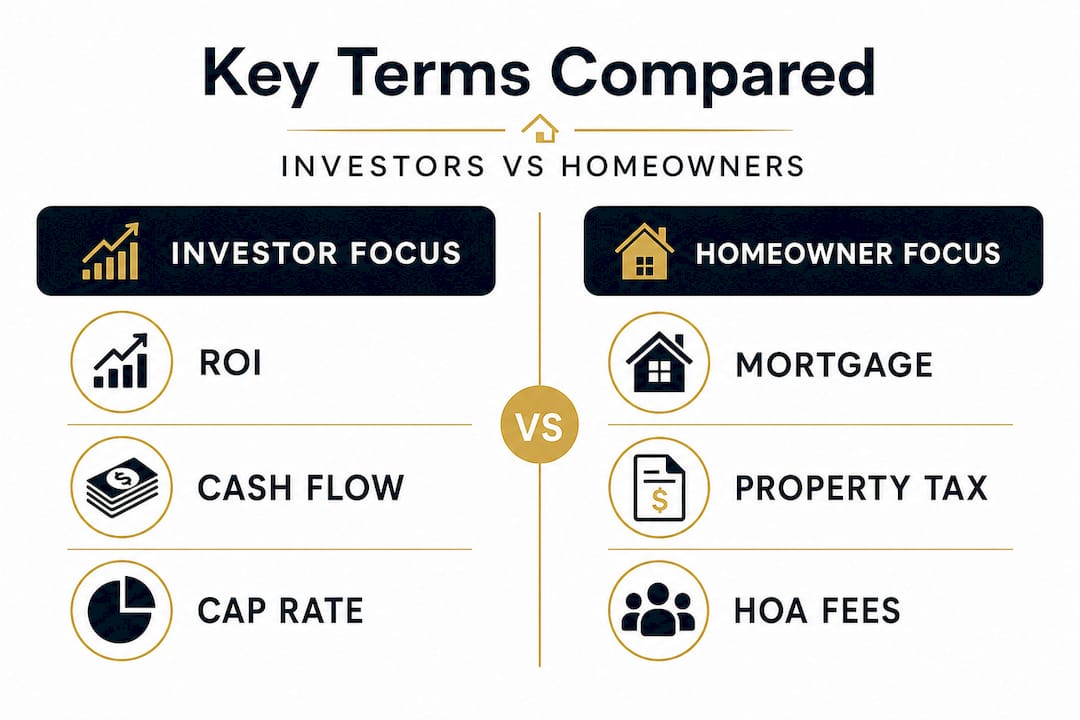
| Term | Investor priority | Homeowner priority |
|---|---|---|
| ROI (return on investment) | Critical | Low relevance |
| Cash flow | Critical | Not applicable |
| Cap rate | Important for rentals | Not applicable |
| Equity | Important for refinancing | Important for net worth |
| Mortgage rate | Affects profitability | Affects monthly budget |
| Appreciation | Long-term strategy | Long-term value |
| Leverage | Core investment tool | Secondary concern |
| Zoning | Affects rental use | Occasional relevance |
Understanding equity is essential regardless of whether you are investing or simply buying a home to live in. It tells you how much of the property you truly own at any point.
If you are starting out as an investor, prioritize these terms first:
- Cash flow: The money left over after all property expenses are paid from rental income.
- Cap rate (capitalization rate): A quick way to compare investment properties. Divide the annual net income by the property's purchase price.
- Leverage: Using borrowed money to control a larger asset. A $20,000 down payment on a $100,000 property means you are leveraging five times your cash.
- ROI: The percentage return you earn on your invested money each year.
If your immediate goal is buying your first home, focus on mortgage terms, property taxes, homeowner association fees (called HOA fees), and title insurance first.
Quick reference guide: If your goal is rental income, focus on cash flow, cap rate, and leverage. If your goal is buying a primary home, focus on mortgage rate, title, and contingencies.
Checking out the investing basics will help you see how these terms work together in a real investment scenario before you put money on the line.
Applying your knowledge: What to do next
With all the core terms and differences covered, here's how you actually put your knowledge to use as a beginner.
Starting small and building confidence is the best strategy for beginners. You do not need to memorize everything before taking your first step. Here is what to do right now:
- Build your personal glossary. Start a simple document or note on your phone. Every new term you encounter, add it with a one-sentence definition in your own words.
- Review sample contracts. You can find standard real estate purchase agreement templates online. Read through one from start to finish to see these terms in context.
- Practice with low-stakes scenarios. Walk through hypothetical deals on paper before involving real money. Estimate equity, run basic cash flow numbers, and practice reading a listing description.
- Ask questions every time. Never let embarrassment stop you. Every professional in real estate was once a beginner asking basic questions. Asking shows you are serious, not uninformed.
- Use a term cheat sheet during your first deals. Print out your glossary and bring it to walkthroughs, meetings, or any time you are reviewing documents.
Essential skills in real estate go well beyond memorizing definitions. The ability to ask clear, smart questions is what separates beginners who close deals from those who stay stuck in theory.
The lowest-cost way to keep learning is to combine free online resources with structured beginner training. Many low risk strategies exist for getting started with minimal capital while you build your knowledge base step by step.
Pro Tip: Keep a simple two-column cheat sheet during your first deals. Column one is the term. Column two is what it means for you specifically in that transaction. Personalizing definitions makes them stick far faster than reading a generic glossary.
Look for the essential skills for investors that go beyond vocabulary, including how to evaluate deals, build relationships, and ask the right questions at the right time.
What most real estate guides miss about beginner education
Most beginner real estate guides treat vocabulary like a quiz. Memorize these 50 terms, pass the test, and you are ready. That approach misses the point entirely.
Real investors, especially beginners who actually succeed, do not win because they memorized a glossary. They win because they were confident enough to ask, "What does that mean?" when they did not understand something. That willingness to ask in real time is worth more than a perfect score on a vocabulary worksheet.
Here is the uncomfortable truth: you will encounter terms in your first few deals that are not in any beginner guide. Real estate contracts can include industry-specific language, local customs, and negotiated language that no article could fully prepare you for. The goal is not perfect knowledge. The goal is enough confidence to ask smart questions and enough awareness to know when something does not feel right.
Language in real estate should empower you. When you hear "earnest money," you should feel confident, not nervous. When someone mentions a contingency period, you should know that is your protection, not a threat.
The beginners who explore the beginner investing benefits early on and start taking action in small ways build that confidence much faster than those who spend months studying before ever talking to an agent or walking a property.
Learning by doing, with a strong foundational vocabulary in place, is the fastest path forward. Give yourself permission to not know everything. Just make sure you know enough to keep moving.
Take your next step in real estate education
Ready to keep learning? Here's how you can accelerate your journey affordably.
You now have a solid foundation. You know the terms, how to read a contract, and how to prioritize your learning based on your goals. But knowing the vocabulary is just the first step. The next step is learning how to apply it in real transactions, find deals, evaluate properties, and build a system that generates income consistently.

That is exactly what beginner real estate training at RealEstateCourse.net is built for. For a one-time investment of $19.99, you get instant access to step-by-step modules that walk you through everything from finding your first opportunity to closing and scaling. No fluff, no complicated theory, just practical skills you can use immediately. If you are serious about getting started in real estate without wasting time or money, this is the most direct path forward.
Frequently asked questions
Which real estate terms are most confusing for beginners?
Contingency, earnest money, equity, and escrow are often the trickiest for first-timers. You can get a clearer breakdown of these by reviewing a contracts guide for investors.
What is the difference between a title and a deed in real estate?
A deed is the physical legal document showing ownership transfer, while a title is the legal concept of ownership itself. Property ownership fundamentals explain this distinction in full detail.
Do I need a lawyer to understand real estate contracts?
While many terms can be learned on your own, consulting a lawyer is smart if you feel confused or unsure before signing. Legal jargon in contracts can derail buyers who skip professional review on complex deals.
How can I keep learning about real estate terms for free?
Look for online glossaries, free beginner courses, or local seminars to keep building your knowledge base. Making money with little capital also depends on finding low-cost ways to build skills before you invest serious money.