
Most people believe you need a six-figure bank account to start investing in real estate. That belief stops thousands of aspiring investors before they even begin. The truth is, many beginners close their first deal with less than $20,000, and some do it with even less. This guide walks you through every practical step, from assessing your current finances to closing your first deal and managing it well. No fluff, no theory. Just a clear, actionable roadmap built for people with limited money and zero prior experience.
Table of Contents
- Assess your readiness and resources
- Secure financing and choose your entry strategy
- Find your first property and run the numbers
- Close, launch, and manage your investment
- What beginners often get wrong (and how to avoid it))
- Next steps: Take action and learn more
- Frequently asked questions
Key Takeaways
| Point | Details |
|---|---|
| Start with little cash | You can begin real estate investing with as little as $10,000 using house hacking or other entry strategies. |
| Assess and prepare | Understanding your finances and risk helps you choose the right investment path and avoid surprises. |
| Compare strategies | Different entry methods like rentals, wholesaling, and REITs have varying risks, work, and payoff. |
| Master the numbers | Careful deal analysis and maintaining reserves is critical for long-term success. |
| Scale simply | Repeat simple strategies like house hacking to grow your portfolio steadily and safely. |
Assess your readiness and resources
Now that you know real estate investing is possible on a budget, let's look at how to assess your current situation and what you'll truly need.
Start by taking an honest inventory of three things: your available cash, your credit score, and your time. These are your real starting assets. You don't need all three to be perfect, but you need to know where you stand before you pick a strategy.
Credit score matters more than cash for many entry strategies. A score of 580 or higher qualifies you for an FHA loan (Federal Housing Administration loan, a government-backed mortgage with low down payment requirements). FHA loans require only 3.5% down on 2 to 4 unit properties, which means roughly $10,000 to $15,000 on a $300,000 duplex, plus closing costs and reserves.
Here's what you'll need at minimum to get started:
- Credit score: 580+ for FHA, 620+ preferred by most lenders
- Cash reserves: At least 6 months of expenses saved as a safety net
- Down payment: 3.5% to 10% depending on loan type and property
- Time commitment: 5 to 10 hours per week during the search and closing phase
- Willingness to learn: No experience needed, but you must be coachable
For a clearer picture, here's a quick look at typical cash needed by property type:
| Property type | Typical down payment | Estimated cash needed |
|---|---|---|
| Single-family (FHA) | 3.5% | $8,000 to $15,000 |
| Duplex/triplex (FHA) | 3.5% | $10,000 to $20,000 |
| Small multifamily (conventional) | 15 to 25% | $40,000 to $80,000 |
| Wholesale deal | $0 to $5,000 | $500 to $5,000 |
Review beginner risks and reserves before committing to any strategy. Knowing your risk tolerance is just as important as knowing your cash balance.
If you want structured guidance on where to start, beginner real estate training can help you build a solid foundation before your first offer.
Pro Tip: Many investors close their first deal using house hacking (buying a multi-unit property, living in one unit, renting the others) with less than $20,000 out of pocket.
Secure financing and choose your entry strategy
With your resources inventoried and goals set, the next step is to secure the right financing and choose your pathway in.
Getting pre-approved before you start shopping is not optional. It tells sellers you're serious, and it tells you exactly how much you can borrow. Here's how to get pre-approved:
- Pull your credit report and fix any errors
- Gather documents: two years of tax returns, recent pay stubs, bank statements
- Compare at least three lenders for rates and fees
- Submit your application and get a pre-approval letter
- Use that letter when making offers to strengthen your position
FHA allows rental income to qualify, which means the rent from other units in your property can count toward your loan approval. That's a major advantage for house hackers.
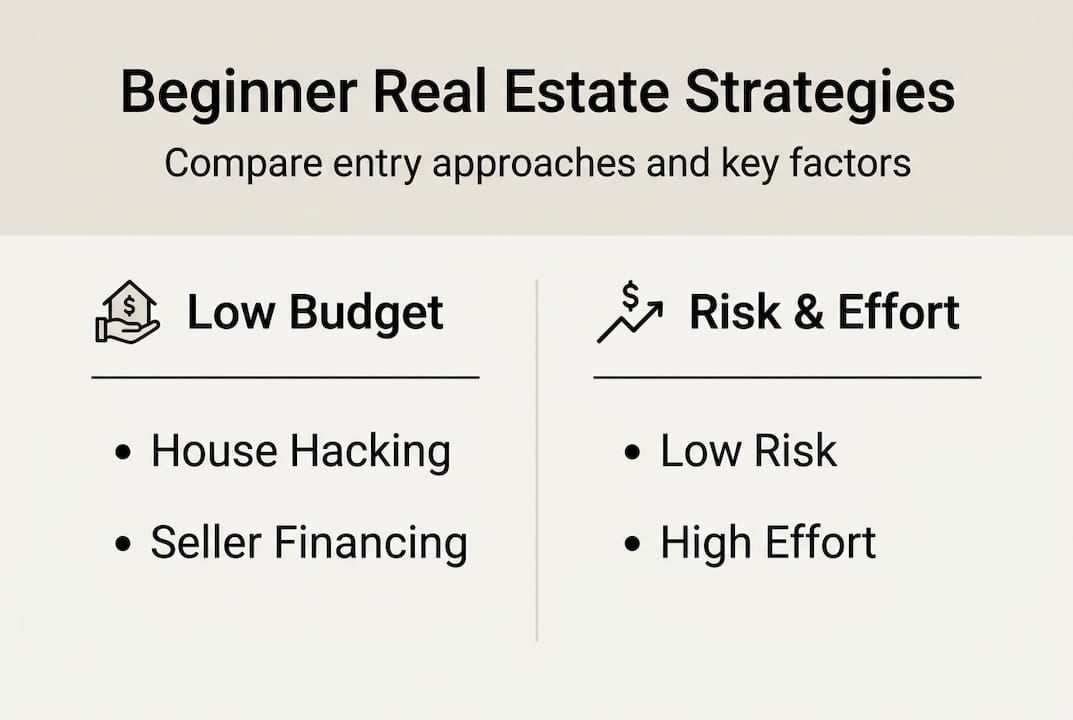
Now, choose your entry strategy. Here's a comparison of the most beginner-friendly options:
| Strategy | Money needed | Effort level | Risk level | Best for |
|---|---|---|---|---|
| House hacking | $10,000 to $20,000 | Medium | Low to medium | Beginners with some savings |
| Wholesaling | $500 to $2,000 | High | Medium | Beginners with limited cash |
| Seller financing | Negotiable | Medium | Medium to high | Creative deal makers |
| REITs | $100+ | Low | Low | Passive, hands-off investors |
Wholesaling and seller financing can be done with little money, but they carry more risk and require sharper negotiation skills. REITs (Real Estate Investment Trusts) are the most passive option but offer the least control.
Explore low-budget investing strategies to match your situation to the right approach before locking in a path.
Pro Tip: If you are a veteran, VA loans (Veterans Affairs loans) may require zero down payment, making house hacking even more accessible. Check your eligibility early in the process.
For a deeper look at empirical investment returns by strategy, reviewing real data helps you set realistic expectations from day one.
Find your first property and run the numbers
Now that your strategy is in place and financing is lined up, it's time to find the right property and make sure the numbers work.

Start your search in three places: a local real estate agent who works with investors, online platforms like Zillow or Realtor.com, and local investor networks or meetups. Each source gives you a different angle on available deals.
Use this checklist to screen every property you consider:
- Location: Is it in a stable or growing rental market?
- Price: Does it fall within your pre-approved loan limit?
- Rents: What do comparable units rent for in that area?
- Repairs: Get a rough repair estimate before going further
- Cash flow: Will rent cover your mortgage, taxes, insurance, and repairs?
- Vacancy rate: Is the local rental market tight or oversupplied?
Once you pass the initial screen, run the full numbers. Focus on these critical metrics:
- Cash flow: Monthly rent minus all expenses (mortgage, taxes, insurance, repairs, vacancy)
- Cap rate: Annual net income divided by purchase price, expressed as a percentage
- Cash-on-cash return: Annual cash flow divided by your total cash invested
- Reserves: Set aside 5 to 10% of rent for vacancy and 1 to 2% of property value annually for repairs
Typical cash-on-cash returns for well-analyzed beginner deals fall between 6% and 12%, with cap rates usually between 5% and 7%.
Reality check: Avoid overestimating rents or underestimating expenses. Use conservative numbers in every analysis. If the deal only works with optimistic projections, it is not a good deal.
Learn how to build a full property analysis with analyzing investment properties. Getting the numbers right is the single most important skill you can develop as a beginner.
For a broader view of different investing strategies and how they compare on returns, it helps to see the full landscape before narrowing your focus.
Close, launch, and manage your investment
After your deal analysis checks out, moving confidently across the finish line is critical.
Here are the key steps from offer to first rent check:
- Make your offer: Use your agent or submit directly with your pre-approval letter attached
- Negotiate terms: Ask for seller concessions on closing costs if possible
- Schedule inspection: Never skip this step, even on newer properties
- Review inspection report: Negotiate repairs or price reductions based on findings
- Close the deal: Sign documents, transfer funds, get the keys
- Prepare the unit: Clean, paint, and make any agreed repairs before listing
- Market and screen tenants: List on rental platforms, run background and credit checks on every applicant
Maintaining at least 6 months of reserves after closing is not optional. Unexpected repairs, vacancies, and slow months happen to every investor.
Remember: Your reserves are your safety net. Do not drain them on upgrades or extras. Keep that cushion intact until your property generates consistent income.
Common risks and how to manage them:
- Vacancy: Budget 5 to 10% of annual rent for vacancy periods
- Repairs: Set aside 1 to 2% of the property's value each year for maintenance
- Bad tenants: Thorough screening upfront prevents most problems down the road
- Market shifts: Conservative analysis protects you when rents soften
Pro Tip: Never skip tenant screening. A bad tenant costs far more than a short vacancy. Run credit, background, and rental history checks every time, no exceptions.
Get practical guidance on managing your first rental so you avoid the most common mistakes new landlords make in their first year.
What beginners often get wrong (and how to avoid it)
Here's what we see consistently: beginners who struggle are usually chasing big profits instead of building steady cash flow. They overextend on their first deal, skip reserves, and panic when something goes wrong. The investors who succeed long-term think differently.
Slow and steady wins in real estate. One solid house hack, managed well, builds more real wealth over five years than three risky deals gone sideways. The timeline from education to first rent is typically 3 to 6 months, and the best path to scaling is simply repeating the house hack strategy after satisfying the one-year FHA owner-occupancy requirement.
The other mistake is thinking you know enough after one deal. Real estate rewards people who stay humble and keep learning. Markets shift. Laws change. Tenant dynamics evolve. The investors who build real portfolios treat education as ongoing, not a one-time event.
Focus on cash flow consistency, not speculation. A property that pays you $300 per month reliably is worth more than one that might appreciate dramatically. Appreciation is a bonus, not a plan.
Building repeatable investing strategies into your process from day one is what separates investors who scale from those who stay stuck at deal one.
Next steps: Take action and learn more
You now have a clear, step-by-step picture of how to start investing in real estate even with limited funds. The next step is to keep building your skills and network.

Practical education speeds up your progress and helps you avoid costly mistakes. The Real Estate Low Budget Game gives you a hands-on way to practice deal analysis, financing decisions, and property management scenarios risk-free. It's beginner-friendly, built for people with limited capital, and designed to turn knowledge into real action. For just $19.99, you get instant access to all course materials, action checklists, and a personalized execution plan. Start today and move from learning to earning faster than you think.
Frequently asked questions
Can I start investing in real estate with less than $10,000?
Yes, strategies like house hacking with FHA loans enable entry with as little as $10,000 to $15,000 plus reserves, depending on the property and market. House hacking enables entry with $10,000 to $20,000 in many markets.
What is house hacking and why do beginners use it?
House hacking means buying a multi-unit property, living in one unit, and renting the others, often using low-down payment loans to offset living costs and start building income. FHA loans require only 3.5% down on 2 to 4 unit properties, making it one of the most accessible first moves.
How quickly can I expect to buy my first investment property?
With focused effort, beginners usually complete their first deal within 3 to 6 months from initial research to first rental income. The timeline from education to first rent is typically 3 to 6 months for motivated beginners.
What are the main risks for first-time real estate investors?
Risks include vacancy, repair costs, and problematic tenants, all of which can be reduced by budgeting for reserves and screening tenants carefully. Vacancy budgeting of 5 to 10% and setting aside 1 to 2% for repairs are standard protective measures.
Are there truly zero money down options?
Yes, options like wholesaling and seller financing require little or no cash upfront, but they carry higher risks and demand more knowledge and effort. Wholesaling and seller financing are viable but best approached after building foundational skills.