
Most people think building real estate equity requires a large down payment or years of savings. That is simply not true. You can start growing equity with the right strategies, even if your budget is tight. This article breaks down exactly what equity is, why it matters as a new investor, and how you can put practical methods to work right away. No complicated finance terms. No fluff. Just clear, step-by-step guidance designed to help you move forward with confidence.
Table of Contents
- What is real estate equity?
- Why equity matters for new investors
- Smart ways to build equity with little capital
- Using equity to generate income and expand opportunities
- The overlooked power of equity: Our take for beginners
- Take your next step: Learn and grow with realestatecourse.net
- Frequently asked questions
Key Takeaways
| Point | Details |
|---|---|
| Equity defined simply | Equity means the value of your property minus what you owe on it. |
| Practical steps for beginners | You can build equity steadily by paying your mortgage and making valuable upgrades. |
| Leverage for expansion | Equity lets you borrow, reinvest, or buy more properties to grow your portfolio. |
| Start small, grow big | Even low-budget investors can use equity strategies to create long-term wealth. |
What is real estate equity?
Equity is one of the most important concepts in real estate, yet it is often explained in ways that confuse beginners. Let's make it simple.
Equity is the difference between the value of a property and the amount owed on it. That's it. If your home is worth $200,000 and you owe $50,000 on your mortgage, you have $150,000 in equity. That $150,000 belongs to you.
Here is a simple breakdown of how equity works at different stages of ownership:
| Stage | Property value | Mortgage balance | Your equity |
|---|---|---|---|
| Just purchased | $200,000 | $180,000 | $20,000 |
| After 5 years of payments | $210,000 | $155,000 | $55,000 |
| After 10 years + improvements | $240,000 | $120,000 | $120,000 |
| Property paid off | $250,000 | $0 | $250,000 |
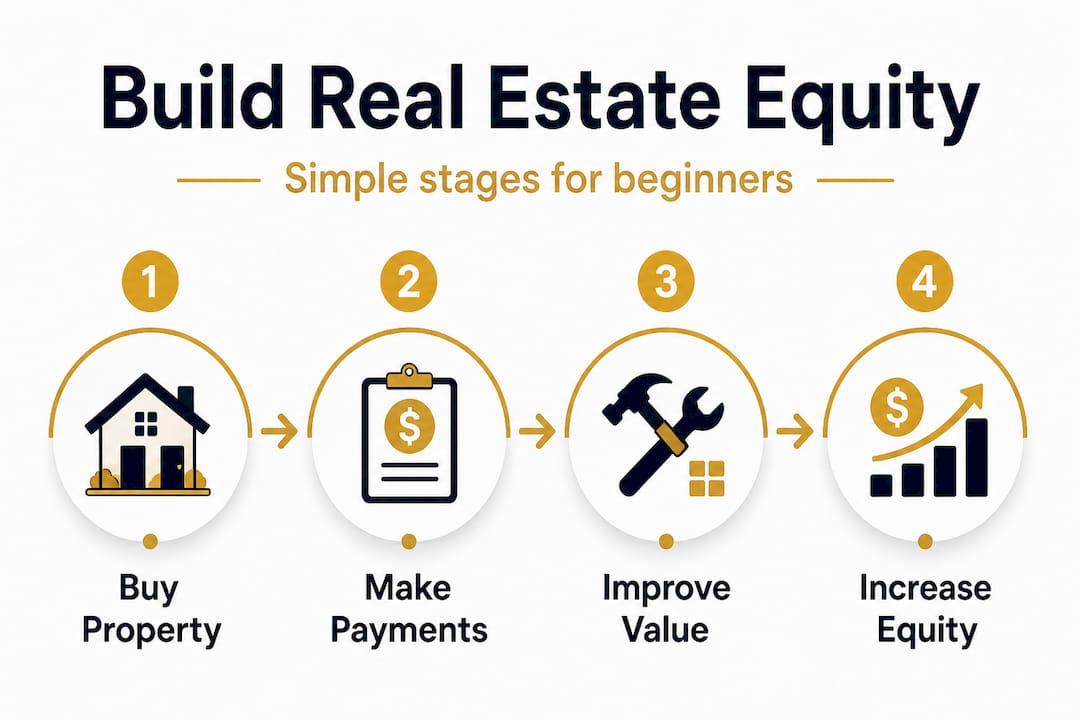
As you can see, equity grows in two main ways. Your loan balance drops as you make payments. And your property value can increase over time through market appreciation or property improvements.
Here are the key facts every beginner should understand about equity:
- Equity builds over time as you pay down your mortgage balance
- Property appreciation adds to your equity even without extra payments
- Improvements and upgrades can raise your property's value and increase equity faster
- Negative equity happens when you owe more than the property is worth, which is something to actively avoid
- Understanding property ownership basics early protects you from costly mistakes
One more thing worth noting: equity is not just a number on paper. It is a real financial asset you can access in specific ways, which we will cover shortly. Getting familiar with real estate contracts early also helps you understand how equity is protected when you buy or sell.
Why equity matters for new investors
Now that you know what equity is, let's explore why it matters so much for you as a new investor.
Think about equity as a financial foundation. The more you build, the more options you have. Equity provides leverage for borrowing, financial flexibility, and profit potential. That means it is not just about owning property. It is about what that ownership allows you to do next.
"Real estate equity is one of the most powerful wealth-building tools available to everyday investors. It grows quietly in the background while you focus on other things, and then one day you realize you have serious financial power at your fingertips." — Real estate educator perspective from real estate investing benefits
Here is a comparison of the short-term and long-term benefits equity provides:
| Time frame | Benefit | What it means for you |
|---|---|---|
| Short term | Emergency financial cushion | Borrow against equity in tough times |
| Short term | Property collateral for loans | Qualify for better loan terms |
| Long term | Wealth accumulation | Build net worth without extra income |
| Long term | Portfolio expansion | Use equity to buy your next property |
| Long term | Passive income potential | Reinvest for rental income or resale profit |
Beyond the numbers, equity gives you choices. And choices are what most beginners are really after. You want options. You want flexibility. Equity delivers both.
Here is why equity matters most at the beginner stage:
- It acts as a safety net when the market shifts or unexpected costs arise
- It gives you the power to borrow at lower interest rates because your property backs the loan
- It allows you to reinvest without needing all-new cash by leveraging what you have built
- It builds confidence because you are growing real wealth, not just paying bills
- Learning the skills for new investors alongside equity-building keeps your strategy sharp
If you want to use equity well, investing with research behind your decisions is critical. Guessing wastes equity. Research multiplies it. And understanding contracts for investors ensures you protect your equity position in every deal you make.
Smart ways to build equity with little capital
Understanding the importance of equity, let's move into practical ways you can start building it even on a tight budget.

Here is the truth most beginners miss: you do not need a lot of money to start. Paying down the mortgage and improving property value are key equity-building tactics. Even small, consistent actions compound over time into significant equity. And there are ways to grow equity even when starting with little cash.
Here are the most effective, beginner-friendly methods:
-
Make regular mortgage payments on time. Every payment chips away at your principal balance. Over time, more of each payment goes toward principal rather than interest. This accelerates equity growth naturally without any extra effort.
-
Make extra payments when possible. Even one extra payment per year reduces your loan balance faster and saves you thousands in interest. Some lenders allow biweekly payment schedules, which achieve the same effect automatically.
-
Invest in cost-effective property improvements. Not all upgrades are equal. Focus on improvements that give you the most value for your dollar. Kitchen updates, fresh paint, landscaping, and bathroom renovations consistently deliver strong returns on investment.
-
Use sweat equity. Sweat equity means doing the work yourself instead of hiring contractors. If you can paint, clean, do minor repairs, or handle basic landscaping, you save money while directly increasing property value. This is one of the most powerful tools available to beginners with limited cash.
-
Buy undervalued properties. Finding a property priced below market value gives you instant equity the moment you close the deal. This requires research, patience, and learning to spot deals others walk right past. But when you find them, the reward is immediate.
-
Focus on locations with growth potential. Buying in an area that is improving, such as one with new schools, roads, or businesses being built nearby, means the market itself will help grow your equity over time without you spending a dime.
Pro Tip: Look for properties where small, affordable improvements can raise the value significantly. A $3,000 kitchen refresh in the right neighborhood can add $15,000 or more to a property's appraised value. That is instant equity created through smart spending.
Avoid these common mistakes that slow equity growth:
- Over-borrowing against your property too early before you have built a solid cushion
- Skipping regular maintenance, which allows small problems to become costly structural issues that drop property value
- Ignoring the local market, which affects whether your property appreciates or depreciates over time
- Waiting too long to start because you think you need more money first
Building essential income-building habits alongside your equity strategy makes a huge difference. Good habits keep you consistent, and consistency is what builds equity over years, not decades. If you are just getting started, the start small, win big approach is a proven path that does not require deep pockets.
Using equity to generate income and expand opportunities
After learning how to build equity, here's how you can use that equity to unlock real opportunities.
Equity can be tapped for loans, reinvestment, or cash-out options. This is where equity stops being just a number and becomes an active tool in your financial strategy.
Here are the main ways beginners can use equity to generate income and grow their portfolio:
-
Home equity loan. This lets you borrow a lump sum against your equity at a fixed interest rate. You receive a set amount, repay it monthly, and use it for investment purposes like purchasing a second property or funding renovations.
-
Home equity line of credit (HELOC). A HELOC works like a credit card backed by your equity. You draw funds as needed, pay interest only on what you use, and repay as you go. This is flexible and useful for investors who need access to capital at different times.
-
Cash-out refinancing. This replaces your existing mortgage with a new, larger loan. The difference between the two loan amounts is paid to you in cash. You can use that cash to purchase additional properties, make improvements, or cover investment costs.
-
Selling to release equity. If you sell a property where equity has grown significantly, you walk away with profit you can reinvest into your next deal. This is a classic equity-based wealth cycle that many successful investors use repeatedly.
-
Renting for income while equity grows. Renting your property generates monthly income while your tenant effectively helps pay down your mortgage. Your equity builds, and you earn cash flow simultaneously. That is a powerful two-for-one advantage.
Building habits for income growth into your routine ensures you use equity wisely rather than impulsively. And following beginner investing tips keeps you grounded as your options expand.
Pro Tip: Use equity as a bridge to your next deal, not as extra spending money. Investors who treat equity as a strategic resource grow their portfolios steadily. Those who treat it like a personal bank account often find themselves back at zero.
Be aware of this key risk: over-leveraging. Taking too much debt against your equity leaves you exposed if property values drop or rental income dries up. A good rule of thumb is to never borrow more than 70 to 80 percent of your equity in any single transaction. Keep a buffer. Protect what you have built.
The overlooked power of equity: Our take for beginners
Here is something most articles about equity get wrong. They treat equity as an end goal. Build it, cash it out, and repeat. But that framing misses the bigger picture entirely.
Equity is not just a reward. It is a tool. And like any tool, how you use it matters far more than how much of it you have.
We have seen beginners with $120,000 in equity blow through it in two years because they treated it like a windfall. We have also seen beginners with just $25,000 in equity turn it into three properties within five years because they used it carefully, strategically, and with patience.
The difference is mindset. Equity-rich beginners who treat their equity like leverage, rather than like savings, make dramatically better decisions.
Here is our honest take: small deals are where the real education happens. A $90,000 duplex in a working-class neighborhood teaches you more about real estate fundamentals than a $400,000 property ever could, and the stakes are lower while you learn. The start small, win big principle is not just a motivational phrase. It is a practical risk management strategy.
We also believe beginners underestimate how fast equity can grow with the right focus. A targeted improvement in the right neighborhood, combined with consistent mortgage payments and smart timing, can build more equity in two years than some investors see in ten. The opportunity is real. It just requires showing up consistently and treating every dollar of equity like it matters.
One more thing worth saying plainly: the biggest mistake we see is waiting. Beginners wait until they have "enough" money, "enough" experience, or "enough" confidence. Meanwhile, equity sits waiting for them in deals they are too hesitant to pursue. You do not need to be perfect. You need to start.
Take your next step: Learn and grow with realestatecourse.net
You now have a clear picture of what equity is, why it matters, and how to build and use it strategically. The next move is putting this knowledge into action.

At realestatecourse.net, you get a complete beginner-friendly training program built specifically for people who are starting with limited capital and zero prior experience. For a one-time investment of just $19.99, you get instant access to step-by-step modules, action checklists, and a personalized execution plan. You will learn how to find deals, structure offers, build equity, and scale your results over time. If you are looking for affordable entry points, check out the cheap real estate auction guide to discover deals most buyers never see. Start today and stop waiting for the "right time."
Frequently asked questions
How do I calculate equity in my property?
Subtract the remaining loan balance from your property's current market value to determine your equity. For example, equity is the difference between what your home is worth and what you still owe.
Can I build real estate equity if I start with little money?
Yes, by making regular payments and improving the property, you can steadily build equity even if your initial investment is small. Paying down the mortgage and making targeted upgrades are two of the most effective tactics available.
How can I use my equity to buy more properties?
You can leverage your equity by refinancing, taking a home equity loan, or selling to fund additional property purchases. Equity tapped for reinvestment is one of the fastest ways beginners expand their portfolios.
Is it risky to borrow against my home equity?
Borrowing against equity can be risky if you overextend yourself, so only use it for investments you fully understand. Keeping a financial buffer and avoiding over-leveraging protects you if market conditions shift unexpectedly.
Does equity increase only through paying the mortgage?
No, equity also increases if your property value rises or you make improvements that add value. Improving property value through upgrades and market appreciation are equally powerful drivers of equity growth.