
Many new investors walk into their first real estate deal focused on the numbers. The price, the profit, the potential. But the contract sitting on the table? That often gets a quick skim at best. That's a costly mistake. Missing contingencies and ambiguous terms are among the most common red flags in real estate agreements, and overlooking them can wipe out your earnest money, expose you to hidden costs, or lock you into a deal you can't exit. This guide breaks down real estate contracts in plain English, so you can protect yourself and invest with confidence, even if you're just starting out.
Table of Contents
- What is a real estate contract and why does it matter?
- Key clauses and terms every investor should understand
- Common risks and pitfalls: How contracts protect you
- From confusion to confidence: Steps for handling contracts as a new investor
- A smarter approach: Why even small investors can leverage contract knowledge
- Take the next step: Build your contract expertise with practical resources
- Frequently asked questions
Key Takeaways
| Point | Details |
|---|---|
| Contracts protect your investment | Understanding the details of contracts helps beginners avoid costly mistakes in real estate. |
| Watch for red flags | Always check for vague timelines, missing contingencies, and review with an attorney before signing. |
| Take proactive steps | Following a clear framework empowers you to navigate deals confidently. |
| Beginner knowledge gives an edge | Even small investors can outperform by mastering basic contract literacy early. |
What is a real estate contract and why does it matter?
Now that you understand why contracts shouldn't be an afterthought, let's break down what they actually are.
A real estate contract is a legally binding agreement between a buyer and a seller. It spells out exactly what each party agrees to do, when they need to do it, and what happens if something goes wrong. Think of it as the rulebook for your transaction. Without it, there's no protection for either side.
A real estate contract determines the obligations, contingencies, and protections for each party involved. That means every clause in that document has a purpose. Skip one, and you could be on the hook for something you never agreed to.
For a contract to be valid, it needs five basic elements:
- Offer: One party proposes the terms of the deal
- Acceptance: The other party agrees to those terms
- Consideration: Something of value is exchanged, usually money
- Legal capacity: Both parties must be legally able to enter a contract
- Lawful purpose: The contract must be for a legal transaction
If any of these elements is missing, the contract may not hold up. That matters a lot when you're working with limited capital and can't afford to lose your deposit.
Here's a quick look at what a typical real estate contract covers:
| Contract element | What it covers |
|---|---|
| Purchase price | The agreed amount the buyer will pay |
| Earnest money | A deposit showing the buyer is serious |
| Contingencies | Conditions that must be met for the deal to close |
| Closing date | The deadline for completing the transaction |
| Property disclosures | Known issues the seller must reveal |
| Default terms | What happens if one party backs out |
Here's a real-world example. Say you put down $2,000 in earnest money on a property but forget to include a financing contingency. Your loan falls through. Without that clause, you could lose your entire deposit because you have no legal way out of the deal. For a beginner with limited funds, that's a serious setback. Understanding the contract before you sign protects every dollar you put in.

Key clauses and terms every investor should understand
With the basics covered, it's vital to know which specific clauses can make or break your deal.
Contracts can look overwhelming at first. But most of the important stuff comes down to a handful of key terms. Learn these, and you'll be ahead of most beginners.
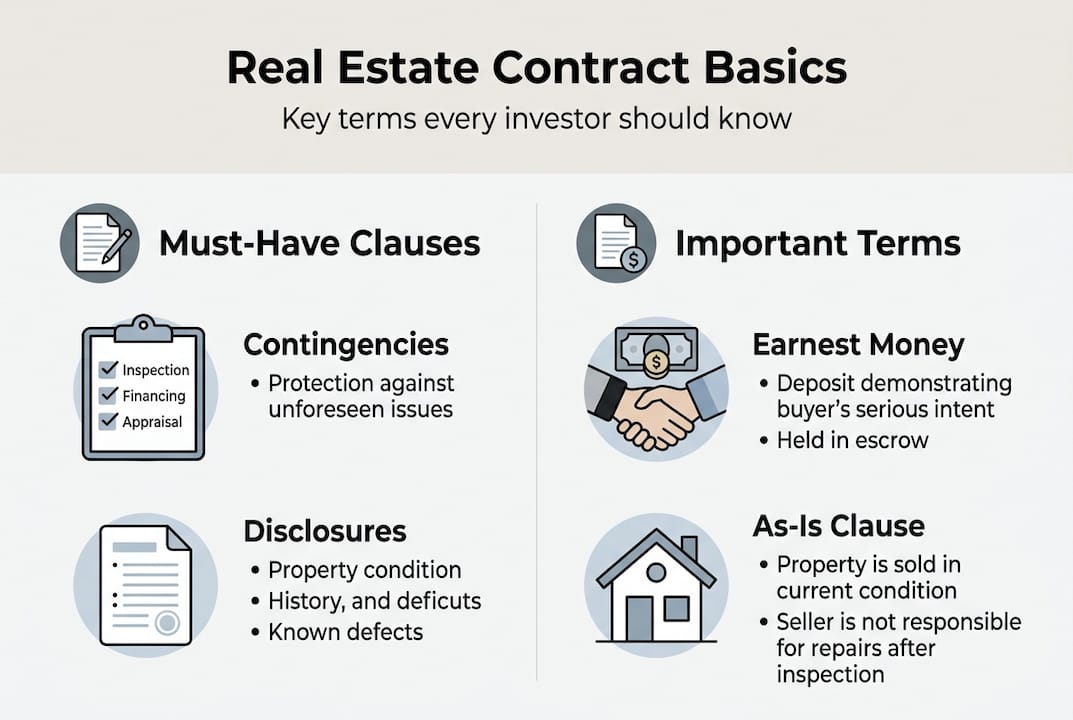
Contingencies are conditions that must be satisfied before the deal closes. Common ones include financing contingencies, inspection contingencies, and appraisal contingencies. If a condition isn't met, you can walk away without losing your deposit.
Disclosures are statements the seller must make about the property's condition. This could include past water damage, foundation issues, or neighborhood nuisances. Sellers are legally required to disclose known problems in most states.
Earnest money is your good-faith deposit. It shows the seller you're serious. If you back out without a valid contingency, you typically lose it.
As-is clauses mean the seller won't make repairs. You're buying the property in its current condition. This can be fine if you've done a thorough inspection, but risky if you haven't.
HOA rules (Homeowners Association) can come with fees, restrictions, and rules that affect how you use or rent the property. Missing these details can cost you money every month.
Here's a simple comparison of major versus minor clauses:
| Clause type | Examples | Risk if ignored |
|---|---|---|
| Major | Financing, inspection, appraisal contingencies | Loss of deposit, forced purchase |
| Major | As-is clause, default terms | Unexpected repair costs, legal liability |
| Minor | Possession date, personal property inclusions | Scheduling conflicts, small disputes |
| Minor | HOA acknowledgment | Ongoing fee surprises |
Now, here's how to spot red flags before you sign:
- Read every page, not just the summary
- Check that all contingencies are clearly written and dated
- Look for vague language like "as agreed" or "to be determined"
- Confirm the closing timeline is realistic
- Verify that all disclosures are attached and signed
Vague timelines and missing contingencies pose significant risks in real estate agreements. Don't assume a blank space means it's not important.
Pro Tip: Always request an attorney review before signing. Many real estate attorneys offer flat-fee contract reviews for a few hundred dollars. That small investment can save you thousands.
Common risks and pitfalls: How contracts protect you
Understanding clauses is half the battle. Next, let's explore exactly how contracts shield you from frequent pitfalls.
Contracts aren't just paperwork. They're your first line of defense. When something goes wrong in a deal, the contract is what determines who is protected and who is exposed.
Here are the most common red flags and what they can cost you:
- No inspection contingency: You're stuck with hidden repair costs after closing
- Vague closing timeline: Delays can trigger penalties or kill the deal entirely
- Missing financing contingency: Loan falls through, you lose your deposit
- Unclear default terms: You don't know your rights if the seller backs out
- Undisclosed HOA fees: Monthly costs eat into your cash flow immediately
- As-is clause without inspection: You inherit every problem with the property
"Edge cases include vague timelines, 'as-is' clauses without inspection, and HOA surprises; always seek attorney review."
Let's look at the HOA example more closely. Imagine you buy a rental property and later discover the HOA charges $400 a month in fees, restricts short-term rentals, and requires board approval for tenants. None of that was on your radar because you didn't review the HOA documents attached to the contract. Now your cash flow projections are off, and your rental strategy is blocked.
That's not a worst-case scenario. It happens regularly to investors who rush through contracts.
Pro Tip: Before signing anything, ask these three questions. First, what are my exit options if this deal falls apart? Second, are all contingencies clearly written with specific deadlines? Third, have I reviewed every attached document, including HOA rules and disclosures?
Contracts protect you when you know how to use them. The goal isn't to be a lawyer. It's to know enough to ask the right questions and catch the red flags before they become real problems.
From confusion to confidence: Steps for handling contracts as a new investor
Knowing the risks is crucial, but real value comes from taking the right steps. Here's how to move forward confidently.
You don't need a law degree to handle real estate contracts. You need a process. Follow these steps every time, and you'll build confidence fast.
- Get the contract early. Ask for a copy before the signing meeting. You need time to read it without pressure.
- Read it fully, once for understanding. Don't skip sections. Read every page to get the full picture.
- Highlight anything unclear. Mark terms you don't understand or clauses that seem vague.
- Compare to a checklist. Use a standard contract checklist to confirm all key elements are present.
- Request attorney review. Attorney review is a critical step before finalizing any real estate agreement. Find a local real estate attorney who offers flat-fee reviews.
- Ask questions before signing. Never sign something you don't fully understand.
- Keep copies of everything. Store signed contracts and all attachments in a secure digital folder.
Before you sign, ask yourself and the seller:
- Are all contingencies in writing with clear deadlines?
- Has the seller disclosed all known property issues?
- What are the default terms if either party backs out?
- Are HOA documents included and reviewed?
- Is the earnest money amount and refund policy clearly stated?
Affordable legal help is more accessible than most beginners think. Many bar associations offer lawyer referral services. Online platforms connect you with real estate attorneys for flat fees starting around $150 to $300 for a contract review. That's a small price compared to losing a $3,000 deposit or buying a property with $20,000 in hidden repairs.
Even on a small deal, contract diligence pays off. The habits you build now carry into every future transaction. Start right, and you'll protect your capital at every stage.
A smarter approach: Why even small investors can leverage contract knowledge
All of this leads to a crucial insight for aspiring investors that's often overlooked.
There's a common misconception that contracts are something only big players need to worry about. The thinking goes: if the deal is small, the risk is small. That's wrong, and it's one of the most dangerous assumptions a new investor can make.
When you're working with limited capital, every dollar matters more, not less. A $2,000 earnest money loss hits a beginner far harder than it hits someone with deep pockets. That's exactly why contract literacy is your most valuable early skill.
Many investors treat contracts as boilerplate, standard documents that are basically the same every time. They're not. Every deal has unique terms, and sellers or their agents sometimes insert clauses that heavily favor one side. If you don't know what to look for, you won't see it.
Learning contracts early gives you a real advantage. You can spot value where others see confusion. You can negotiate from a position of knowledge. And you can protect your investment at every step, regardless of deal size. This is a skill that scales with you as your portfolio grows.
Take the next step: Build your contract expertise with practical resources
Ready to take action? Here's where you can get hands-on support and grow faster.
Learning contracts is one of the best investments you can make as a beginner. It protects your money, builds your confidence, and gives you an edge in every deal you pursue. But reading one article is just the start.

If you want step-by-step training that covers contracts, deal finding, and real execution strategies, beginner real estate training at Real Estate Course is built exactly for you. For a one-time cost of $19.99, you get instant access to all modules, action checklists, and a personalized execution plan. No fluff. No experience required. Just practical skills you can use right away.
Frequently asked questions
What is the most important part of a real estate contract for a beginner?
The contingency clauses are most important because they protect your money and allow you to back out if necessary. Missing contingencies are a critical red flag that every beginner should learn to identify before signing.
How can I avoid common contract mistakes when investing with low capital?
Always read the contract thoroughly, watch for ambiguous terms, and seek attorney review before signing. Attorney review is always recommended to avoid surprises that could cost you your deposit or more.
What are the risks of buying 'as-is' without inspection?
Purchasing 'as-is' without an inspection can expose you to expensive repairs or undisclosed issues that the seller was not required to fix. This major edge case is one of the most avoidable mistakes in real estate.
Should I worry about HOA rules in my contract?
Yes, HOA clauses can introduce hidden fees and restrictions that directly affect your cash flow and rental strategy, so always review them closely. HOA surprises are a documented red flag and a common source of unexpected costs for new investors.