
Most people assume real estate contracts are only for big-money players with lawyers on speed dial. That's a costly misconception. Whether you're buying your first rental, flipping a distressed property, or starting with almost no capital, contracts are the backbone of every deal you'll ever do. They protect you, give you legal rights, and open doors that most beginners don't even know exist. This guide breaks down exactly what real estate contracts are, what makes them valid, and how you can use them right now to start building income, even if your budget is tight.
Table of Contents
- What is a real estate contract?
- Key components of a valid real estate contract
- Types of real estate contracts investors encounter
- How contracts protect low-budget real estate investors
- What most new investors miss about real estate contracts
- Start mastering real estate contracts today
- Frequently asked questions
Key Takeaways
| Point | Details |
|---|---|
| Contract basics matter | Learning what makes a contract valid is key for protecting your investment. |
| Options for low-budget deals | Assignment contracts empower you to participate in real estate with minimal cash. |
| Avoid missing elements | Missing information or signatures can make your contract unenforceable. |
| Different contract types | Knowing which contract fits your situation helps you make smarter deals. |
| Practical application wins | Using real estate contracts wisely minimizes your risks and maximizes your opportunities. |
What is a real estate contract?
A real estate contract is a legally binding agreement outlining the terms of a property transaction. That's the plain-English version. It means two or more parties agree in writing to specific terms, and the law holds them to it. No contract, no legal protection. It's that simple.
Contracts show up in every type of property deal:
- Buying or selling a home
- Renting out a property
- Securing the right to purchase later
- Transferring your interest in a deal to another buyer
For investors, contracts aren't just paperwork. They're your power. They let you lock in a price, set conditions, and walk away if something goes wrong, all without losing money unnecessarily.
Here's a quick look at how contracts function across different transaction types:
| Transaction type | Contract used | Main purpose |
|---|---|---|
| Buying/selling property | Purchase and sale agreement | Transfers ownership |
| Renting a property | Lease agreement | Defines tenant/landlord terms |
| Right to buy later | Option contract | Locks in future purchase rights |
| Flipping deals for profit | Assignment contract | Transfers deal rights to another buyer |
Two key legal facts you need to know:
- Binding: Once signed by all parties, both sides are legally obligated to follow through or face consequences.
- Enforceable: If someone breaks the terms, you can take legal action to recover losses or force performance.
"A real estate contract is a legally binding agreement outlining the terms of a property transaction." Understanding this from day one puts you ahead of most beginners.
For beginner real estate training, knowing what a contract does is step one. Everything else builds from here.
Key components of a valid real estate contract
Not every written agreement is legally valid. A contract missing critical elements can fall apart in court, leaving you with no protection and no deal. Here's what every valid contract must include.

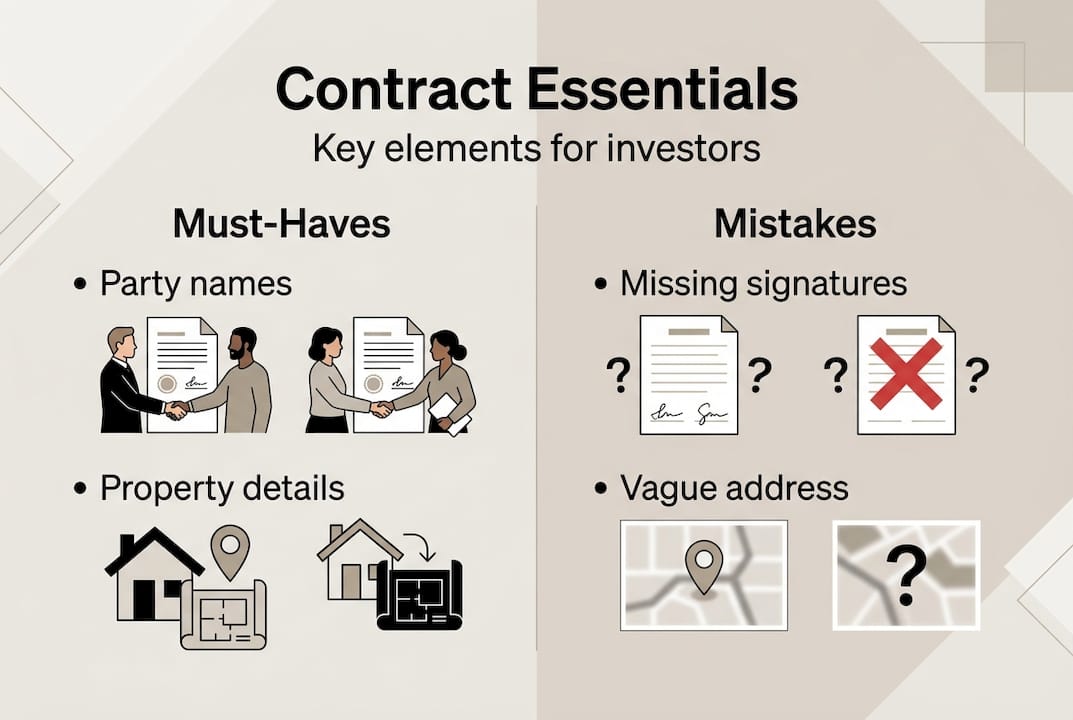
A valid real estate contract must include identifiable parties, property description, purchase price, and signatures. These aren't optional extras. They're the foundation.
Here's a numbered breakdown of the essential components:
- Identifiable parties: Full legal names of the buyer and seller. Nicknames or initials won't hold up.
- Property description: The exact address and legal description of the property. Vague descriptions create disputes.
- Purchase price: The agreed amount. This must be clearly stated, not estimated.
- Contingencies: Conditions that must be met before the deal closes, like a satisfactory inspection or approved financing.
- Timelines: Deadlines for inspections, financing approval, and closing. Missing these can void the contract.
- Signatures and dates: All parties must sign and date the agreement. Without this, it's just a draft.
Here's a comparison of a strong contract versus a weak one:
| Element | Strong contract | Weak contract |
|---|---|---|
| Party identification | Full legal names | First names only |
| Property description | Legal address and parcel ID | Street address only |
| Contingencies | Specific conditions listed | Vague or missing |
| Signatures | All parties signed and dated | One party unsigned |
Pro Tip: Before you sign anything, read every line carefully. Pay attention to contingency deadlines. Missing a deadline by even one day can cost you your earnest money deposit or kill the deal entirely.
Learning the key components required for a valid real estate contract protects you from making expensive rookie mistakes. This knowledge is non-negotiable.
Types of real estate contracts investors encounter
Once you know the components, the next step is recognizing the different contracts you'll negotiate as an investor. Each one serves a specific purpose, and knowing when to use each type gives you a serious edge.
Investors commonly encounter purchase agreements, lease contracts, option contracts, and assignment contracts. Here's what each one means for you:
-
Purchase and sale agreement: This is the most common contract. It sets the price, terms, and closing date for buying or selling a property. Both parties are bound once signed. Risk: if you back out without a valid contingency, you may lose your deposit.
-
Lease agreement: Defines the relationship between a landlord and tenant. As an investor, you'll use this when renting out properties. It covers rent amount, lease duration, maintenance responsibilities, and rules. Risk: a poorly written lease leaves you exposed to tenant disputes.
-
Option contract: Gives you the right, but not the obligation, to purchase a property at a set price within a specific timeframe. You pay a small option fee upfront. Benefit: you control the property without committing to buy it yet. This is powerful when you're waiting on financing or assessing the deal.
-
Assignment contract: You sign a purchase agreement with a seller, then sell your rights in that contract to another buyer for a fee. You never actually buy the property. Benefit: you can profit from deals without needing a down payment or mortgage.
"Understanding each contract type means you can choose the right tool for every deal, instead of guessing and hoping for the best."
Pro Tip: If you're starting with limited capital, focus on types of contracts for low-budget investors like assignment contracts. They let you earn income from real estate without needing to own anything.
How contracts protect low-budget real estate investors
Understanding contracts isn't just theory. Here's how they directly protect you and boost your success as a low-capital investor.
Contracts enable investors to control properties and establish legal rights even with minimal capital. That's the key insight most beginners miss. You don't need to own a property to profit from it. You just need the right contract.
Here's a step-by-step look at how contracts work in your favor:
- Lock in a deal before funding: Use a purchase agreement with a financing contingency. This lets you secure a property at today's price while you arrange the money. If financing falls through, the contingency protects your deposit.
- Protect yourself from fraud: Contracts require full disclosure of property details. If a seller misrepresents the condition and you have it in writing, you have legal recourse.
- Secure inspection rights: An inspection contingency gives you the right to back out or renegotiate if the property has hidden problems. Without this clause, you're buying blind.
- Use assignment contracts to flip deals: Find an underpriced property, sign a purchase agreement, then assign your contract to another buyer for a fee. Some investors earn $3,000 to $10,000 per deal this way, without ever owning the property.
- Negotiate seller financing: A well-written contract can include terms where the seller acts as the bank. This is a real strategy for buyers who can't qualify for traditional loans.
Statistic callout: Studies on wholesale real estate strategies show that assignment contracts account for a significant portion of entry-level investor deals, particularly in markets where traditional financing is harder to access. For benefits of contracts for small investors, this strategy is one of the most accessible starting points available.
Contracts give you leverage. They let you act like an experienced investor even when you're just starting out.
What most new investors miss about real estate contracts
Here's the honest truth: most new investors treat contracts as a formality. They skim them, sign quickly, and move on. That's a mistake that costs real money.
Contracts aren't a hurdle. They're a tool. And like any tool, they work best when you actually understand how to use them. The investors who succeed early aren't necessarily the ones with the most money. They're the ones who read every clause, ask questions, and use contract terms creatively.
Skipping due diligence is where most beginners get burned. A missed contingency deadline, a vague property description, or an unsigned page can unravel a deal you worked months to find.
Here's the contrarian view: theory alone won't protect you. You learn contracts by doing deals. Start with a simple assignment contract on a low-risk deal. Read it line by line. Ask a local real estate attorney to review it once. That single experience teaches you more than hours of reading.
For practical investing insights, the pattern is clear: investors who treat contracts as a skill, not a checkbox, close more deals and avoid costly errors. Make contract literacy your first real investment.
Start mastering real estate contracts today
You now know what real estate contracts are, what makes them valid, and how they protect you as a low-budget investor. That knowledge is powerful. But knowing and doing are two different things.

If you're ready to put contract knowledge to work, low-budget real estate training is a click away. At realestatecourse.net, you get step-by-step modules covering contracts, deal-finding, and execution strategies, all for a one-time payment of $19.99. No fluff, no guesswork. Just practical training built for beginners who want real results without a big budget. Start today and build the skills that turn contracts into income.
Frequently asked questions
What makes a real estate contract legally binding?
A real estate contract is legally binding if it clearly identifies the parties, property, price, and has signatures from all parties. Missing any of these elements can make it unenforceable.
Can I invest in real estate with little money using contracts?
Yes. Techniques like assignment contracts allow you to control property deals with minimal upfront capital, earning a fee without ever purchasing the property yourself.
What happens if a contract is missing a key element?
If a contract is missing required elements like signatures or a proper property description, it may not hold up in court, leaving you without legal protection. Always verify that all required elements are present before signing.
What types of real estate contracts should beginners know?
Beginners should understand purchase agreements, lease contracts, option contracts, and assignment contracts, as each serves a different purpose in property transactions.