
Most people assume cash offers in real estate are reserved for wealthy buyers with millions sitting in the bank. That assumption stops a lot of beginners before they ever get started. The truth is, a cash offer is simply a purchase proposal where the buyer pays the full price upfront using liquid funds, without needing mortgage financing, typically via wire transfer or cashier's check at closing. You don't need to be rich to pull this off. You just need to know the right strategies. This guide breaks it all down in plain language, step by step, so you can compete with confidence even on a tight budget.
Table of Contents
- What is a real estate cash offer?
- Why do cash offers matter for beginner investors?
- How do cash offers work? Step-by-step for beginners
- Creative ways to make cash offers without much capital
- iBuyers, instant sales, and the role of tech
- What most guides miss about cash offers in 2026
- Level up your cash offer game with expert training
- Frequently asked questions
Key Takeaways
| Point | Details |
|---|---|
| Cash offers not just for the wealthy | Beginners can use creative funding methods to compete with cash offers. |
| Major seller advantages | Cash offers close faster, have fewer contingencies, and reduce risk for sellers. |
| Multiple low-capital strategies | Options like delayed financing, bridge loans, and partnerships make cash offers possible for new investors. |
| Speed and negotiation power | Cash buyers can close in half the time and may secure 5-20% discounts. |
| Tech-enabled instant offers | iBuyers and online tools are making cash offers and sales faster and more accessible. |
What is a real estate cash offer?
Let's get the definition straight first, because a lot of beginners get confused by the word "cash."
A cash offer does not mean you show up with a briefcase full of bills. According to real estate professionals, a real estate cash offer is when a buyer proposes to purchase a property using liquid funds, without relying on a bank loan or mortgage. The payment happens at closing, usually through a wire transfer or cashier's check.
Here's what really matters: "cash" in real estate means no mortgage contingency. Sellers don't have to worry about the deal falling apart because a lender backed out.
"Cash doesn't always mean money sitting in a savings account. Lines of credit, home equity, and liquid investment accounts all count as sources for a legitimate cash offer."
What qualifies as "cash" in a real estate deal?
- Bank account funds (checking, savings, money market)
- Home equity lines of credit (HELOCs)
- Liquid investment accounts (stocks, mutual funds that can be converted quickly)
- Private or bridge loans (borrowed funds that allow a cash-close)
- Partnerships (pooling funds with another investor)
Not always literal cash is the key insight here. As Investopedia explains, some buyers finance post-close, using a method called delayed financing. They buy the property in cash, then immediately refinance to get their money back out. Investors also use this approach for flips and rental properties.
Sellers love cash offers for three main reasons: speed, certainty, and simplicity. There's no waiting on bank approvals, no appraisal requirements from a lender, and no financing contingency that can blow up the deal at the last minute. If you understand using equity in real estate, you're already ahead of most beginners in this space.
Why do cash offers matter for beginner investors?
With a basic definition out of the way, let's see why cash offers can be a game-changer for new investors, especially those on tight budgets.

The biggest practical advantage is speed. Cash offers close in as little as 7 to 14 days compared to 30 to 60 days for financed deals. For a motivated seller, that difference is huge. Speed equals certainty, and certainty is what sellers are really buying when they accept a cash offer.
Here's a quick look at how cash offers stack up:
| Factor | Cash offer | Financed offer |
|---|---|---|
| Average close time | 7 to 14 days | 30 to 60 days |
| Contingencies | Minimal or none | Appraisal, financing, inspection |
| Risk of deal falling through | Very low | Moderate to high |
| Seller preference | High | Lower in competitive markets |
| Discount potential | 5% to 20% below market | Rarely below asking |
The numbers tell a compelling story. All-cash sales made up roughly 32 to 33% of U.S. home sales in 2024 through early 2025, dipping to about 29% by December 2025. Florida leads the country with up to 47% of homes purchased with cash. The West Coast sits much lower at around 18%. Cash buyers in those markets negotiate 5% to 20% discounts below market value, which is a meaningful edge when you're trying to make money with little capital.
Statistic callout: Cash buyers nationwide saved an average of 5 to 20% below asking price in recent transactions, simply because sellers valued the certainty of a clean close.
Pro Tip: In markets with motivated sellers (think: probate properties, inherited homes, landlords tired of tenants), even a modest cash offer can beat a higher financed offer. Lead with speed, not just price.
This is exactly why real estate investing for beginners should include cash offer strategies from day one. Even if you start small, knowing how to position yourself as a cash buyer opens doors that financed offers simply can't.
How do cash offers work? Step-by-step for beginners
Knowing why cash offers matter, here's the exact process you'll follow as a first-time cash buyer.
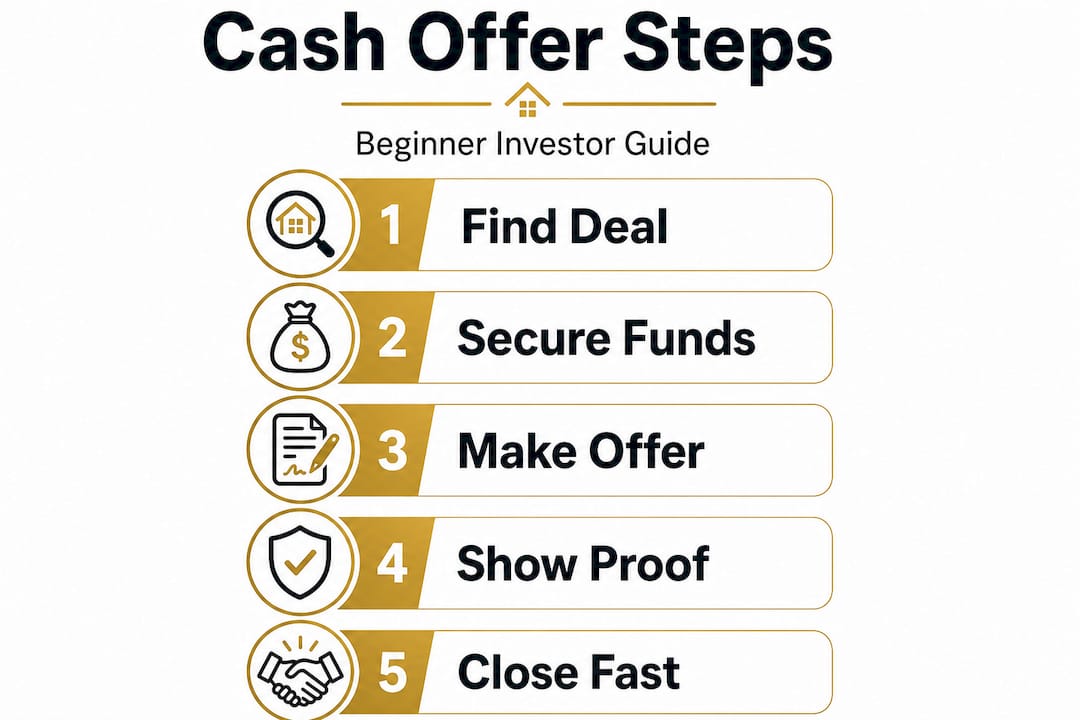
The process is simpler than most beginners expect. Here's how it works from start to finish:
-
Gather your proof of funds. This is a bank statement, letter of credit, or official document showing you have access to the funds needed. It can be a statement from your brokerage account, a letter from your private lender, or a HELOC statement. The key is showing the seller you're not bluffing.
-
Submit a written offer. Your offer letter states the purchase price, any contingencies (or the lack of them), and your proposed closing date. In a cash deal, you waive the financing contingency. You may still include an inspection contingency, which is smart even when you're buying for cash.
-
Open escrow and make your earnest money deposit. Earnest money shows good faith. It typically ranges from 1% to 3% of the purchase price and is held in escrow until closing.
-
Complete your due diligence. Even without a lender pushing for an appraisal, you should do your own property research. Know the market value. Walk through the property. Get an inspection done.
-
Close the deal. You'll provide your funds via wire transfer or cashier's check. The title company handles the paperwork, you sign the closing documents, and the property is yours.
A solid understanding of real estate contracts makes this whole process much smoother. Knowing what each clause means keeps you from making costly mistakes, especially when you're removing a financing contingency.
Pro Tip: Respond to sellers and agents quickly. In a competitive market, slow communication can cost you the deal even if your offer is strong. Set up email alerts and be ready to sign documents digitally.
The essential real estate skills for beginners always include knowing how to read a contract and communicate clearly with all parties involved. Speed and professionalism close deals.
Creative ways to make cash offers without much capital
You've learned the standard process. Now, let's tackle how most beginners creatively use cash offer strategies even without a six-figure bank account.
Here's the reality: most beginner investors do not have $200,000 sitting in a checking account. That doesn't mean you can't make a legitimate cash offer. It means you need to use the right tools.
| Strategy | How it works | Best for | Watch out for |
|---|---|---|---|
| Delayed financing | Buy with cash, refinance immediately after close | Fix-and-flip investors | Needs initial capital or a loan source |
| Bridge loans | Short-term loan (days to weeks) to fund close | Rental or flip investors | Higher interest rates (8% to 12%) |
| Cash-offer programs | Services like Homeward or Orchard front the cash | Beginners buying primary residence | Service fees (1% to 3%) |
| Private partnerships | Partner with someone who has capital | Complete beginners with no funds | Need clear profit-sharing agreement |
| DSCR loans | Debt-service coverage ratio loans, can close in 10 days | Rental investors | Requires income-generating property |
As Investopedia notes, beginners with low capital can make real cash offers using delayed financing, bridge loans, cash-offer services, private partnerships, or fast DSCR loans that can close in as little as 10 days. These aren't tricks or shortcuts. They're real methods that experienced investors use every day.
Common pitfalls to watch out for:
- Service fees from cash-offer programs can eat into your profit margin. Always calculate total cost before using one.
- Bridge loan terms are short. If your deal takes longer than expected, interest costs add up fast.
- Partner agreements need to be in writing. A handshake deal between friends can end relationships and deals at the same time.
- Proof of funds letters from private lenders must look credible. Sellers and agents will verify them.
- Delayed financing requires the original purchase to be truly arms-length, meaning you can't buy from a family member and immediately refinance.
If you're looking to invest with limited funds, cash-offer strategies combined with partnerships or bridge loans give you the most flexibility for flips, rentals, or quick assignments.
iBuyers, instant sales, and the role of tech
With creative strategies in mind, it's also important to understand how tech platforms and iBuyers are shaping the modern cash offer process.
iBuyers are technology-driven companies that use algorithms to make instant cash offers on homes. For sellers, this means a quick, predictable sale without open houses or negotiations. For investors, understanding how iBuyers operate helps you see where the real opportunities are.
Here's how a typical iBuyer transaction works, using Opendoor as an example:
- Submit an online request. The seller enters the property address and basic details on the platform.
- Home assessment. The iBuyer may request a video walkthrough or in-person visit to verify the condition.
- Receive a final offer. The offer accounts for repair deductions and service fees, typically 5% to 8%.
- Short escrow period. The iBuyer closes quickly, often in a matter of days, and purchases the home as-is.
- Seller moves out and gets paid. No staging, no showings, no deal fall-through risk.
For beginner investors, iBuyers can be useful in two ways. First, you can sell a property quickly to an iBuyer after adding value. Second, watching iBuyer activity in a market tells you where demand is hot. Where iBuyers buy frequently, motivated sellers are also more open to investor cash offers.
The hidden drawback is cost. iBuyer service fees, plus repair deductions, mean sellers often net less than they would on the open market. That's not always a problem for a motivated seller, but it's important context when you're evaluating your own deals. As a buyer or investor, understanding this gap helps you compete and spot deals others miss.
What most guides miss about cash offers in 2026
Now that you've learned the strategies and mechanics, here's an honest look at what really works, and what's overhyped, in the cash offer world of 2026.
Here's something most beginner guides won't tell you: cash offers are not always the winning move.
In 2025 and into 2026, lower interest rates have made financed offers more competitive again. The declining share of all-cash sales in recent months reflects a shift toward buyer-friendly markets where financing is no longer such a disadvantage. In some markets, a financed offer at full asking price beats a low-ball cash offer every time.
The real edge in 2026 is not just having cash. It's knowing when to use it.
Most beginners make the mistake of treating "cash offer" as a magic phrase that wins every deal. It doesn't. What wins deals is a combination of smart research, quick action, strong relationships with agents and wholesalers, and a clear understanding of what a motivated seller actually needs. Sometimes that's speed. Sometimes it's flexibility. Sometimes it's just someone who picks up the phone.
We've seen many first-timers overpay for a property just to "win" with a cash offer. That's backwards. The goal is to buy right, not just to buy fast. Developing the habits that build income is what separates investors who build real wealth from those who just close deals.
Our honest take: learn the mechanics of cash offers thoroughly, build one or two reliable capital sources (a HELOC, a private lender relationship, or a strong partner), and focus most of your energy on finding undervalued deals. The cash offer is your tool. Strategy is your actual advantage.
Level up your cash offer game with expert training
Ready to apply what you've learned, but want step-by-step support?
Understanding cash offers is a great start. But knowing exactly how to find the right deals, approach sellers, structure offers, and close without losing money takes real, hands-on training.

At Real Estate Low Budget Game, we built a beginner-friendly course designed for people who are starting with limited capital and zero prior experience. For a one-time investment of just $19.99, you get instant access to step-by-step modules, action checklists, and a personalized execution plan. You'll learn practical methods, not fluff. Ready to find cheap real estate deals and make your first confident cash offer? Start today.
Frequently asked questions
Do I need all the cash in my bank to make a cash offer on a house?
No, many buyers use lines of credit, home equity, or bridge loans to make a cash offer without the full amount liquid. As Investopedia notes, some buyers finance post-close through delayed financing, meaning the funds don't need to be permanently tied up in savings.
How fast can a cash offer close compared to traditional financing?
A cash offer can close in as little as 7 to 14 days. Traditional financed offers typically take 30 to 60 days, making cash a major advantage for sellers who need to move quickly.
Can I negotiate a lower price with a cash offer?
Yes, cash buyers frequently secure a 5% to 20% discount below market value. Sellers accept lower prices because all-cash transactions carry far less risk of falling through than financed deals.
What is a proof of funds and why do I need it?
Proof of funds is a document showing you have immediate access to the purchase amount, such as a bank statement or lender letter. It reassures sellers that your cash offer is legitimate and that the deal can actually close without financing delays.