
Most beginners assume that rising property prices automatically mean more money in their pocket. That's only partly true. Real estate appreciation is the rise in a property's market value over time, but turning that growth into real profit requires understanding costs, inflation, and strategy. This guide breaks down exactly what appreciation is, how to measure it, what drives it, and how to use it as part of a bigger income-building plan. By the end, you'll know the numbers to watch and the mistakes to avoid.
Table of Contents
- What is real estate appreciation?
- How is real estate appreciation measured?
- Key factors that drive real estate appreciation
- Appreciation versus profit: What most beginners miss
- How to use appreciation in your real estate strategy
- Our take: Focusing on what matters, not just the numbers
- Ready to build real estate wealth? Start with proven resources
- Frequently asked questions
Key Takeaways
| Point | Details |
|---|---|
| Appreciation basics | Appreciation is the increase in your property's market value over time and is a key part of long-term real estate investing. |
| Measuring gains | You can measure appreciation by comparing your current property value to your purchase price and calculating the percentage increase. |
| Profit versus appreciation | True investment profit factors in costs and inflation, while appreciation alone may not mean real gains. |
| What drives appreciation | Local market trends, improvements, and economic growth all impact your property's appreciation potential. |
| Practical next steps | Track both market benchmarks and your own numbers to make smarter real estate decisions. |
What is real estate appreciation?
Appreciation is straightforward at its core. It means your property is worth more today than it was when you bought it. That difference in value is called appreciation.
"Real estate (home) appreciation is the increase in a property's market value over time."
But appreciation is not the whole picture of your investment. It is only one way real estate can make you money. Understanding how real estate generates income helps you see where appreciation fits in.
Here is what appreciation includes and what it does not include:
Appreciation includes:
- The rise in market value from the time of purchase to the current date
- Increases driven by market forces, location desirability, and economic growth
- Value added by renovations or improvements you make to the property
Appreciation does NOT include:
- Rental income or cash flow you collect from tenants
- Tax benefits like depreciation deductions
- Equity paydown from your mortgage payments
Why does appreciation matter for investors?
It builds equity. Equity is the portion of the property's value that you actually own. As your property appreciates, your equity grows even if you have not paid down much of your mortgage. That equity can be accessed later through a sale or refinancing, giving you capital to reinvest. For beginners, appreciation is often the most visible reward of holding a property long term. But it is not automatic, and it is not always as large as it appears.
The opposite of appreciation is depreciation, which is when a property loses market value. This can happen due to neighborhood decline, economic downturns, or poor property condition. Knowing both sides helps you make smarter decisions before you buy.
How is real estate appreciation measured?
Now that you know what appreciation is, let's dig into how you can measure it and how the industry tracks it.
There are two main ways investors measure appreciation: calculating it for an individual property or using published market indexes.

Calculating appreciation for your own property
Here is a simple step-by-step process:
- Write down the original purchase price of the property.
- Find the current market value (use a recent appraisal or comparable sales).
- Subtract the purchase price from the current value.
- Divide that number by the original purchase price.
- Multiply by 100 to get the percentage gain.
Example: You bought a property for $200,000. It is now worth $260,000.
- $260,000 minus $200,000 equals $60,000
- $60,000 divided by $200,000 equals 0.30
- 0.30 multiplied by 100 equals 30% appreciation
A practical way to measure appreciation for an individual property is to compare its current value to the purchase price and compute a total percentage gain. Simple and effective.
Using national market indexes
Beyond your own property, you can track broader market trends. National appreciation benchmarks are typically measured using repeat-sales index methods that track price changes for the same properties over time while holding quality roughly constant. The most widely used source is the FHFA House Price Index.
Here is a quick comparison of both methods:
| Method | What it measures | Best used for | Limitation |
|---|---|---|---|
| Individual property calculation | Your specific property's gain | Tracking personal investment returns | Doesn't account for market-wide trends |
| FHFA House Price Index | National or regional market trends | Benchmarking against the broader market | Doesn't reflect your specific property |
Pro Tip: Always check whether any renovations or major upgrades happened between the purchase date and today. Improvements can inflate your apparent appreciation rate. If you want to isolate true market-driven gains, separate the renovation costs from the value increase. For deeper insight into tracking your investments effectively, exploring investing research basics will help you build this habit early.
Key factors that drive real estate appreciation
Once you know how to measure appreciation, it is crucial to understand what actually causes it to change year after year.
Property values do not rise randomly. Several forces push prices up or pull them down. As a beginner, knowing these forces helps you pick markets and properties with better potential.
The main drivers of appreciation:
- Economic growth: When a local economy is strong, jobs are plentiful and wages rise. More people can afford to buy homes, pushing prices up. Cities with growing industries like technology or healthcare often see consistent appreciation.
- Population trends: When more people move into a city or region than move out, demand for housing rises. More demand with limited supply means higher prices.
- Supply vs. demand: If builders cannot keep up with the number of buyers, home prices rise. This is especially true in cities with geographic constraints like mountains, coastlines, or strict zoning laws.
- Location upgrades: New schools, parks, shopping centers, and public transit can all make a neighborhood more desirable and push property values higher.
- Infrastructure investment: Highway expansions, new transit lines, or major employer relocations near a property can significantly increase its value over time.
- Government policy: Tax incentives, zoning changes, or first-time buyer programs can stimulate demand and drive appreciation in specific areas.
Renovations and improvements
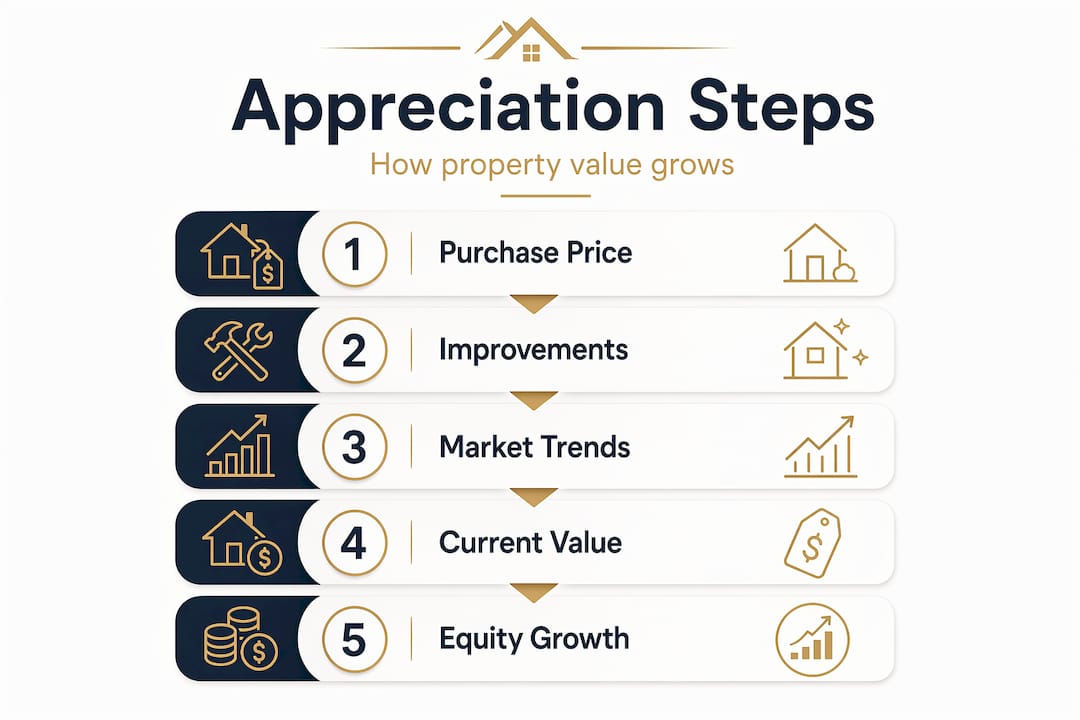
You have some control over appreciation through smart upgrades. Kitchen remodels, bathroom updates, and added square footage can increase a property's value faster than the general market trend. However, not all renovations deliver equal return on investment. You want improvements that match what buyers in that specific area expect and want.
Market timing and local cycles
Real estate markets move in cycles. They expand, peak, contract, and recover. Buying at the right point in the cycle can accelerate your appreciation gains. Buying at the peak can mean years of flat or negative appreciation before a recovery.
Pro Tip: Before you buy in any market, research local job and wage trends. A market with steady employment growth and rising median incomes is far more likely to sustain appreciation than one relying on a single employer or a volatile industry.
National benchmarks use repeat-sales methods that hold quality constant, so they strip out the noise of individual improvements. But your local market may behave very differently. Always compare local data against national figures. For a full picture of why these factors matter, read about the broader benefits of real estate investing for beginners.
Not all appreciation is guaranteed. Real estate markets can and do fall. Risk exists in every investment, and appreciation is no exception.
Appreciation versus profit: What most beginners miss
Understanding value growth is only half the story. Now it is time to see what appreciation means for your bank account and how to avoid beginner mistakes.
Many new investors see a property gain $50,000 in value and think they made $50,000. That is rarely the case. Your real profit is what is left after you account for all the costs involved.
What reduces your actual profit:
- Real estate agent commissions (typically 5 to 6% of the sale price)
- Closing costs when you bought and when you sell
- Mortgage interest paid over the holding period
- Property taxes paid each year
- Maintenance, repairs, and insurance costs
- Capital gains taxes on your profit
After subtracting these costs, a property that "appreciated" by 20% might deliver a real profit much smaller than you expected.
Nominal appreciation vs. real appreciation
Here is a critical concept most beginners overlook:
| Type | What it means | Example |
|---|---|---|
| Nominal appreciation | The raw percentage increase in price | 5% price gain in one year |
| Real appreciation | Price gain adjusted for inflation | 5% gain minus 3% inflation equals 2% real gain |
Appreciation is not the same as inflation-adjusted real value growth. A property can have nominal price gains while real inflation-adjusted value is flat or down. If home prices rise 3% but inflation is also 3%, your purchasing power has not improved at all.
In early 2026, this became very real for many investors. Home price growth was subdued and inflation outpaced home price growth for the ninth consecutive month, meaning real home values actually declined again in February 2026. Investors who focused only on nominal gains missed this important signal.
Common beginner mistakes to avoid:
- Assuming price increases equal profit without subtracting costs
- Ignoring inflation when calculating investment returns
- Overlooking how long you hold the property (time affects total cost significantly)
- Buying based on past appreciation without analyzing current fundamentals
- Confusing neighborhood buzz with sustainable long-term demand
Understanding real estate risk and income together will help you avoid these costly missteps.
How to use appreciation in your real estate strategy
Now that you know the caveats, let us see how you can put appreciation knowledge to work for your real estate goals.
Setting realistic appreciation goals
Use national data as your starting point. The FHFA House Price Index provides a widely cited benchmark for U.S. home price appreciation. In its March 2026 release, it showed a year-over-year change of about 1.6%. That is your baseline. Some local markets outperform significantly. Others lag behind. Research before you buy.
Tips for maximizing appreciation potential:
- Choose markets with strong fundamentals. Look for cities with job growth, population inflow, and limited housing supply.
- Buy below market value when possible. Starting with equity built in gives you a head start.
- Plan strategic renovations. Focus on improvements that align with what buyers in that market want.
- Hold for the long term. Appreciation is a slow process in most markets. Short-term flipping depends more on forced appreciation through renovations than natural market growth.
- Monitor your local market regularly. Track comparable sales, new listings, and days on market to gauge whether appreciation is accelerating or cooling.
Monitoring appreciation as part of ongoing management
Track your property's estimated value at least once or twice a year. Use sales data from comparable properties nearby. Compare your findings against FHFA index trends to see if your property is keeping pace with the market.
First action steps for beginners:
- Identify two or three local markets you want to research
- Find the FHFA House Price Index data for those areas
- Calculate the appreciation rate for sample properties in each market
- Build a simple spreadsheet to track purchase price, current value, and costs
Starting with these basics makes appreciation a tool rather than a mystery. Review beginner real estate tips to build on this foundation with practical, low-capital strategies.
Our take: Focusing on what matters, not just the numbers
Here is something most appreciation guides will not tell you: appreciation is often the least controllable part of your investment. Markets move on their own timeline. You cannot force a neighborhood to gentrify or a city to grow. What you can control is your buying process, your cost management, and your income strategy.
We see beginners make the same mistake repeatedly. They hear that real estate "always goes up" and buy in a hot market at peak prices, assuming appreciation will bail them out. Then the market stalls. Costs pile up. Cash flow is negative. The investment becomes a burden instead of a wealth builder.
The investors who actually build wealth through real estate are not the ones who chased the biggest appreciation markets. They are the ones who focused on fundamentals. They bought properties that generated positive cash flow from day one. They managed costs carefully. They held through cycles. Appreciation was a bonus, not the plan.
Over-focusing on appreciation also leads to overleveraging. When you expect big price gains, it is tempting to stretch your budget and take on more debt than is wise. One bad quarter in the market can wipe out years of paper gains and leave you underwater.
The winning strategy blends realistic appreciation expectations with strong cash flow management, disciplined buying criteria, and patience. Sustainable habits matter more than lucky timing. Developing income-building habits alongside your appreciation knowledge is what separates investors who succeed from those who struggle.
Ready to build real estate wealth? Start with proven resources
You now have a solid grasp of what appreciation is, how to measure it, and how to use it wisely. But reading is just the starting line. Real progress comes from applying this knowledge with a structured, step-by-step plan designed for beginners.

At Real Estate Course, we built a beginner real estate training program specifically for people who want to move from learning to earning, without needing a big budget or prior experience. For a one-time investment of just $19.99, you get instant access to practical modules, action checklists, and a tailored execution plan that puts appreciation in the context of a complete income-building strategy. You will not just understand the numbers. You will know exactly what to do with them.
Frequently asked questions
How do you calculate real estate appreciation for your property?
Subtract your purchase price from your current home value, divide by the purchase price, then multiply by 100 to get the percent appreciation. This method gives you a clear total percentage gain for your specific investment.
Is real estate appreciation guaranteed every year?
No, appreciation can slow down, stop, or even reverse depending on market conditions. Inflation outpaced home price growth for nine consecutive months in early 2026, a real reminder that appreciation is never automatic.
How does inflation impact real estate appreciation?
Inflation reduces your real purchasing power, so nominal price gains do not always equal real wealth growth. A property can have nominal gains while its inflation-adjusted value stays flat or falls.
What is the average home appreciation rate in the US?
The FHFA House Price Index showed a year-over-year change of about 1.6% in its March 2026 release, though local markets can vary significantly above or below this benchmark.
Does renovation increase property appreciation?
Yes, improvements and renovations can add value and accelerate appreciation, especially when they match local buyer demand. However, appraisal indexes and individual property values can diverge, since indexes track broad market data while your specific property's value depends on its condition, upgrades, and local pricing at the time of sale.