
You want to build income through real estate, but your savings account isn't exactly overflowing. That's the situation millions of beginners face, and it stops most of them before they ever take a single step. The good news is that you don't need a massive down payment or years of experience to get started. Strategies like house hacking, the BRRRR method, and indirect real estate options give you real, practical entry points into real estate income, even on a tight budget. This guide breaks each one down clearly so you can choose the path that fits your situation right now.
Table of Contents
- What you need before you start investing
- House hacking: Live and earn at the same time
- BRRRR method: Recycling your cash for more deals
- Making money without buying property: Indirect real estate investing
- How real estate actually earns you money
- Our take: The strategy most beginners overlook
- Ready to take your first real step?
- Frequently asked questions
Key Takeaways
| Point | Details |
|---|---|
| Start small, think smart | You do not need a fortune to start earning money in real estate—there are practical, legal ways to get started with very little. |
| House hacking reduces barriers | Living in and renting out part of your home can cover your mortgage and jumpstart your investing journey with owner-occupant financing. |
| Indirect options require less cash | You can invest in real estate markets for as little as $10 by using REITs or crowdfunding platforms with no landlord responsibilities. |
| Success depends on research | Understanding your financing, market, and property management basics is as important as finding a ‘deal’. |
What you need before you start investing
With your motivation clear, the first step is understanding what you'll need to realistically begin, before you pick a strategy. Many beginners skip this part and end up frustrated. Knowing your starting point saves you from wasted effort and costly mistakes.
Assess your risk tolerance first. Real estate is not a guaranteed paycheck. Tenants miss rent. Roofs leak. Vacancies happen. You need to be honest with yourself about how much financial stress you can handle if things go sideways. NAR guidance emphasizes that investing with little or no cash increases risk, and you should match your strategy to your comfort level while doing your homework on local markets, zoning issues, tenant rules, and property management realities.
Know your credit position. Your credit score directly affects your loan options and interest rates. A score below 580 will close most conventional loan doors, though some programs still exist. Knowing where you stand before you approach a lender puts you in control.
Here is a quick look at what each common entry path requires:
| Strategy | Min. credit score | Capital needed | Time commitment | Best for |
|---|---|---|---|---|
| House hacking | 580+ (FHA) | 3.5% down | High (you live there) | Complete beginners |
| BRRRR method | 620+ | Some rehab funds | High (active management) | Hands-on investors |
| REITs / crowdfunding | None | As little as $10 | Very low | Risk-averse beginners |
Key documents to gather before you start:
- Government-issued ID
- Last two years of tax returns
- Recent pay stubs or proof of income
- Bank statements (last 2-3 months)
- Credit report (pull all three bureaus)
- Debt obligations summary
Note that for lower entry barriers for new investors, indirect options like REITs and real estate crowdfunding platforms let you skip most of this paperwork entirely. You invest like a stock market participant, not a property owner.
Pro Tip: Pull your free credit report at AnnualCreditReport.com before anything else. Even boosting your score by 20 to 40 points can unlock better loan terms, lower rates, and more financing options. Small improvements make a big difference in what you can access.
House hacking: Live and earn at the same time
Now that you've covered your bases, it's time to dive into the most popular low-cash strategy: house hacking. This approach is powerful because it combines your housing expense with an income-generating asset. You live in the property while your tenants help pay your mortgage.

House hacking typically works like this: you buy a multi-unit property, like a duplex, triplex, or fourplex, move into one unit, and rent out the others. Tenant rent offsets your mortgage and other housing costs. In some markets, it can cover your payment entirely, meaning you live for free while building equity.
Here is the step-by-step process:
- Research multi-unit properties in your area. Look for duplexes and small apartment buildings priced within your financing range. Focus on neighborhoods with low vacancy rates and strong rental demand.
- Get pre-approved using owner-occupant financing. Living in the property makes you eligible for programs like FHA and VA loans, which have lower down payment requirements than investment property loans.
- Run the numbers. Calculate total monthly costs (mortgage, insurance, taxes, maintenance reserve) against expected rental income. Make sure the math works even with one unit vacant.
- Make an offer and close. Work with an agent familiar with multi-unit properties to negotiate and close.
- Move in and list your rentals. Screen tenants carefully. This is your home too, so do not rush the process.
- Collect rent and track your expenses. Keep clean records from day one for tax purposes and cash flow monitoring.
Here is how the main loan options compare for house hacking:
| Loan type | Min. down payment | Credit requirement | Key advantage | Key limitation |
|---|---|---|---|---|
| FHA loan | 3.5% | 580+ | Low down payment, flexible | Mortgage insurance required |
| VA loan | 0% | Varies by lender | No down payment, no PMI | Must be eligible veteran/service member |
| Conventional loan | 5-20% | 620+ | No mortgage insurance at 20% | Higher credit bar |
Owner-occupant financing programs like FHA and VA are specifically designed to help people buy homes they live in. When you house hack, you qualify under those same rules, even though you're generating rental income.
"Using the FHA loan to house hack my first duplex was a game changer. My tenants covered $1,100 of my $1,400 mortgage. I was essentially paying $300 a month to own property and build equity." — Experience shared by a first-time investor who used the beginner house hacking approach
Pro Tip: Tenant screening is critical when you share a building. Always run a background check, verify income (aim for 3x the monthly rent), and call previous landlords. The wrong tenant in your building affects your daily life, not just your income.
BRRRR method: Recycling your cash for more deals
If you want to build up your portfolio using the same capital again and again, BRRRR might be the next move. BRRRR stands for Buy, Rehab, Rent, Refinance, Repeat. It is a strategy for scaling with limited cash by purchasing undervalued properties, improving them, and then pulling your capital back out through refinancing.
Here is each step explained:
- Buy below market value. This is the most critical step. You need to find a distressed or underpriced property where you can force appreciation through repairs. Overpaying here breaks the whole model.
- Rehab strategically. Focus on updates that add rental value: kitchens, bathrooms, curb appeal, and mechanical systems. Get at least three contractor bids before committing.
- Rent it out. Place a qualified tenant and establish consistent rental income. Lenders need to see this stability before they will refinance.
- Refinance. Once the property is rented and appraised at its new higher value, do a cash-out refinance. This pulls a portion (often 70-75% of the new value) of your equity back out as cash.
- Repeat. Use that recovered capital as the down payment on your next deal. Rinse and repeat to grow your portfolio.
Where most beginners go wrong with BRRRR:
- Underestimating rehab costs. Always add a 15-20% buffer to your contractor estimates.
- Overpaying for the purchase. The deal is made on the buy. If the numbers don't work at purchase, they won't work later.
- Choosing the wrong market. A property only adds value if renters want to live there. Research vacancy rates and rent trends before you buy.
- Skipping the appraisal estimate. You need a rough post-rehab value (called ARV, or after-repair value) before you spend a dollar on repairs.
Pro Tip: Reliable contractors are worth their weight in gold. Ask for references and follow up on them. Visit one of their completed jobs if possible. A bad contractor can eat your entire profit margin and set your timeline back by months. Build relationships with two or three trusted tradespeople before you need them urgently.
You can walk through the step-by-step BRRRR process in detail to map out each stage before you commit real money to a deal.
Making money without buying property: Indirect real estate investing
Ready to get exposure to real estate without dealing with tenants or loans? Indirect options can be a smart first step, especially if you are building your savings or credit while learning the fundamentals.
A REIT (Real Estate Investment Trust) is a company that owns income-producing real estate, like apartment buildings, office parks, or shopping centers. You buy shares of that company, just like a stock. The company is required by law to pay out at least 90% of its taxable income as dividends, which means you receive regular income without owning a single piece of property.
Real estate crowdfunding platforms work similarly. You pool money with other investors to fund specific real estate projects. Some platforms let you start with as little as $10.
For very limited capital, indirect real estate options like REITs and crowdfunding are the most accessible starting point for most beginners.
Pros of indirect real estate investing:
- Ultra-low minimums (some platforms start at $10)
- No tenant responsibilities
- Easy to diversify across multiple property types
- Liquidity (publicly traded REITs can be sold like stocks)
- Passive income through dividends
Cons to keep in mind:
- Less control over investment decisions
- Subject to market risk and stock market volatility
- Lower potential returns compared to direct ownership
- Crowdfunding platforms may lock up your money for years
Pro Tip: Start with a small amount in a REIT ETF (exchange-traded fund) to get comfortable with how real estate income works before committing to larger strategies. Even $50 in a real estate fund teaches you how dividends work, how to read a portfolio, and what market fluctuations feel like in practice.
How real estate actually earns you money
No matter which strategy you start with, here's how the money is actually made in real estate, and why numbers always matter.
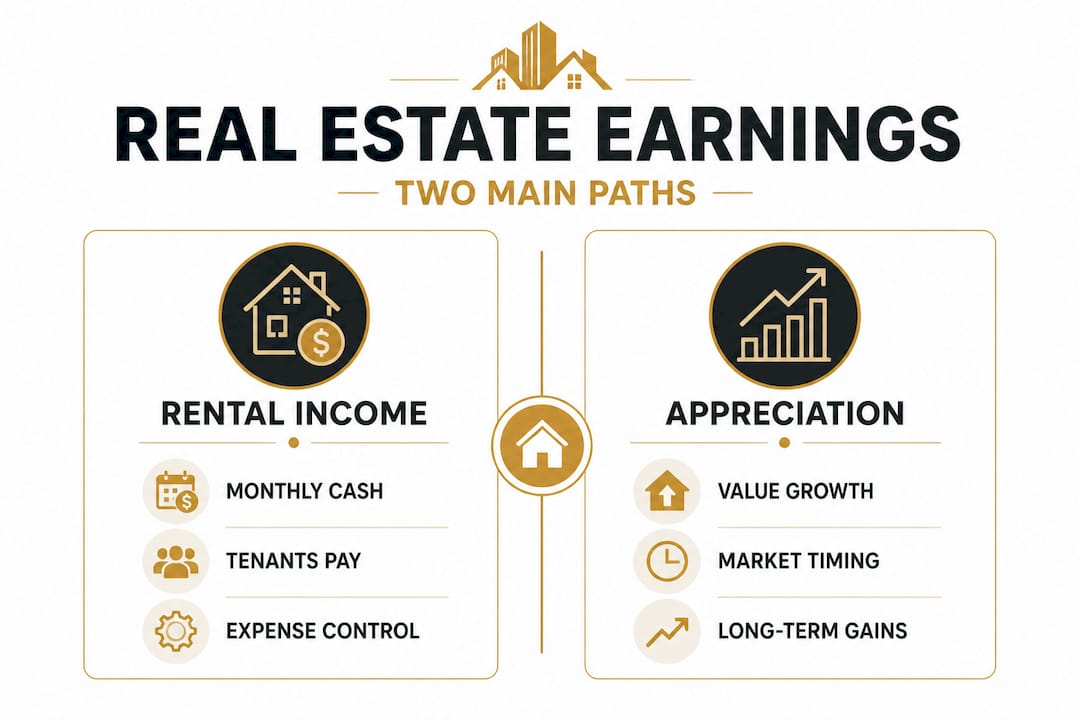
Real estate generates wealth in two main ways: rental income and appreciation. Understanding both is essential.
Rental income is what you collect each month from tenants, minus your expenses. Real estate earnings come from net rental income (after expenses) and appreciation, with the option to sell or refinance against your equity later.
Here is a simple cash flow example:
| Category | Monthly amount |
|---|---|
| Gross rent collected | $1,800 |
| Mortgage payment | $1,050 |
| Property taxes | $175 |
| Insurance | $75 |
| Maintenance reserve | $100 |
| Property management (if used) | $180 |
| Net monthly cash flow | $220 |
That $220 per month might not seem like much on one property. But with three or four properties running similar numbers, you're looking at $660 to $880 a month in passive income, and you're building equity at the same time.
Appreciation is the increase in your property's value over time. You can benefit from it in three ways:
- Sell the property and pocket the profit after paying off the remaining mortgage.
- Cash-out refinance to borrow against the increased equity and invest that capital in another deal.
- Hold and let equity build as a long-term wealth strategy for retirement or generational transfer.
Real estate income is not guaranteed. Budget for at least one month of vacancy per year and a 5-10% maintenance reserve. Properties that pencil out only in perfect conditions are too risky to pursue.
The investors who win in real estate are the ones who run conservative numbers, plan for unexpected costs, and stay patient. The income is real, but it takes discipline and preparation to keep it flowing.
Our take: The strategy most beginners overlook
Most beginners fixate on finding the perfect deal. They spend months analyzing properties and never pull the trigger. Here's what we've seen work consistently: start with education before action.
The biggest mistakes in real estate don't happen because someone chose the wrong loan or the wrong zip code. They happen because someone didn't know what they didn't know. An investor who buys a duplex without understanding tenant law, property management costs, or how refinancing works can lose everything on their first deal.
House hacking is often dismissed as too small or too slow. But it builds three skills simultaneously: property evaluation, tenant management, and cash flow analysis. Those three skills are the foundation of every other real estate strategy. Skipping them to jump into a large BRRRR project is like skipping fractions and jumping into calculus.
We also think the indirect route (REITs, crowdfunding) is undervalued as a learning tool. Yes, the returns are modest. But spending six months watching how real estate income moves, how dividends are calculated, and how markets affect property values trains your instincts. That background makes you a sharper investor when you do step into a direct deal.
The best move is usually the one you can actually execute with your current resources, not the one that sounds most impressive at a dinner table.
Ready to take your first real step?
This article gives you a clear picture of what's possible. But knowing the strategies and knowing how to execute them are two very different things. That's exactly where realestatecourse.net comes in.

For a one-time investment of just $19.99, you get instant access to a beginner-friendly course that covers everything in this article and more, with step-by-step modules, action checklists, and a personalized execution plan. No fluff. No theory overload. Just the practical training you need to go from curious to closing. Students have used these exact methods to start earning real estate income from scratch. If you're ready to stop reading and start doing, this is the next step.
Frequently asked questions
Can I invest in real estate with bad credit?
Yes, but bad credit limits your loan options significantly. Consider improving your score first, or start with REITs and crowdfunding platforms that don't require credit checks for access.
What is the lowest amount I need to get started?
You can start with as little as $10 through some real estate crowdfunding platforms and REIT funds. House hacking with an FHA loan requires 3.5% down, making it one of the most affordable hands-on entry points available.
Is house hacking legal everywhere?
House hacking is legal in most U.S. locations, but zoning rules, HOA restrictions, and local tenant laws vary widely. Always verify local regulations before you purchase a property with the intent to rent units.
How risky is real estate investing with little or no cash?
It carries more risk than investing with a large down payment because you have less equity cushion and higher financing costs. Research your local market and financing options thoroughly before committing to any strategy.