
Thousands of aspiring investors feel completely priced out of real estate. They assume you need a six-figure savings account, perfect credit, or a wealthy family member to get started. That belief stops most people before they ever take a single step. The truth is different. Proven strategies like house hacking, auction deals, and creative financing let you enter the market with far less than you think. This guide walks you through every step, from gathering your documents to managing your first property, so you can start building real wealth without waiting until you have "enough" money.
Table of Contents
- Getting started: Prerequisites and essential resources
- Finding affordable properties: Auctions, house hacking, and beyond
- Financing on a budget: Loans, partnerships, and creative solutions
- Managing property for maximum returns
- What most guides miss about building wealth on a tight budget
- Ready to take the next step? Learn and invest with expert guidance
- Frequently asked questions
Key Takeaways
| Point | Details |
|---|---|
| House hacking multiplies returns | House hacking can grow investor wealth five times faster than renting and reduces living costs by up to 60%. |
| Auctions offer affordable entry | Real estate auctions are a practical path to finding low-cost properties suitable for budget-conscious investors. |
| Creative financing is essential | Low down payment loans, partnerships, and crowdfunding can help you invest with minimal upfront cash. |
| Management affects success | Effective property management and tenant screening maximize income even in low-budget deals. |
| Start small, reinvest consistently | Consistent learning and reinvesting are more important than chasing cheap deals for long-term wealth. |
Getting started: Prerequisites and essential resources
Before you search for your first deal, you need to get organized. Think of this stage as building your foundation. Skip it, and you will waste time and miss opportunities.
Documents you need to gather first:
- Proof of income (pay stubs, tax returns, or bank statements)
- Government-issued photo ID
- Current credit report (you can pull this free at AnnualCreditReport.com)
- Proof of any existing assets, such as savings or retirement accounts
- Employment verification letter if you are salaried
Your credit score matters more than you think. A score above 580 qualifies you for FHA loans (Federal Housing Administration loans, which are government-backed mortgages designed for first-time buyers). A score above 620 opens even more doors. If your score needs work, spend 60 to 90 days paying down balances before applying.
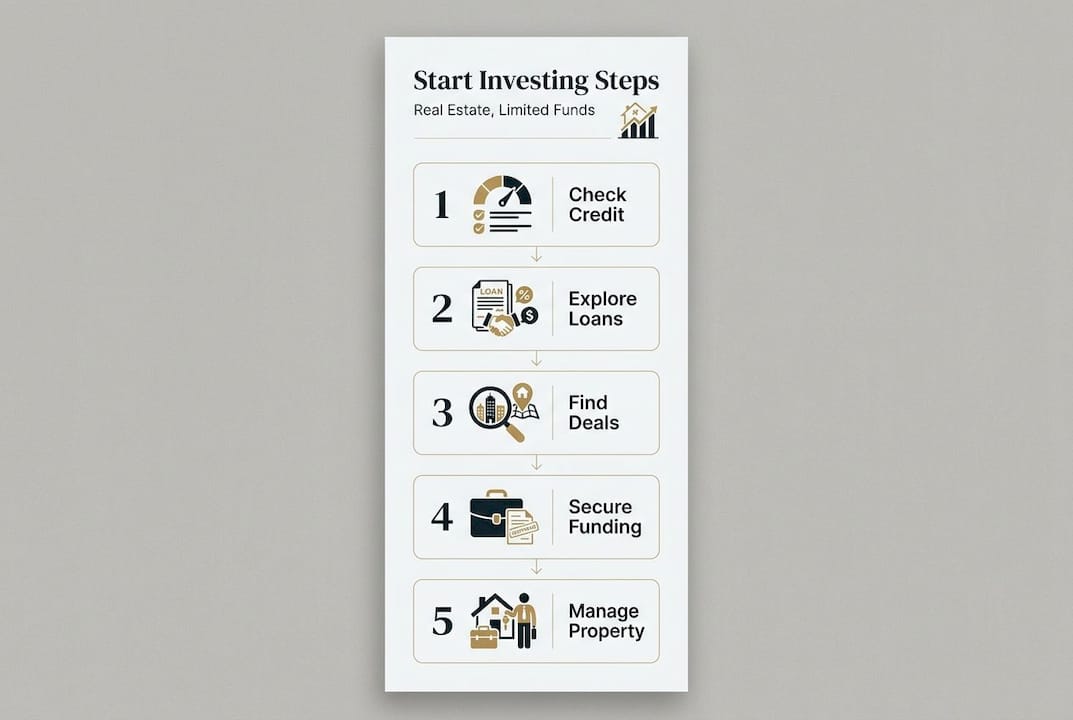
Mindset shift: Investor vs. renter
Most people rent because it feels safe. But house hacking builds 5x wealth over 10 years compared to renting, and it can reduce your housing costs by 40 to 60 percent. That is not a small difference. That is the difference between struggling and building real financial stability.
Here is a quick overview of entry-level strategies you will learn in this guide:
| Strategy | Minimum capital needed | Best for |
|---|---|---|
| House hacking | 3.5% down (FHA) | Beginners with steady income |
| Tax lien/auction deals | $500 to $5,000 | Investors willing to research |
| Partnerships | $0 to $5,000 | Those with skills but little cash |
| Seller financing | Varies, often low | Motivated sellers, flexible terms |
For first-time buyer tips that go beyond the basics, reviewing local market guides can sharpen your expectations before you make an offer.
Pro Tip: Government-backed FHA loans require as little as 3.5% down. On a $200,000 property, that is $7,000. Compare that to a conventional 20% down payment of $40,000. The gap is enormous, and FHA loans are specifically designed to help buyers like you.
You can also find cheap auction deals that require even less upfront capital, especially when you know what to look for. The auction blog insights on our platform break down exactly how these deals are structured and what to watch out for.
Now that you know the journey begins with preparation, let's explore concrete steps for finding affordable properties.
Finding affordable properties: Auctions, house hacking, and beyond
The biggest mistake beginners make is searching only on mainstream listing sites. The best deals rarely show up on Zillow first. You need to know where to look and how to act fast when you find something.
House hacking: The most beginner-friendly strategy
House hacking means buying a property, living in one unit, and renting out the remaining units to offset or eliminate your mortgage payment. A duplex, triplex, or even a single-family home with a basement apartment all work. According to 78% of investors surveyed by BiggerPockets, house hacking was their starting point. That is not a coincidence. It works because it reduces your personal living costs while building equity at the same time.
Step-by-step: How to find and secure your first deal
- Define your target area. Pick a neighborhood you know well. Familiarity reduces research time and helps you spot undervalued properties faster.
- Set a realistic budget. Use the table in the previous section to decide which strategy fits your current capital. Be honest with yourself.
- Search auction listings. County tax auctions, foreclosure auctions, and online platforms like Auction.com list properties well below market value. Check auction deal pricing to understand what realistic discounts look like.
- Drive for dollars. Physically drive through target neighborhoods and note properties that look vacant or neglected. These owners are often motivated sellers.
- Network at local real estate investor meetups. Many deals never hit public listings. They move between investors at meetups, on Facebook groups, and through word of mouth.
- Make offers quickly. Low-budget deals attract competition. If your research is solid, act. Hesitation costs deals.
- Inspect before you commit. Always get a property inspection, even at auction. Repair costs can erase your profit margin entirely.
For deeper insight into specific markets, the LA and OC investment tips guide covers how to evaluate deals in competitive urban areas, and the LA first-time buyer guide is useful if you are buying in a high-cost market.
Auctions vs. direct purchase: A quick comparison
| Factor | Auction | Direct purchase |
|---|---|---|
| Price | Often 10 to 40% below market | Market rate or negotiated |
| Speed | Fast, sometimes same day | 30 to 60 days typical |
| Inspection access | Limited or none | Full access |
| Competition | High | Moderate |
| Financing flexibility | Usually cash or hard money | Conventional or FHA |
Pro Tip: Focus on multi-unit properties or high-yield low-rent properties when house hacking. Single-family homes limit your rental income to one tenant. A duplex or triplex gives you two or three income streams from one purchase. The auction overview on our site shows you how to evaluate multi-unit auction deals step by step.
The budget training available on our platform walks you through how to analyze any deal before you commit, so you never overpay.
Once you've identified promising properties, it's time to secure funding and structure your investment.
Financing on a budget: Loans, partnerships, and creative solutions
Money is the number one reason people say they cannot invest. But there are more financing options available to low-budget investors than most people realize. You do not need to save for years before getting started.
Low down payment loan options:
- FHA loans: 3.5% down, credit score 580 or higher, available for 1 to 4 unit properties
- VA loans: 0% down for eligible veterans and active military, no private mortgage insurance required
- USDA loans: 0% down for properties in eligible rural areas, income limits apply
- Conventional 97 loans: 3% down for first-time buyers, offered through Fannie Mae and Freddie Mac
Each of these programs exists specifically to help buyers with limited cash. The key is knowing which one fits your situation and applying before you find a property, not after.
Creative financing options:
Real estate crowdfunding platforms let you invest in properties with as little as $10 to $500. You do not own the property outright, but you earn a share of the income and appreciation. It is a practical way to learn while your savings grow.

Peer-to-peer lending connects you with private lenders who offer more flexible terms than banks. These loans often close faster and require less documentation.
Partnering with friends or family is another real option. One person brings the capital, the other brings the time and management skills. A simple written agreement protects both parties and keeps the relationship intact.
Seller financing is one of the most underused tools in real estate. A motivated seller agrees to act as the bank, accepting monthly payments directly from you instead of requiring a bank loan. Terms are negotiable. Down payments can be as low as 5 to 10 percent, and interest rates are often lower than conventional loans.
Leverage is the real engine of real estate wealth. A 3% annual appreciation on a $300,000 property generates an 85% return on your initial capital when you put 10% down. You are earning returns on the full property value, not just your investment.
A buyer agent who specializes in working with first-time investors can help you navigate financing options and negotiate better terms. Their expertise often pays for itself.
Pro Tip: When approaching sellers about seller financing, focus on their situation, not just the price. A seller who needs to move quickly, avoid capital gains taxes, or generate monthly income is far more likely to agree to creative terms. Ask questions before making an offer.
The beginner real estate training on our platform includes a full module on financing strategies, walking you through each option with real examples and scripts you can use.
After financing is secured, attention turns to managing your property efficiently.
Managing property for maximum returns
Owning a rental property is not passive income from day one. Especially when you are starting with a low-budget property, hands-on management makes the difference between profit and loss.
Cost-effective management tactics:
- DIY maintenance: Learn basic plumbing, drywall repair, and appliance troubleshooting. YouTube tutorials can save you hundreds per repair call.
- Use free or low-cost property management tools: Apps like Cozy (now part of Apartments.com), TurboTenant, and Rentec Direct handle rent collection, maintenance requests, and lease management at low or no cost.
- Screen tenants thoroughly: Run credit checks, verify income (look for 3x monthly rent), check rental history, and call previous landlords. One bad tenant can cost you thousands.
- Offer small incentives for on-time payment: A $25 monthly discount for autopay enrollment dramatically reduces late payments and collection headaches.
- Build a local contractor network: Having two or three reliable, affordable contractors on call prevents emergencies from becoming expensive disasters.
Low-rent properties deliver the highest returns relative to purchase price, but they also come with higher tenant turnover and more maintenance demands. This is not a reason to avoid them. It is a reason to manage them proactively.
Handling vacancy and legal compliance:
Vacancy is your biggest cost. Every month a unit sits empty, you pay the full mortgage with no offset. Keep vacancy low by:
- Pricing rent competitively, not at the absolute maximum the market allows
- Responding to maintenance requests within 24 hours
- Offering lease renewal incentives to good tenants
- Marketing units 30 to 45 days before current leases expire
Legal compliance varies by state and city. Research local landlord-tenant laws before you rent. Violations can result in fines, lawsuits, or forced lease terminations. The property management guide covers key compliance considerations for investors in California markets.
For ongoing management tips specific to low-budget investors, our blog publishes practical, no-fluff guidance you can apply immediately.
With these strategies for managing your property, let's zoom out and see how to measure your success and refine your process.
What most guides miss about building wealth on a tight budget
Here is the uncomfortable truth that most real estate content skips: the deal itself is rarely what makes you wealthy. The management after the deal is what separates investors who build lasting wealth from those who break even or lose money.
Most beginners obsess over finding the cheapest possible property. They spend months searching for a deal that is 20% below market when a property at 10% below market, managed well, would outperform it over five years. Disciplined management, consistent reinvestment, and learning from small mistakes early on matter far more than the entry price.
Most real estate wealth is built through compounding, not through a single great deal. Every dollar of equity you build gets reinvested into the next property, and the one after that. The investors who win are the ones who stay consistent, not the ones who find one perfect deal.
The other thing most guides miss is the cost of inaction. Every year you wait, property values tend to rise, rents increase, and the barrier to entry grows. A property that costs $200,000 today may cost $220,000 in two years. The "I'll wait until I have more money" approach often guarantees you never start.
Explore house hacking strategies that real investors have used to get started with limited capital and scale from there. The pattern is always the same: start small, manage well, reinvest, and repeat.
The investors who build real wealth are not the ones who found the most spectacular deals. They are the ones who took consistent, disciplined action and kept learning along the way.
Ready to take the next step? Learn and invest with expert guidance
You now have a clear picture of how low-budget real estate investing works. The strategies are real. The results are achievable. What separates people who act from people who stay stuck is having the right support and structure to follow through.

At realestatecourse.net, we built a beginner-friendly training program specifically for people in your position. For a one-time investment of just $19.99, you get instant access to step-by-step modules, action checklists, and a personalized execution plan. You will learn how to find deals, finance them on a budget, and manage them for real returns. You can also browse auction deals and pricing to see real opportunities available right now. No fluff. No theory. Just practical methods that work.
Frequently asked questions
What is house hacking and how does it work for low-budget investors?
House hacking means buying a property, living in part of it, and renting out other units to cover costs or generate profit. Research shows it builds 5x the wealth of renting over 10 years while cutting housing costs by 40 to 60 percent.
What are the risks of investing in low-budget real estate?
The main risks are higher tenant turnover, more frequent maintenance, and hands-on management demands. Low-rent properties deliver strong returns but require active oversight to stay profitable.
How much initial capital is needed to start investing in real estate?
With FHA loans and creative funding strategies, you can start with as little as 3 to 3.5% down, which means $6,000 to $7,000 on a $200,000 property.
How can investors find cheap real estate deals?
Auction listings, local investor meetups, driving for dollars, and house hacking are the top methods. According to BiggerPockets, 78% of investors used one of these approaches to find their first deal.
Can you build long-term wealth with low-budget real estate?
Absolutely. Over 10 years, house hacking and leverage can grow your wealth up to five times faster than renting, especially when you reinvest equity consistently into additional properties.