
Getting your first real estate leads feels overwhelming when you have no track record, no big budget, and no idea where to start. You are not alone in this. Most new agents struggle with the same problem: they know they need leads, but they do not know how to get them without spending a fortune. The good news is that lead generation works best as a repeatable system rather than a single tactic. This guide breaks down exactly what you need, step by step, to build a steady flow of leads starting today, with little or no money upfront.
Table of Contents
- What you need to start generating leads
- Step-by-step system for generating your first leads
- Mastering follow-up: The secret to turning leads into clients
- Common mistakes and how to avoid them
- Tracking and verifying your results
- What most new agents get wrong about real estate lead generation
- Take your lead generation to the next level
- Frequently asked questions
Key Takeaways
| Point | Details |
|---|---|
| Start with your SOI | Your existing connections are the easiest and cheapest place to find your first leads. |
| Use a repeatable system | Choose one method and show up consistently for the best results. |
| Follow up fast | Responding within minutes is critical for converting new leads. |
| Track your progress | Measure contacts, follow-ups, and results every week to see what works. |
| Avoid scattershot efforts | Picking one method and refining it will outperform bouncing between tactics. |
What you need to start generating leads
Now that you understand the importance of a system, let's look at exactly what you need to get started. No fancy tools or big budget required.
The barrier to entry for lead generation is much lower than most new agents think. You do not need a premium CRM subscription, a paid advertising account, or a flashy website. What you do need is a clear starting point and the discipline to show up consistently.
Here are the core requirements to begin:
- A sphere of influence (SOI) list. This is simply a list of people who already know you. Friends, family, neighbors, former coworkers, church members, anyone you have a real relationship with. Aim for at least 50 to 100 names to start.
- A commitment to follow-up. The biggest mistake new agents make is reaching out once and then going silent. Consistent follow-up is where the real results happen.
- A simple tracking system. This does not have to be expensive software. A basic Google Sheet or free spreadsheet works perfectly well to track your contacts and outreach history.
- A willingness to add value first. Every interaction should lead with something useful, a market update, a neighborhood tip, or a helpful article. Not a sales pitch.
Here is a simple comparison of what you need versus what you think you need:
| What you think you need | What you actually need |
|---|---|
| Paid lead portal subscription | SOI list of 50 to 100 contacts |
| Professional website | A free Google Sheet to track follow-ups |
| Large advertising budget | Consistent weekly outreach routine |
| Years of experience | Willingness to learn and show up |
| Expensive CRM software | Basic spreadsheet or free CRM tool |
Starting small in real estate is not a weakness. It is smart strategy. The agents who build lasting careers are the ones who master the basics before adding complexity.
A beginner-friendly way to start with a low or no budget is to leverage your sphere of influence with a structured outreach approach. This method costs nothing but your time, and it consistently outperforms cold paid leads for new agents.

Understanding how real estate generates income from the start also helps you focus your lead generation on the activities that actually lead to commissions, not just busywork.
Pro Tip: The size of your SOI list matters far less than how often and how genuinely you reach out. A list of 60 people you contact regularly beats a list of 500 people you ignore.
Step-by-step system for generating your first leads
Once you have the basics in place, here is a proven system you can follow immediately, even as a complete beginner.
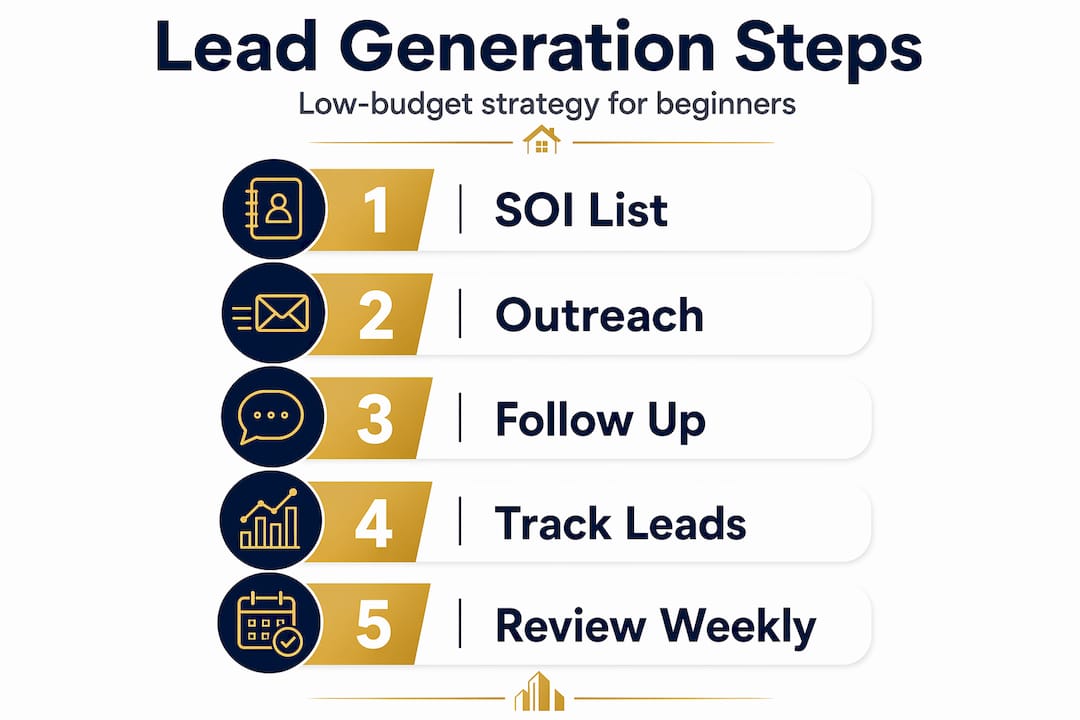
The key is to pick one primary lead channel and commit to it. Trying to do everything at once leads to burnout and zero results. Beginners should pick one lead source to build consistently, whether that is referrals, networking, or open houses, before adding more channels.
Here is the system broken down into clear steps:
-
Build your SOI list. Write down everyone you know. Include names, phone numbers, email addresses, and how you know them. Aim for 100 to 200 people. Do not overthink who belongs on the list. If you know them, they go on it.
-
Set a weekly outreach schedule. Contact five to ten people from your list every week. Rotate through the list so everyone hears from you every few months. Keep it friendly and personal, not scripted or robotic.
-
Start with check-in conversations. Your first message should not mention real estate at all. Ask how they are doing. Reference something specific to them. Build the relationship before you ever bring up your work.
-
Mention your business naturally. After a genuine conversation, it is completely natural to say something like, "By the way, I am working in real estate now. If you ever hear of anyone looking to buy or sell, I would really appreciate the referral."
-
Host or support open houses. Volunteer to host open houses for other agents if you do not have your own listings yet. Collect every sign-in sheet. Follow up with every single attendee within 24 hours.
-
Try neighborhood farming. Pick one neighborhood and become the local expert. Send a monthly email or postcard with real market data, recent sales, and helpful tips. Consistency over months builds serious name recognition.
-
Track every action. Log every call, text, email, and conversation in your spreadsheet. Note what stage each person is at and when to follow up next.
Building essential real estate habits early in your career sets the foundation for everything that follows. And real estate networking is one of the highest-return activities a new agent can do, especially when it costs nothing.
Here is a quick comparison of the most common beginner lead channels:
| Lead channel | Cost | Time to first lead | Scalability |
|---|---|---|---|
| SOI outreach | Free | 1 to 4 weeks | Medium |
| Open houses | Free | Same day | High |
| Neighborhood farming | Low | 3 to 6 months | Very high |
| Paid lead portals | $100 to $500/month | 1 to 2 weeks | High (if followed up) |
| Social media content | Free | 1 to 3 months | High |
The data backs this up. NAR data shows that 43% of buyers and 66% of sellers found their agent through referrals or past relationships. That is a massive portion of the market that costs you nothing to access.
Pro Tip: When reaching out to your SOI, use a simple talk track like this: "Hey [Name], just checking in. How is everything going with you?" That is it. Keep it human. The goal is a conversation, not a pitch.
Mastering follow-up: The secret to turning leads into clients
Generating leads is just the start. Here is how to make sure your effort actually pays off by mastering the crucial follow-up.
Most new agents follow up once or twice and then give up. This is one of the costliest mistakes in real estate. Studies consistently show that the majority of deals close after the fifth or sixth touchpoint, yet most agents stop after one or two.
Speed to lead is one of the biggest levers in converting inquiries into actual clients. When someone fills out a form or sends a message, your response time determines whether you get the business. Responding within five minutes of an inquiry dramatically increases your conversion rate compared to waiting even one hour.
Here is a practical follow-up routine to build into your week:
- Block two 30-minute sessions per week specifically for follow-up calls and texts. Treat these like appointments you cannot cancel.
- Respond to new inquiries within five minutes whenever possible. If you cannot call right away, send a quick text to acknowledge the message.
- Use a simple script for calls: "Hi [Name], this is [Your Name] from [Brokerage]. I saw you were looking at the property on [Street]. I would love to answer any questions. Do you have two minutes?"
- Follow up at least three to five times before moving a lead to your long-term nurture list. Most people are just busy, not uninterested.
- Track every follow-up attempt in your CRM or spreadsheet. Note the date, method, and outcome so you never lose track of where you stand.
"The agents who win are not the ones who get the most leads. They are the ones who follow up the fastest and the most persistently." This is a principle backed by NAR's own guidance on converting online leads: respond quickly, use brief and friendly talk tracks, and attempt contact multiple times on the same day.
Developing essential real estate skills like active listening, clear communication, and organized follow-up separates agents who build income from those who struggle for years without results.
Pro Tip: When leaving a voicemail, keep it under 20 seconds. Mention the specific property or reason for calling. People respond when they feel you are relevant to their situation, not when they feel like one of 100 cold calls.
Common mistakes and how to avoid them
To avoid wasted effort and frustration, let's cover what NOT to do as a new agent aiming to build a lead pipeline.
New agents tend to make the same predictable mistakes. Knowing them upfront saves you months of spinning your wheels.
- Jumping between lead channels. Trying five different methods at once means you never get good at any of them. Choosing one channel to start builds the consistency and measurable results you need early on.
- Failing to follow up quickly. Online lead generation without tight follow-up consistently underperforms. Treat speed to lead and same-day multi-attempt follow-up as non-negotiable habits, not optional extras.
- Being too salesy with your SOI. Nobody wants to feel like they are being sold to by a friend. Lead with value, ask genuine questions, and let your business come up naturally. Pushing too hard drives people away.
- Ignoring offline methods. Open houses, neighborhood farming, and in-person networking still work incredibly well. Many new agents focus entirely on digital methods and miss a huge portion of the market.
- Overspending on paid portals too soon. Buying leads before you have a solid follow-up system in place is like pouring water into a bucket full of holes. You will spend money and see little return. Master the basics first.
- Not tracking anything. If you are not measuring your outreach, appointments, and conversions, you have no idea what is working. Even a simple spreadsheet gives you the data you need to improve.
Understanding the benefits of real estate investing for beginners helps you stay motivated and focused on the right goals, especially when the early stages feel slow.
Tracking and verifying your results
Execution is not enough. Here is how to measure progress so that you keep getting better and avoid spinning your wheels.
You cannot improve what you do not measure. Tracking your lead generation activities every week gives you a clear picture of what is working and what needs to change. A practical weekly routine includes dedicated time for lead follow-up, building local visibility, and reviewing open-house results.
Here is a simple lead tracking table you can copy right now:
| Activity | Weekly goal | Actual completed | Notes |
|---|---|---|---|
| SOI outreach contacts | 8 | ||
| New leads added to list | 3 | ||
| Follow-up calls or texts | 15 | ||
| Open house attendees contacted | All | ||
| Appointments booked | 1 to 2 | ||
| Conversions (signed clients) | 1 |
Key metrics to monitor every week:
- Contacts made: How many people did you actually reach out to?
- Leads generated: How many new prospects entered your pipeline?
- Response rate: What percentage of your outreach got a response?
- Appointments set: How many actual conversations led to a meeting?
- Conversions: How many leads became signed buyers or sellers?
Learning how to make money in real estate with little capital is directly tied to how disciplined you are about tracking these activities. The numbers tell you the truth, even when your gut says otherwise.
Pro Tip: At the end of each week, spend 10 minutes reviewing your numbers. Ask yourself: What worked? What did not? What will I do differently next week? This simple habit compounds into serious improvement over time.
What most new agents get wrong about real estate lead generation
Having shown you how to set up and track your results, here is our candid take on what truly sets successful beginners apart.
Most new agents believe that success in real estate comes from having access to better tools, bigger budgets, or more advanced technology. This is flat out wrong. The agents who build lasting income in their first year are almost always the ones who master something much simpler: showing up consistently for the people who already know them.
Paid portals and advanced CRMs are not bad. They can absolutely accelerate results. But here is the uncomfortable truth: technology and paid leads only amplify what you already do well. If your follow-up is weak and your relationship skills are underdeveloped, spending money on leads just means you fail faster and more expensively.
The most productive agents we have seen spend the majority of their time listening to their SOI and genuinely serving people, not chasing cold leads or jumping between shiny new tools. They ask good questions. They remember details. They send relevant information without being asked. This is not glamorous. But it works at a level that no paid portal can replicate in your first year.
The contrarian reality is this: the simplest system, executed consistently, beats the most sophisticated system executed poorly. Starting small in real estate and building repeatable habits is not a consolation strategy for people without money. It is the actual fastest path to real, sustainable income.
Stop waiting until you have a bigger budget or more experience. Start with the 50 people who already trust you. Build the habit of reaching out. Track what happens. Adjust and improve. That is the entire game.
Take your lead generation to the next level
You now have a clear, actionable framework for generating your first real estate leads on a minimal budget. The next step is going deeper, with structured training that walks you through every module from fundamentals to finding deals and closing them.

At Real Estate Course, you get beginner-focused, step-by-step training built specifically for people starting with little experience or capital. For a one-time investment of just $19.99, you get instant access to all course materials, interactive lessons, action checklists, and a personalized execution plan. No fluff. No guesswork. Just practical methods that move you toward real income. If you are serious about building a real estate career or side income, this is the clearest path forward.
Frequently asked questions
What is the cheapest way for a new agent to get leads?
Leverage your sphere of influence with a structured outreach approach. Genuine check-ins with people who already know you cost nothing and consistently produce warm, high-quality leads.
How fast should I respond to a new real estate lead?
Aim to respond within five minutes of receiving an inquiry. Speed to lead is one of the biggest factors in whether a potential client chooses you or the next agent they contact.
Does hosting open houses really generate buyer and seller leads?
Yes, open houses are one of the most effective free tools available to new agents. Open houses generate leads for both buyers and sellers when you collect contact info from every attendee and follow up quickly afterward.
How do I know if my lead generation methods are working?
Track your outreach, appointments, and conversions in a simple spreadsheet every week. A practical weekly routine that includes reviewing your numbers tells you exactly which activities are producing results and which ones need to change.
Should I buy online leads as a beginner?
Focus on SOI, referrals, and relationship-based methods first. Organic channels deliver higher early ROI for beginners, and paid lead platforms work best after you already have a strong follow-up system in place.