
Real estate has a reputation for being a rich person's game. But that reputation is wrong. You don't need a large down payment, a fancy degree, or years of experience to start earning income through property. Millions of everyday people generate real, recurring income from real estate every year using practical, proven methods. This guide walks you through exactly how real estate produces income, which strategies work best for beginners, and how you can take your first steps even if your budget is tight.
Table of Contents
- Understanding the basics: How real estate income works
- Common ways to earn: Rental, flips, and more
- Access for beginners: Starting with limited capital
- Building momentum: Reinvesting and scaling income
- Our perspective: What most beginner investors miss about real estate income
- Next steps: Unlocking real estate income with expert guidance
- Frequently asked questions
Key Takeaways
| Point | Details |
|---|---|
| Multiple income streams | Real estate can generate income through rents, appreciation, and creative deals. |
| Low-capital entry points | You don’t need lots of money to start; strategies exist for beginners with limited funds. |
| Momentum through reinvestment | Reinvesting earnings and leveraging habits help scale your real estate income faster. |
| Mindset is critical | Success in real estate comes from consistent action and strong habits, not just capital. |
Understanding the basics: How real estate income works
Now that you know what's possible, let's break down the basic ways real estate produces cash flow.
Real estate generates income through rental payments, appreciation, and equity. These three sources work independently or together, and understanding each one gives you a clear picture of why real estate is such a powerful wealth-building tool.

Rental income is the most straightforward. You own a property, someone pays you monthly rent, and after expenses you keep the difference. That leftover amount is called cash flow. Even a single rental unit generating $200 to $400 per month in positive cash flow adds up to $2,400 to $4,800 per year in passive income.
Appreciation means your property grows in value over time. Historically, U.S. real estate values increase roughly 3% to 5% per year on average, though some markets outperform significantly. You don't realize this gain until you sell, but it builds your net worth steadily in the background.
Equity is the portion of the property you actually own outright. Every mortgage payment you receive from a tenant chips away at your loan balance, increasing your equity. Over time, you can pull that equity out through refinancing and use it to fund your next investment.
Here's a simple breakdown of the three income types:
| Income type | How it works | When you benefit |
|---|---|---|
| Rental income | Monthly rent minus expenses | Every month |
| Appreciation | Property value increases over time | When you sell or refinance |
| Equity build | Mortgage paydown reduces your debt | Ongoing, accessed later |
The benefits for beginners are especially compelling because even a small property, a single-family home or a duplex, can tap into all three income types at once. You're not just collecting rent. You're building long-term wealth on multiple fronts simultaneously.
Key takeaways from this section:
- Rental income creates monthly cash flow you can reinvest or spend
- Appreciation builds your net worth passively without any extra effort
- Equity becomes a financial asset you can access when the time is right
- Even small investments can activate all three income streams at once
Common ways to earn: Rental, flips, and more
With the basics in mind, let's look at the most accessible methods aspiring investors can use to generate income.
You can earn income through rental properties, flipping homes, wholesaling, and more. Each approach has its own risk level, time commitment, and startup cost. Knowing your options helps you pick the right starting point.
Here are the four most common income strategies ranked from lowest to highest capital requirement:
-
Wholesaling. You find a distressed property, get it under contract at a low price, and then sell that contract to another buyer for a fee. You never actually buy the property. A typical wholesale fee ranges from $3,000 to $15,000 per deal. This is the lowest barrier to entry in real estate because you need very little money upfront.
-
House hacking. You buy a small multifamily property (like a duplex or triplex), live in one unit, and rent out the others. Your tenants essentially pay your mortgage. This is one of the smartest beginner moves in real estate because you're living for free or close to it while building equity.
-
Fix and flip. You buy a property below market value, renovate it, and sell it for a profit. This strategy requires more capital and carries more risk, but the rewards can be significant. A well-executed flip can return $20,000 to $50,000 or more in profit in just a few months.
-
Buy and hold rentals. You purchase a property and rent it out for the long term. This builds passive income month after month. It requires the most upfront capital but also delivers the most consistent, predictable returns over time.
| Strategy | Capital needed | Time to income | Risk level |
|---|---|---|---|
| Wholesaling | Very low | Fast (weeks) | Low to medium |
| House hacking | Low to medium | Immediate | Low |
| Fix and flip | Medium to high | Months | Medium to high |
| Buy and hold rental | Medium to high | Ongoing monthly | Low to medium |
Building networking for real estate income is also critical at this stage. Many deals never hit the public market. They get passed between investors through relationships. The sooner you start building connections with other investors, agents, and wholesalers, the sooner you start hearing about deals that others miss.
Pro Tip: Start with wholesaling or house hacking if your budget is tight. Both strategies let you learn the market, build connections, and generate income without large upfront costs. Once you've built cash reserves, you can move into fix-and-flip or buy-and-hold investments.
Understanding habits that build income fast matters here too. Investors who generate consistent income aren't just lucky. They follow daily routines that keep them learning, networking, and taking action on deals.
Access for beginners: Starting with limited capital
Understanding these options is important, but here's how you can get started even if your resources are limited.
You can begin investing in real estate with little or no money through strategies such as house hacking, teaming up, and creative financing. The capital barrier is much lower than most people think. Let's walk through the most practical approaches.
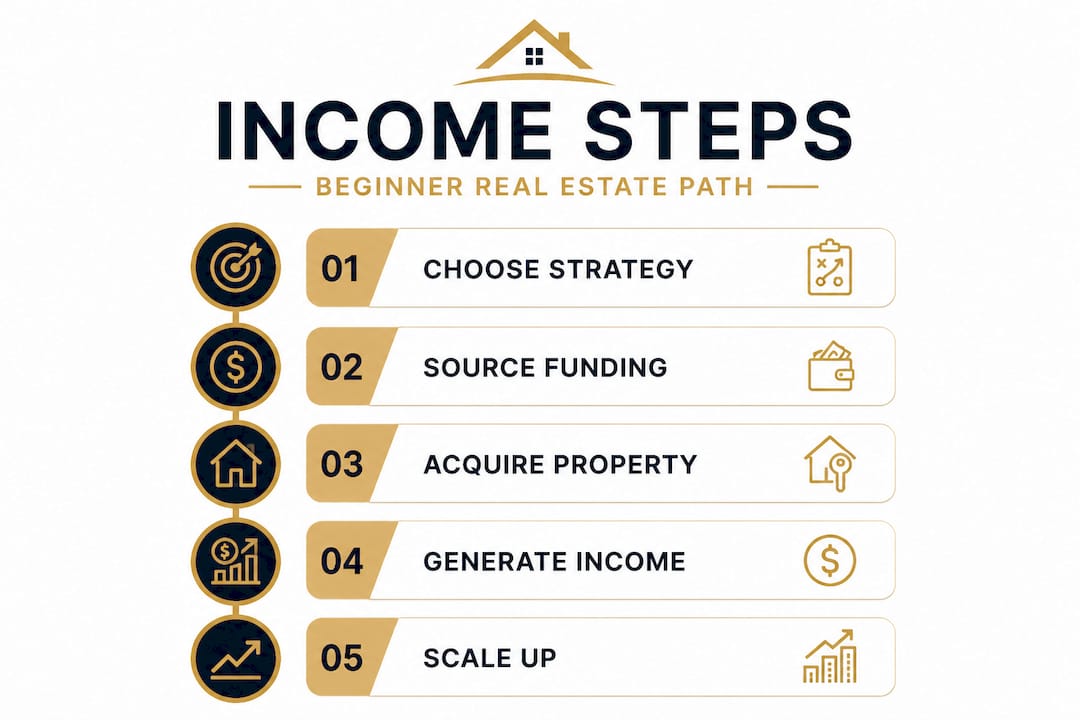
House hacking in detail. Find a duplex, triplex, or small apartment building. Use an FHA loan (which requires as little as 3.5% down) to purchase it. Move into one unit and rent the others. If you buy a triplex and each unit rents for $900, that's $1,800 per month from your two tenants. If your total mortgage payment is $1,600, you're actually pocketing $200 per month while living rent-free. That's a powerful starting position.
Joint ventures and partnerships. You don't have to invest alone. Find a partner who has capital but lacks the time or knowledge to find and manage deals. You bring the hustle and know-how. They bring the money. Split the profits. This structure is used by beginner and experienced investors alike. It's completely legal and extremely common.
Creative financing. This includes seller financing (where the property owner acts as the bank and you pay them directly), subject-to deals (where you take over an existing mortgage without formally refinancing), and lease options (where you lease a property with the right to buy it later). These tools let you control real estate without needing a large traditional down payment.
Distressed properties and auctions. Properties sold at foreclosure auctions, tax sales, or through motivated sellers often go for well below market value. These deals require quick action and some research, but they're one of the best ways to acquire property at a discount, especially for beginners with limited funds.
"The biggest myth in real estate is that you need money to make money. The truth is, you need knowledge, action, and resourcefulness. The money follows."
Here's a practical checklist to invest with limited funds:
- Research FHA and USDA loan programs that allow low down payments for owner-occupants
- Attend local real estate meetups to find potential partners and mentors
- Learn to identify distressed properties through tax records, driving neighborhoods, and online tools
- Study seller financing basics so you can negotiate deals outside traditional bank loans
- Start building your credit score now even if you're not ready to buy yet, since better credit means better loan terms later
Pro Tip: Your first deal doesn't need to be perfect. It just needs to be profitable. Many successful investors closed their first deal on a property that needed work, in a neighborhood they drove past every day, using a partner's money. Getting started beats waiting for the perfect deal every single time.
Building momentum: Reinvesting and scaling income
Once you've started, it's crucial to focus on how to turn that initial success into ongoing, increasing income.
Recurring income is possible through reinvestment, consistent habits, and smart networking. Your first deal teaches you the process. Your second deal becomes faster and easier. By your fifth deal, you have systems that work without you having to reinvent the wheel each time.
Here's how to build momentum step by step:
-
Reinvest your profits. When your first rental generates $300 per month in cash flow, don't spend it all. Set it aside and let it accumulate. Within 12 months you could have $3,600 toward your next deal's closing costs or down payment.
-
Build daily habits. Spend 30 minutes each day looking at listings, researching neighborhoods, or making calls. Consistent daily action compounds just like money does. Investors who study the market daily spot opportunities faster than those who check in occasionally.
-
Leverage relationships. Your network determines your deal flow. Every agent, investor, contractor, and lender you build a relationship with is a potential source of deals, funding, or advice. Stay active in local real estate groups, both in person and online.
-
Track your numbers. Know your income, expenses, cash flow, and equity for every property. This keeps you honest about performance and tells you when it's time to sell, refinance, or buy more.
-
Adapt based on data. If one strategy isn't working in your current market, pivot. The best investors are flexible. If wholesaling slows down, pivot to rental arbitrage or short-term rentals.
Here's a practical timeline for a beginner building real estate income over 24 months:
| Month | Focus area | Expected outcome |
|---|---|---|
| 1 to 3 | Education and market research | Deep understanding of local market |
| 4 to 6 | Networking and deal hunting | First wholesale or house hack deal |
| 7 to 12 | Managing first deal and reinvesting | Early cash flow, growing network |
| 13 to 18 | Second deal and system building | Multiple income streams beginning |
| 19 to 24 | Scale and optimize | Consistent monthly cash flow |
Building fast income habits and consistently using networking tips throughout this timeline means you're not just growing your portfolio. You're building a repeatable system that runs more smoothly over time.
Our perspective: What most beginner investors miss about real estate income
Most beginner content focuses on tactics: which strategy to use, which market to pick, which loan to get. That stuff matters. But in our experience, it's not what separates investors who succeed from those who quit after their first roadblock.
Many beginners overlook the importance of habits and mindset in building sustainable real estate income. Here's what we've seen over and over again: two people learn the exact same wholesaling strategy. One closes three deals in their first six months. The other closes zero. The difference isn't luck. It's consistency, follow-through, and the willingness to make 20 phone calls when the first 19 say no.
Real estate income is not passive in the beginning. It becomes more passive over time as you build systems and hire help. But in the early stages, it rewards the people who show up every single day, even when nothing seems to be happening.
Another overlooked truth: your network is your real unfair advantage. Most deals don't come from the MLS (Multiple Listing Service). They come from the investor you met at a meetup six months ago, the wholesaler who texted you because you stayed in touch, or the agent who called you first because you built a real relationship. This is why low risk for beginners is actually a reality when you're educated and well-connected. Knowledge and relationships reduce risk far more than any amount of capital does.
Stop waiting until you have more money, more time, or more confidence. The investors making money right now started before they felt ready. They learned on the job. They made mistakes and kept going. That's the real formula.
Next steps: Unlocking real estate income with expert guidance
With a clearer view of how real estate income works, here's how you can take your next steps more confidently.
The knowledge in this article gives you a strong foundation. But knowing what to do and knowing exactly how to do it in your specific market are two different things. That's why structured, step-by-step training makes such a big difference for beginners.

At Real Estate Course, we've built a beginner-friendly program designed specifically for people who want real income from real estate without needing a large budget. The course walks you through finding deals, evaluating properties, executing strategies, and building repeatable systems for $19.99, one time, with instant access. You also get action checklists and an execution plan tailored to your situation. If you're ready to find cheap deals and start building income step by step, this is the most direct path forward.
Frequently asked questions
Can I make money in real estate with little capital?
Yes, you can use strategies like house hacking, partnerships, and creative financing to start earning income in real estate with minimal upfront investment. As outlined in real estate with limited funds, the money barrier is lower than most beginners expect.
What is the fastest way to generate real estate income?
Wholesaling, short-term rentals, and fix-and-flip strategies often produce faster income than traditional rental properties, though each requires specific skills. Rental and flipping income depends heavily on how quickly you can find, evaluate, and close deals.
How risky is starting in real estate as a beginner?
Real estate is considered lower risk compared to other investments for beginners when approached with proper education and strategy. Real estate is low risk for beginners who take time to learn before they buy.
Do I need a license to invest in real estate?
No, a license is not required to purchase property for investment, but certain activities like brokering deals on behalf of others may require state licensing.