
Most people assume real estate is a game for the already-wealthy. That's simply not true. Median homeowner equity grows from around $180,000 in years one through five to $340,000 in years six through ten, and that's just from holding one property. You don't need a massive down payment or a finance degree to benefit from this. You just need the right strategies and a clear picture of how the numbers actually work. This article breaks down the mechanics of real estate wealth, compares it to other investments, walks you through proven methods, and shows you how to avoid the traps that trip up beginners.
Table of Contents
- The real estate wealth-building engine: How it actually works
- Real estate vs other investments: Returns, risks, and what the numbers show
- Key strategies for building wealth: From homeownership to BRRRR
- Pitfalls and risks: What every new investor needs to know
- The overlooked truth: Why consistency beats big bets in real estate
- Get started: Take your first step toward building wealth
- Frequently asked questions
Key Takeaways
| Point | Details |
|---|---|
| Multiple wealth engines | Real estate builds wealth through appreciation, rental income, equity, and leveraging other people’s money. |
| Consistent investing wins | Long-term buy-and-hold strategies and reinvesting cash flow reliably compound wealth over decades. |
| Start small, scale smart | Strategies like BRRRR and buying low allow newcomers with limited funds to get started and grow. |
| Be risk-aware | Understanding and managing leverage, legal, and market risks is crucial to lasting success. |
The real estate wealth-building engine: How it actually works
Now that you know building wealth with real estate is possible for everyday investors, let's explore the mechanics behind how this asset creates lasting value.
Real estate builds wealth through four distinct channels working at the same time. Understanding each one helps you make smarter decisions from day one.
1. Appreciation Appreciation means your property increases in value over time. Markets rise and fall in the short term, but the long-term trend has historically moved upward. A house purchased for $200,000 today could be worth $280,000 or more in ten years, depending on the market. You don't have to do anything except hold the property for that gain to accumulate.
2. Rental income If you rent out your property, tenants pay your mortgage and expenses. What's left after costs is called cash flow. Even modest cash flow of $200 to $400 per month adds up to thousands of dollars annually, all while your property appreciates.
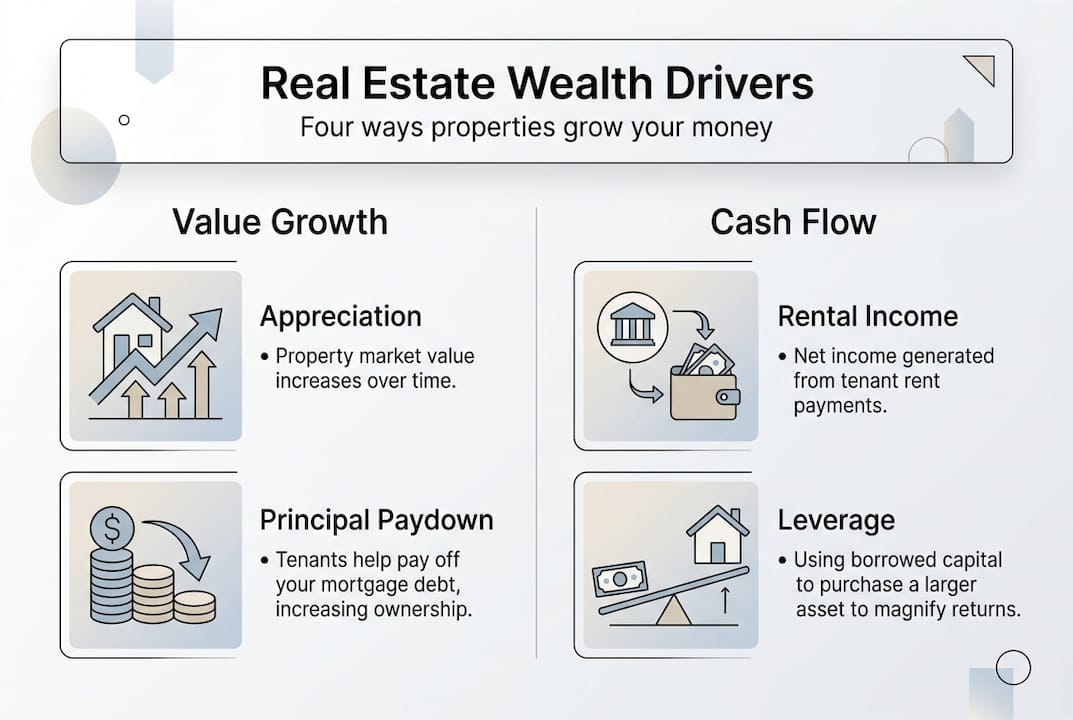
3. Principal paydown Every mortgage payment you make (or that your tenant effectively makes for you) reduces your loan balance. This increases your equity. Equity is the portion of the property's value that you actually own outright. The longer you hold, the more equity you accumulate.
4. Leverage Leverage means using borrowed money to control a larger asset. With a 20% down payment on a $200,000 property, you control $200,000 in real estate using just $40,000 of your own money. If the property rises 10% in value to $220,000, you've made $20,000 on a $40,000 investment. That's a 50% return, not 10%.
| Wealth driver | How it works | Timeline |
|---|---|---|
| Appreciation | Property value rises over time | Long term (5+ years) |
| Rental income | Tenants cover costs and generate surplus | Immediate to short term |
| Principal paydown | Loan balance shrinks with each payment | Ongoing |
| Leverage | Small capital controls large assets | Multiplied throughout |
Research consistently shows that long-term holding beats speculation, with rental yields historically outpacing capital gains across most global markets. Keeping a property for years rather than flipping it quickly is usually the smarter play.

Why? Because the power of these four drivers multiplies when they work together. You're not just waiting for appreciation. You're collecting cash flow, building equity, and growing your overall net worth simultaneously.
The key insight that many beginners miss is that owning a home long-term changes the math completely. Short-term thinking cuts off the compounding before it really kicks in.
If you want to learn how to find properties that maximize these drivers, exploring real estate auction tips is a practical place to start. Below-market deals amplify every one of these wealth channels from the very first day.
Pro Tip: Use the equity snowball. When your property builds enough equity, refinance or sell and reinvest those gains into the next property. Each cycle grows your portfolio faster than starting from scratch.
Real estate vs other investments: Returns, risks, and what the numbers show
Understanding the mechanics is key, but how does real estate truly measure up to other ways to build wealth? Let's see what the long-term data reveals.
Investors today have more options than ever. Stocks, REITs, index funds, and direct real estate all compete for your capital. Knowing how they compare prevents you from chasing the wrong vehicle for your goals.
Side-by-side performance
US residential real estate has delivered roughly 5% real annual returns from 2000 to 2025 in many markets. The S&P 500 has posted similar real returns over the same period. REITs (Real Estate Investment Trusts, which are companies that own real estate and trade like stocks) have historically delivered around 11% annually from 1972 through 2024, before factoring in fees and taxes.
| Investment type | Avg annual return | Volatility | Minimum entry |
|---|---|---|---|
| Direct real estate | ~5% real | Low to medium | $5,000+ (FHA) |
| S&P 500 index fund | ~5% real | Medium to high | $1+ |
| REITs | ~11% nominal | Medium | $1+ |
| Rental property (leveraged) | 15%+ on equity | Medium | $10,000+ |
The table tells part of the story. But raw returns don't capture everything.
Why real estate stands apart
- Leverage amplifies your effective return. A 5% gain on a property worth $200,000 produces a much higher return on your actual invested capital.
- Tax benefits reduce your real cost. Depreciation deductions, mortgage interest write-offs, and 1031 exchanges (a tax-deferred swap of one investment property for another) can significantly boost after-tax returns.
- Stability is built in. Real estate doesn't fluctuate by 30% in a single week the way individual stocks can.
- Inflation hedge. As costs rise, rents and property values tend to rise with them. Your mortgage payment stays fixed while income grows.
That said, real estate carries unique risks that stocks don't. Properties aren't liquid. You can't sell a bedroom to cover an emergency. Market cycles can lock you into a property that's temporarily worth less than you paid. And bad tenants or unexpected repairs can turn a cash-flowing asset into a money drain quickly.
Getting educated before you buy is essential. For real estate investing insights tailored to beginners, step-by-step training makes the difference between a profitable first deal and a costly mistake.
For a broader look at how to approach this as a beginner, the real estate investing for beginners resource breaks down entry points and expectations in plain language.
The bottom line: direct real estate, used correctly with leverage and long hold times, can outperform passive stock investing over decades, especially when you account for tax advantages and forced savings through mortgage paydown.
Key strategies for building wealth: From homeownership to BRRRR
You've seen how real estate compares. Now let's look at specific strategies you can use to build real wealth, step by step.
Strategy 1: Start with your own home
Buying and living in a home is the simplest entry point. You get to use the property, build equity through mortgage payments, and benefit from appreciation, all without managing tenants. Over time, this single move can generate hundreds of thousands of dollars in wealth. The data is clear: homeowner equity growth from years one through ten is substantial, even without any other real estate moves.
Strategy 2: House hacking
House hacking means buying a multi-unit property (a duplex, triplex, or fourplex), living in one unit, and renting out the others. Your tenants cover most or all of your mortgage. You build equity and cash flow while living nearly rent-free. FHA loans allow you to buy with as little as 3.5% down on owner-occupied properties with up to four units. This is one of the most accessible strategies for investors with limited capital.
Strategy 3: The BRRRR method
BRRRR stands for Buy, Rehab, Rent, Refinance, Repeat. Here's how it works in practice:
- Buy a distressed property below market value, ideally at 70% of the after-repair value (ARV) minus your expected repair costs.
- Rehab the property to increase its value and attract quality tenants.
- Rent it out to generate monthly cash flow.
- Refinance with a cash-out refinance based on the new, higher appraised value, pulling out most or all of your initial investment.
- Repeat with the recycled capital on the next property.
According to the BRRRR strategy guide, this approach allows investors to scale their portfolios quickly because you're recycling the same dollars instead of tying them up permanently. One investor using this method could theoretically acquire multiple properties using the same initial $30,000, if each deal is structured correctly.
"The BRRRR method turns one deal's equity into the seed money for the next. Done right, it scales your portfolio without needing a new pile of cash every time."
The low-budget investing approach is exactly what makes BRRRR so attractive for beginners. You don't need to be rich to start. You need to be strategic.
One practical way to find deals suitable for BRRRR is through auctions, where properties often sell below market value. Learning about finding auction deals gives you a competitive edge before you start searching.
Pro Tip: Focus on cash flow first, not just appreciation. A property that cash flows $300 per month is a business. A property you're hoping will appreciate is a speculation. Build the business first.
Pitfalls and risks: What every new investor needs to know
While these methods can rapidly grow wealth, it's crucial to recognize the risks. Here's what to watch for and how to avoid costly mistakes.
Real estate is not a guaranteed path to riches. Every strategy carries real downside potential. Knowing the risks in advance keeps you from making decisions you'll regret.
Leverage cuts both ways
This is the most important risk to understand. A 10% property value drop can wipe out 50% of your equity if you put only 20% down. If you bought a $200,000 property with $40,000 down and it drops to $180,000, your equity shrinks from $40,000 to $20,000. That's a 50% loss on capital, even though the property only fell 10%. Overusing debt is the fastest way new investors destroy themselves.
Common pitfalls to avoid:
- Overestimating rental income. Vacancies happen. Budget for at least one or two months of vacancy per year when calculating expected returns.
- Underestimating repairs. Always get a professional inspection before buying. Surprise costs from plumbing, roofing, or HVAC issues can erase months of profit instantly.
- Poor entity structure. Owning properties in your personal name exposes everything you own to lawsuits. Setting up an LLC (Limited Liability Company) separates your investing assets from your personal assets.
- Ignoring insurance gaps. Standard homeowner's insurance often doesn't cover rental properties adequately. Landlord insurance and an umbrella policy are essential.
- Buying in bad markets. Local job growth, population trends, and rental demand determine how well your property performs. Never buy based on hope alone.
"Every experienced investor has a war story about a deal that went sideways. The difference between failure and a lesson is having enough reserves to survive it."
Market downturns, insurance cost spikes, and tighter regulations (like rent control laws) can all squeeze your returns unexpectedly. These aren't reasons to avoid real estate. They're reasons to go in educated and financially prepared.
Understanding navigating home equity is also critical when deciding whether to refinance or sell, especially during market shifts. Pulling equity at the wrong time or for the wrong reason can backfire.
Review common investing risks before committing to any deal. Preparation is not optional. It's what separates investors who last from those who sell at a loss after one bad year.
The overlooked truth: Why consistency beats big bets in real estate
Armed with strategies and risk awareness, let's examine a perspective most new investors miss when starting their wealth-building journey.
Here's something most real estate content won't say clearly: the investors who win aren't usually the ones chasing the flashiest deals. They're the ones who show up consistently, reinvest their cash flow, and outlast the market cycles that shake out everyone else.
Boring works. A duplex held for 15 years in a steady rental market often outperforms a risky flip that went sideways. Reinvesting even $300 per month in cash flow into reserves, then into the next deal, builds compounding momentum that dramatic deal-chasing can't match.
Most beginners overestimate what they can do in year one and underestimate what 10 years of steady buying and holding produces. The investors sharing realistic investor stories aren't always the ones who hit a home run on deal one. They're the ones who kept going after a slow start.
The market will drop. Tenants will cause headaches. Insurance will cost more than you expected. The investors who win are simply the ones who prepared, stayed patient, and kept building. Consistency, not brilliance, is the real superpower here.
Get started: Take your first step toward building wealth
Ready to put these insights into action? Here's how you can accelerate your real estate journey, even with a modest budget.
You've seen the strategies. You understand the risks. Now it's time to move. The biggest mistake new investors make isn't picking the wrong deal. It's waiting too long to learn.

At beginner real estate training, we built a step-by-step course specifically for people starting with limited money and zero prior experience. For a one-time cost of $19.99, you get instant access to every module, action checklist, and your personalized execution plan. No fluff. No theory. Just real methods that work. You can also explore the auction deal finder section to see exactly how beginners find below-market properties and create their first income-generating deals. Start today. The longer you wait, the more equity someone else is building.
Frequently asked questions
How does leverage help you build wealth in real estate?
Leverage lets you control a valuable property with a fraction of its total price, multiplying your returns as values rise. However, leverage amplifies losses just as fast, so using it responsibly is critical.
What is the BRRRR method in real estate?
BRRRR stands for Buy, Rehab, Rent, Refinance, Repeat. The BRRRR strategy lets you recycle your initial investment capital into multiple properties over time by pulling equity out through refinancing after adding value.
Is owning a home really a good investment?
Yes, when held over time. Median homeowner equity climbs significantly between years one through five and years six through ten, making long-term ownership one of the most reliable wealth-building tools available.
What are the biggest risks for new real estate investors?
The major risks include over-leveraging, poor property management, lawsuits from inadequate entity structure, and market downturns. A 10% value drop can erase half your equity if you're carrying too much debt.
Can I start investing in real estate with little money?
Absolutely. Strategies like BRRRR and house hacking are designed for limited capital. The BRRRR method specifically lets you recycle the same dollars across multiple deals instead of needing fresh capital every time.