
Most beginners think real estate success comes down to having money or finding the perfect market. But that belief leaves a lot of opportunity on the table. The truth is, your connections can open doors that cash alone never will. Referral-based trust is a proven driver in real estate hiring and deal flow, which means who you know directly shapes what you can earn. This guide breaks down exactly why networking matters and gives you clear, practical steps to start building valuable connections today, even if you are starting from zero.
Table of Contents
- Why networking matters in real estate
- Key benefits: Income, deals, and career growth
- Top networking strategies for beginner investors
- Real-world examples: Deals closed through networking
- Why most beginners overlook networking—and what they miss
- Take action: Build your real estate network today
- Frequently asked questions
Key Takeaways
| Point | Details |
|---|---|
| Networking reduces risk | Connections help you appear more credible and trustworthy, leading to better first opportunities. |
| Referrals speed up deals | Being introduced through a trusted contact often results in faster and more successful negotiations. |
| Practical strategies matter | Simple actions like attending meetups or following up make a significant difference for beginners. |
| Value first, ask second | Provide real help or information before asking for favors to grow genuine relationships. |
Why networking matters in real estate
People often think real estate is a numbers game. You find a property, run the math, and make a move. But the real game is about trust. Buyers, sellers, and employers all prefer to work with people they know or people someone they trust vouches for.
Think about it from a seller's perspective. Two buyers make an offer. One is a stranger who sent a cold email. The other was introduced by a mutual contact. The seller feels safer with the referral. That is not luck. That is networking at work.
The data backs this up clearly. 67% of property recruiters prefer hiring referred candidates over cold applicants. They also rate referrals as significantly less risky. And 60% say that having strong networking opportunities improves work readiness for those entering the industry. This is not a minor edge. It is a structural advantage.
"More than six in ten property recruiters say who you know and a history of networking make graduates more likely to land jobs."
Beginners often focus on cold prospecting. They send dozens of emails or make calls to people who have never heard of them. The response rate is low and the frustration is high. Networking flips that model. You build credibility over time so that when you reach out, there is already a foundation of trust.
Developing the right habits for income growth and pairing them with active networking creates a compounding effect. Each new contact can introduce you to two more. Each relationship can eventually lead to a referral, a deal, or a mentor who shortens your learning curve by years.
Here is how networking opens concrete doors for beginners:
- Job opportunities: Real estate offices and brokers often hire through referrals before posting publicly
- Off-market deals: Investors share deals within trusted circles, not on public listing sites
- Mentorship access: Experienced investors rarely advertise mentoring, but they will help people they have met and liked
- Joint ventures: Partners look for people they trust, not just people with money
- Market intelligence: Your network gives you real-time information about neighborhoods, pricing, and buyer demand
These are not abstract benefits. They are real advantages you can start accessing right now. Understanding the skills for new investors helps you show up to these conversations ready to add value and earn trust.
| Networking benefit | Impact for beginners |
|---|---|
| Referral introductions | Access to deals and roles faster |
| Mentor connections | Avoid costly mistakes |
| Market knowledge | Make smarter, faster decisions |
| Joint venture partners | Start without full capital |
| Employer referrals | Land first real estate role sooner |
Key benefits: Income, deals, and career growth
Networking produces different results depending on how you do it. Weak ties, meaning people you do not know well, often bring the most surprising opportunities. Strong ties, people you know deeply, tend to deliver reliable referrals. Both matter.
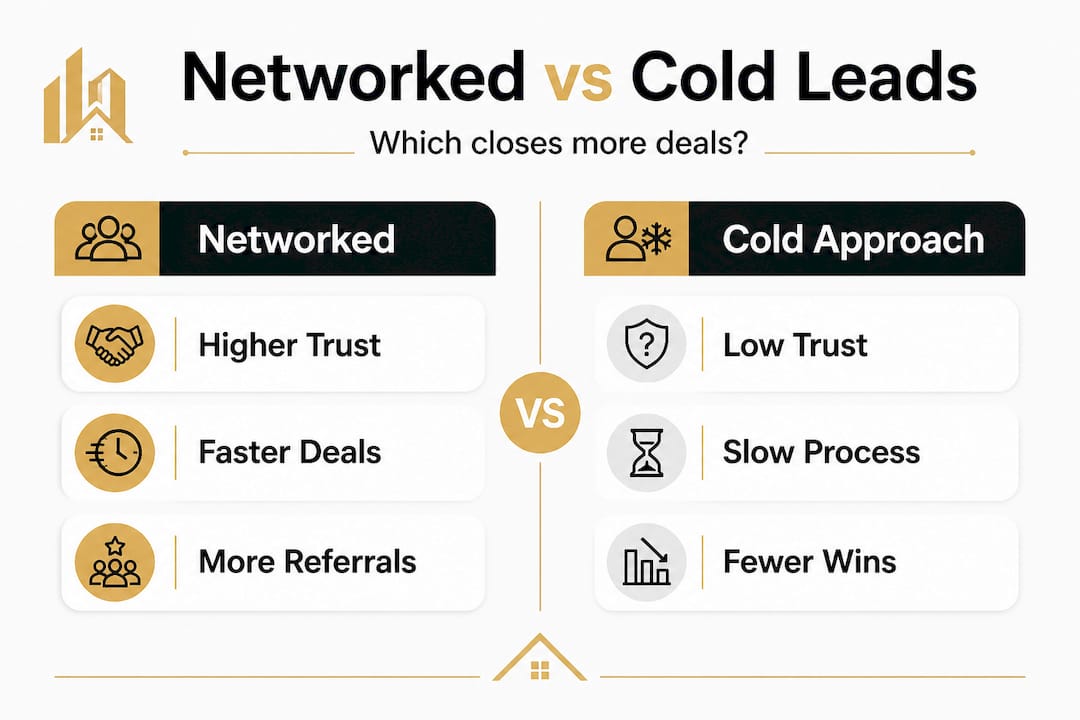
The comparison below shows why networked leads outperform cold approaches across the board.
| Factor | Cold approach | Networked lead |
|---|---|---|
| Initial trust level | Low | High |
| Time to first response | Days to weeks | Hours to days |
| Likelihood of deal closure | Low | Significantly higher |
| Perceived risk to the other party | High | Low |
| Ease of negotiation | Difficult | More collaborative |
These differences are not small. A networked lead can move from introduction to signed agreement in a fraction of the time. That matters enormously when you are trying to close your first deal and build momentum.
Networking opportunities consistently improve real estate work readiness and long-term success. This is why the most effective investors treat relationship-building as a core strategy, not an afterthought.
Here are the key outcomes of successful networking for beginners:
- Exclusive leads: You hear about properties before they hit the market
- Mentorship: Someone with experience guides you past common beginner traps
- Faster sales: Pre-existing trust shortens negotiation timelines
- Career entry: Introductions get you into roles that cold applications cannot
- Joint venture access: Partners fund deals you find but cannot finance alone
- Reputation building: A strong network talks about you, even when you are not in the room
Every single one of these outcomes translates directly into income. You do not need to master all of them at once. Even one strong mentorship connection can save you from a costly mistake and point you toward your first profitable deal.
Using smart research for deals alongside your network makes you doubly effective. You walk into conversations with real knowledge, which builds credibility fast.

Pro Tip: Skip the big national conventions when you are just starting out. A local meetup with 15 to 20 people will deliver far better results. You can actually have real conversations, follow up easily, and be remembered. At a 500-person event, you become invisible. A small local real estate investment association meeting is where real relationships begin.
If you are wondering how to get started with limited funds, check out the beginner strategies covered in investing for beginners. Connecting those strategies with a growing network accelerates everything.
Top networking strategies for beginner investors
Now let's get practical. Here are the most effective networking strategies you can start using this week, both in person and online.
Effective strategies for beginners:
- Attend local real estate meetups: Search Meetup.com or BiggerPockets for groups in your city. Show up consistently, not just once
- Join online investor communities: Facebook groups, Reddit forums, and BiggerPockets forums are active with beginners and experienced investors willing to share
- Ask for warm introductions: When you meet someone valuable, ask if they know anyone else you should connect with. This is how networks grow naturally
- Connect with real estate agents: Agents hear about deals first. Build genuine relationships with two or three local agents and they will think of you when opportunities arise
- Follow up after every interaction: Send a short message within 24 hours of meeting someone. Mention something specific from your conversation to show you were genuinely listening
- Attend open houses: Even if you are not buying, open houses introduce you to agents, sellers, and other investors casually
The most important principle is to give before you ask. Share a useful article. Introduce two people who should know each other. Offer to help someone analyze a deal. When you add value first, people remember you positively.
Referral-based trust reduces perceived risk for everyone involved. When you build a reputation as someone who shows up, follows through, and helps others, referrals start flowing your way naturally.
Pro Tip: Before attending any event, prepare three things: a brief description of what you are looking for, a specific type of deal you want to learn about, and one thing you can offer to others. Walking in prepared means you never have to say "I'm just starting out" in a way that makes you feel small. Everyone started somewhere. Your preparation shows your commitment.
Digital networking is just as real as in-person. LinkedIn is powerful for connecting with property managers, lenders, and experienced investors. BiggerPockets lets you post questions and get answers from people who have already done what you want to do. Explore beginner-friendly digital networking tools to build your online presence without spending a lot of time or money.
One mistake beginners make is treating networking like a transaction. They show up, hand out a card, and then immediately ask for help. That approach burns bridges fast. Instead, think of networking as planting seeds. Water them consistently. The harvest comes later.
Another common mistake is failing to prepare. Show up knowing basic real estate terms, having done some research on the local market, and ready to ask thoughtful questions. This applies equally online. If you want to make money with little capital, your network is your most affordable and highest-return asset.
Real-world examples: Deals closed through networking
Let's look at how real beginner investors used connections to land their first deals. These scenarios reflect what actually happens when you apply these strategies consistently.
-
The referral that led to the first rental: A beginner attended three local meetups without finding immediate opportunities. On the fourth visit, he connected with a landlord who was tired of managing a small rental property. The landlord referred him to the owner of another property nearby. Within six weeks, he had helped facilitate his first rental deal through a mutual introduction that never appeared online.
-
The mentor who fast-tracked a wholesale deal: A new investor posted regularly in a BiggerPockets forum, asking thoughtful questions and engaging with other members' posts. An experienced wholesaler noticed her consistency and offered to walk her through her first deal. That mentorship compressed what might have taken two years of trial and error into four months of guided action.
-
The agent who shared an off-market lead: A beginner made a habit of attending open houses, not to buy, but to build relationships with agents. After three months, one agent called him directly about a property that was not yet listed. Because trust was already established, the conversation moved fast.
-
The joint venture born from a casual conversation: Two beginners met at a local real estate association dinner. One had found a strong deal but lacked financing. The other had savings but no experience finding properties. They partnered and closed their first deal together within 90 days.
"Referred candidates and networked introductions consistently lead to faster, lower-risk outcomes in real estate hiring and deal closure." — Property recruitment research
These examples show a clear pattern. Networking does not just help you meet people. It directly creates the conditions for deal flow and income. When you combine relationship-building with the practical skills from start small, win big strategies, your first deal moves from a distant goal to a realistic near-term outcome.
Why most beginners overlook networking—and what they miss
Here is an uncomfortable truth most real estate courses skip entirely. Formal education in real estate focuses heavily on theory, legal frameworks, and financial models. It rarely teaches you how to walk into a room and build trust with a stranger. Yet that skill, practiced consistently, can outperform knowledge or money when you are just starting out.
Many beginners feel like outsiders. They look at experienced investors and assume those people were born with connections. They were not. Every successful investor you admire started with zero contacts in real estate. They built their network one conversation at a time.
The real edge is that networking is a learnable skill, not a personality trait. You do not need to be naturally outgoing. You need to be consistent. Small, repeated actions work better than grand gestures. Sending a follow-up message after an event. Commenting genuinely on someone's LinkedIn post. Showing up to the same meetup three months in a row. These small habits compound.
Developing the right habits for income growth and applying them to your networking strategy gives you a clear process to follow. You do not need to rely on inspiration or natural charisma.
The investors who struggle for years are often the ones who studied hard but stayed isolated. The ones who move fast are the ones who put themselves in rooms, online and offline, where opportunities and mentors exist. Your outsider status is temporary. It ends the moment you start showing up.
Take action: Build your real estate network today
You now have a clear picture of why networking works and how to start. The next step is putting these strategies into practice with the right training alongside them.

At Real Estate Low Budget Game, we built our beginner course specifically for people who are starting with limited funds and zero industry contacts. For just $19.99, you get instant access to step-by-step modules that teach you how to find deals, build relationships, and generate income from real estate without needing large capital or years of experience. The course covers exactly how to position yourself as a credible investor even when you are new, so that when you walk into networking events, you know what to say and what to look for. Start now and pair your new network with the practical knowledge to make real moves.
Frequently asked questions
What is the most effective networking method for new real estate investors?
Attending local real estate meetups and asking existing contacts for warm introductions gives beginners the fastest path to real opportunities, since 67% of property recruiters prefer referred candidates over cold applicants.
How does networking help beginners close their first real estate deal?
Trusted referrals and direct introductions give beginners access to deals that never appear publicly, because referral-based trust lowers perceived risk for sellers, partners, and employers alike.
Can networking really substitute for experience or capital in real estate?
For many beginners, strong connections provide access to mentors, joint venture partners, and off-market leads even with minimal funds, since over 60% of recruiters confirm that networking directly improves success rates in real estate careers.
What mistakes should beginners avoid when networking?
Never focus only on asking for favors. Offer genuine value first, follow up consistently, and build real relationships rather than treating every interaction as a transaction you want to win immediately.