
Most people assume you need a lot of money to get into real estate. The truth is, thousands of investors start with little or no capital every year, and they find profitable deals by using the right strategies. Whether you're drawn to wholesaling, off-market properties, or passive options like REITs, there are proven entry points for every budget. This guide walks you through each approach step by step. You'll learn what resources you actually need, where to find deals others overlook, and how to take action even if you're starting from zero.
Table of Contents
- Assessing your resources and prerequisites
- Wholesaling: The zero-to-low capital entry point
- Off-market deals: Direct mail, cold calling, and agent relationships
- House hacking, REITs, and crowdfunding: Alternative paths for limited capital
- The reality: How relationships and persistence unlock true deals
- Next steps: Build your deal-finding skills
- Frequently asked questions
Key Takeaways
| Point | Details |
|---|---|
| Low capital strategies | Wholesaling, house hacking, and REITs let you start investing with little money down. |
| Off-market sourcing | Direct mail, cold calling, and agent relationships uncover deals below market rates. |
| Persistence pays off | Consistent outreach and network-building are the keys to sustainable deal flow. |
| Relationships matter | Paying full commissions builds loyalty and access to exclusive pocket listings. |
Assessing your resources and prerequisites
Before you start searching for deals, you need an honest look at where you stand. Your capital, credit score, available time, and skill set all determine which strategy makes the most sense for you right now.
Here's a quick checklist to assess your readiness:
- Capital: Do you have $0 to $2,000 available? That's enough for wholesaling. Do you have $3,500 or more? You may qualify for an FHA loan.
- Credit score: A score of 580 or above opens FHA loan options. A score below 580 still works for wholesaling and REITs.
- Time: Can you commit 10 to 20 hours per week? Active strategies like wholesaling require consistent outreach. Passive options like REITs need much less.
- Skills: Are you comfortable talking to people? Cold calling and networking are core skills for active deal hunting.
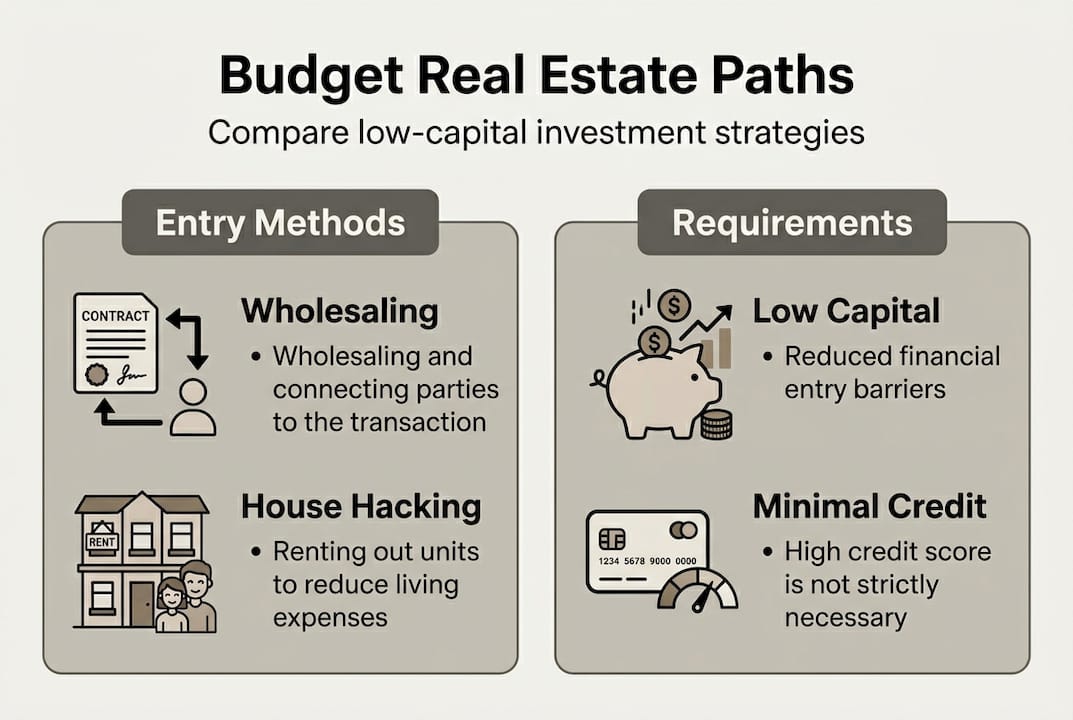
Core strategies for finding real estate deals with limited capital include wholesaling, house hacking, off-market sourcing via direct mail and cold calling, and low-capital entry like REITs or crowdfunding.
| Strategy | Capital needed | Min. credit score | Weekly time |
|---|---|---|---|
| Wholesaling | $0 to $2,000 | None required | 15 to 20 hrs |
| FHA house hacking | $3,500+ | 580+ | 5 to 10 hrs |
| REITs | $10 to $500 | None required | 1 to 2 hrs |
| Crowdfunding | $500 to $1,000 | None required | 2 to 3 hrs |
| Direct mail outreach | $200 to $500/mo | None required | 5 to 10 hrs |
Pro Tip: Before you do anything else, open a spreadsheet and write down your exact savings, your current credit score, and the hours you can realistically commit each week. This one step saves you from choosing the wrong strategy and wasting months of effort. Learning wholesaling for beginners is often the best starting point if your capital is under $2,000.
Wholesaling: The zero-to-low capital entry point
Wholesaling is the process of finding a property at a below-market price, putting it under contract, and then selling that contract to a buyer for a fee. You never actually purchase the property. That's why it requires almost no money to get started.
Here's how a basic wholesale deal works, step by step:
- Build your buyer list. Connect with cash buyers through local real estate investment clubs, online forums, and social media groups. You need buyers lined up before you find a deal.
- Find a distressed property. Look for properties with visible issues: overgrown yards, boarded windows, absentee owners. These owners are often motivated to sell fast.
- Make an offer below market. Aim for 60 to 70 percent of the property's after-repair value (ARV). ARV is what the property would be worth after renovations.
- Sign a purchase contract. Use a simple purchase and sale agreement to lock in the deal.
- Assign the contract. Sell your right to buy the property to a cash buyer for a fee. This fee is your profit.
- Close and collect. The buyer closes with the seller. You collect your assignment fee at closing.
Beginners in wholesaling can typically expect to earn $9,000 to $30,000 annually from 3 to 6 deals in their first year. More experienced wholesalers see average assignment fees of $7,000 to $12,000 per deal.
Pro Tip: The most common beginner mistake is hunting for deals before building a buyer list. If you lock up a contract and have no one to sell it to, you could lose your earnest money deposit. Always line up buyers first. Check out these beginner wholesaling tips to avoid the pitfalls that trip up most new investors.
Off-market deals: Direct mail, cold calling, and agent relationships
Off-market properties are homes not listed publicly on the MLS (Multiple Listing Service). Because fewer buyers know about them, you face less competition and often negotiate better prices.
Three methods work best for sourcing these deals:
Direct mail. Send postcards or letters to targeted lists of homeowners, such as absentee owners or people behind on taxes. Targeted direct mail generates a 1 to 3 percent response rate. That means for every 100 mailers, expect 1 to 3 people to call you back.
Cold calling. Call homeowners directly using publicly available skip-tracing data. This method gets a 1 to 2 percent response rate. To close 8 contracts, you may need to make roughly 5,500 calls with consistent effort. It sounds like a lot, but consistency is what separates results from zero.
Agent relationships. Building strong connections with real estate agents who pay full 3% commissions can give you access to pocket listings before they ever hit the market.
"Treat every agent interaction as an investment. Agents remember who makes their job easy, and that loyalty pays off in early access to the best deals."
Here's a quick comparison:
| Method | Avg. response rate | Cost to start | Best for |
|---|---|---|---|
| Direct mail | 1 to 3% | $200 to $500/mo | Systematic outreach |
| Cold calling | 1 to 2% | $50 to $100/mo | Fast, direct contact |
| Agent referrals | Varies | Commission | Exclusive listings |
Tools you'll need for each approach:
- Direct mail: A mailing list service, a simple postcard template, and a budget for printing and postage.
- Cold calling: A skip-tracing tool to find phone numbers, a basic CRM (customer relationship manager) to track calls, and a simple script.
- Agent relationships: A professional email, a clear buyer profile, and patience to build trust over time.
For a deeper look at finding off-market deals and understanding how serious buyers approach exclusive access, studying off-market listing strategies used in competitive markets offers real insight.
House hacking, REITs, and crowdfunding: Alternative paths for limited capital
Not everyone wants to cold call or drive neighborhoods looking for distressed homes. That's okay. These three strategies let you build real estate wealth with less hands-on effort.

House hacking means buying a multi-unit property, living in one unit, and renting out the others. The rental income offsets or fully covers your mortgage. You can get started with FHA loans that require as little as 3.5 percent down, making this accessible if you have a 580+ credit score.
REITs (Real Estate Investment Trusts) are companies that own income-producing properties. You buy shares like a stock. Some REITs let you start with as little as $10. You earn dividends without owning or managing property directly.
Real estate crowdfunding lets multiple investors pool money to fund a property deal. Platforms typically require $500 to $1,000 to start.
What to watch for with each option:
- Fees: REITs and crowdfunding platforms charge management fees that can reduce returns.
- Liquidity: REITs traded on exchanges are easy to sell. Crowdfunding investments are often locked up for 3 to 5 years.
- Risk: All real estate carries risk. Passive options don't mean zero risk.
| Strategy | Min. investment | Projected annual return | Liquidity |
|---|---|---|---|
| House hacking | $3,500 to $10,000 | Variable (offset costs) | Low |
| Public REITs | $10 to $500 | 4 to 8% avg. | High |
| Crowdfunding | $500 to $1,000 | 6 to 12% projected | Low to medium |
The reality: How relationships and persistence unlock true deals
Here's something most guides won't tell you directly. The strategy matters less than the consistency you bring to it.
New investors often focus all their energy on learning the method and almost none on the follow-through. They send one batch of mailers and stop. They make 50 cold calls and give up. Real results come from repetition, not shortcuts.
Agent relationships are the clearest example of this. Paying full commissions builds agent loyalty and opens access to off-market pocket listings that never appear publicly. Most beginners try to negotiate commissions down, and in doing so, they cut themselves off from the best inventory.
The investors who succeed treat every outreach attempt as a data point. They track every call, every mailer, every agent meeting. Over time, patterns emerge, and those patterns become a repeatable system.
Practical relationship-building tips and understanding agent exclusivity strategies can dramatically shorten your path to your first deal. Persistence and people skills, not just capital, are what separate those who find deals from those who just study them.
Next steps: Build your deal-finding skills
You've now seen the real methods that work for investors starting with limited capital. The next move is building the skills to execute them consistently.

At real estate training for beginners, you get step-by-step modules that cover everything from wholesaling basics to building your agent network, for a one-time cost of just $19.99. There's no fluff, no filler. Just practical lessons, action checklists, and a tailored execution plan you can start using today. If you're ready to stop reading about real estate and start doing it, this is your next step.
Frequently asked questions
What is the fastest way to find real estate deals with no money?
Wholesaling is often the fastest option, requiring little or no capital and giving you a realistic shot at your first deal within 1 to 3 months of consistent effort.
How effective are direct mail and cold calling for finding off-market properties?
Direct mail yields a 1 to 3% response rate, while cold calling produces roughly 1 to 2% response and approximately 8 contracts for every 5,500 calls made with consistent follow-through.
What are the best alternative strategies if I can't do active deal hunting?
House hacking, REITs, and real estate crowdfunding are solid options that allow you to build wealth with lower capital requirements and far less direct involvement in finding or managing properties.
Why are agent relationships important in finding exclusive real estate deals?
Paying full commissions builds agent loyalty, which can give you early access to pocket listings and off-market deals that most buyers never even get to see.