
Most people assume real estate investing is reserved for the wealthy. That's simply not true. Real estate investing does not require high capital or prior experience to generate income. With the right knowledge, you can start small, use creative strategies, and build real wealth over time. This guide breaks down exactly how real estate works, what income it creates, which beginner-friendly options exist, and how to avoid the most common mistakes. Whether you have $500 or $50,000, there is a path forward for you.
Table of Contents
- What is real estate investing?
- How real estate generates income and wealth
- Popular types of real estate investments for beginners
- Risks, challenges, and how to start safely
- Our take: What most beginner investors misunderstand
- Get started: Real estate investing resources for beginners
- Frequently asked questions
Key Takeaways
| Point | Details |
|---|---|
| Accessible entry points | Beginner investors can start with little capital using creative strategies and partnerships. |
| Multiple wealth drivers | Real estate builds wealth through cash flow, appreciation, debt paydown, and tax benefits. |
| Risk management essentials | Focus on structuring deals safely, not just chasing market timing, for lasting success. |
| Beginner-friendly options | REITs and auctions offer practical and low-budget paths to real estate investing. |
| Expert guidance matters | Learning from trusted resources speeds progress and helps avoid costly mistakes. |
What is real estate investing?
Real estate investing means buying, holding, or selling property to earn a financial return. That return can come in several forms, and you don't need to own a mansion to benefit.
At its core, real estate investing involves purchasing property to generate income through rental payments, property value appreciation, equity buildup from mortgage paydown, tax benefits like depreciation and interest deductions, and leverage to control larger assets with less capital. Each of these mechanisms works differently, and together they make real estate one of the most flexible wealth-building tools available.
Here's a quick breakdown of the five main income and wealth drivers:
- Rental income: Tenants pay you monthly rent, which covers your costs and ideally leaves a profit.
- Appreciation: Property values rise over time, increasing what your investment is worth.
- Equity: As your mortgage gets paid down, you own more of the property outright.
- Tax benefits: The IRS allows deductions for depreciation, mortgage interest, and certain expenses.
- Leverage: You can control a $300,000 property with a $60,000 down payment.
"You don't need to be wealthy to start. You need to understand how the money moves."
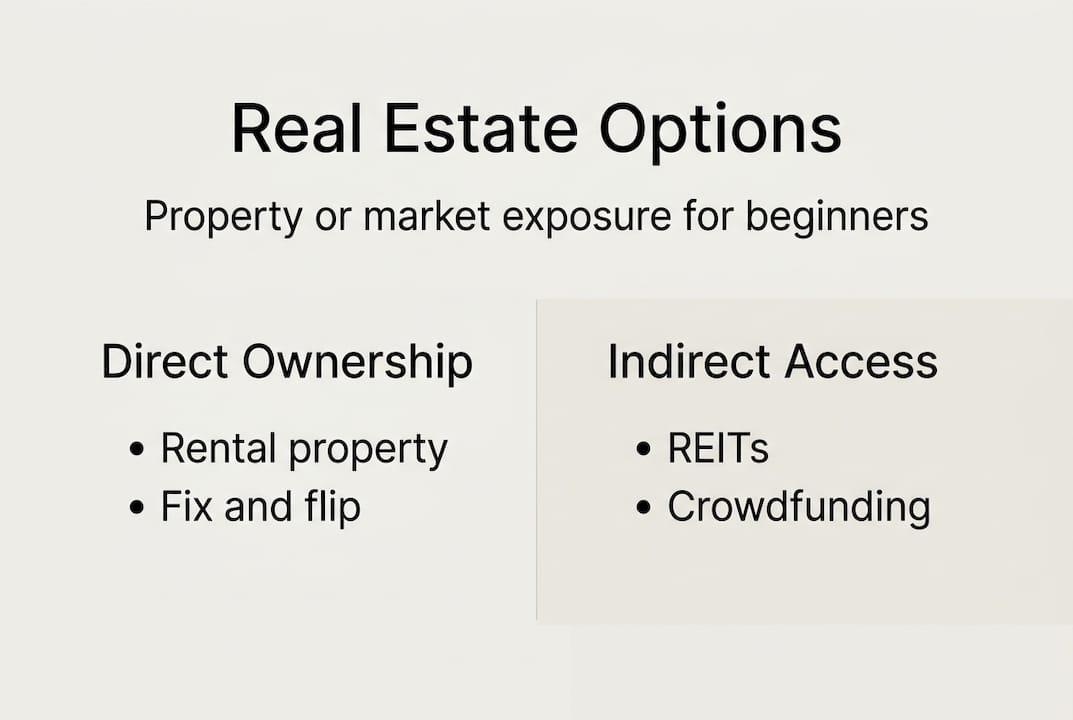
Not every strategy requires direct property ownership either. REITs (Real Estate Investment Trusts) let you buy shares in large property portfolios, similar to buying stock. Real estate crowdfunding platforms let groups of investors pool small amounts to fund larger deals. These options make finding cheap real estate opportunities accessible even when your budget is tight.
For a broader picture of how a typical deal works, the real estate deal overview breaks it down step by step. And if you're looking for structured training that explains all of this without the jargon, low budget real estate training is a practical place to start.
The key takeaway here is simple. Real estate investing is not one thing. It's a collection of strategies, and you choose the one that fits your budget and goals.
How real estate generates income and wealth
Now that we've defined the concept, let's see how real estate investing creates wealth in practice.
Each wealth-building mechanism works on its own timeline and at different intensity levels. Understanding all five helps you pick the right strategy for where you are right now.
1. Cash flow Cash flow is rental income minus your expenses (mortgage, taxes, insurance, repairs). A property earning $1,500 per month in rent with $1,100 in monthly costs generates $400 in monthly cash flow. That's $4,800 per year from a single property.

2. Appreciation US properties appreciate roughly 3 to 5% annually on average. On a $200,000 property, that's $6,000 to $10,000 in added value each year, even if you never do any work on it.
3. Equity buildup Every mortgage payment chips away at what you owe. Over time, the gap between what the property is worth and what you owe grows. That gap is your equity, and it's real money you can tap later.
4. Tax advantages The IRS lets landlords deduct property depreciation, mortgage interest, and operating costs. For many investors, these deductions offset a significant portion of their taxable income.
5. Leverage Leverage allows control of a $300,000 asset with just $60,000 down. If that property appreciates 4%, you've gained $12,000 on a $60,000 investment. That's a 20% return on your actual cash invested.
| Wealth Mechanism | Timeline | Requires Active Work? |
|---|---|---|
| Cash flow | Monthly | Moderate |
| Appreciation | Long term | No |
| Equity buildup | Ongoing | No |
| Tax benefits | Annual | Low |
| Leverage | At purchase | No |
Pro Tip: Don't chase one mechanism. The best real estate deals stack multiple income sources at once. A rental property with solid cash flow, steady appreciation, and good tax deductions outperforms a flip that only profits once.
For deeper insights on how to evaluate deals and spot opportunities, the auction strategies blog covers real examples worth reading.
One more benchmark worth knowing: REITs averaged 11.8% in annual returns from 1972 to 2024. That's a strong track record for a vehicle that requires zero property management.
Popular types of real estate investments for beginners
Let's explore beginner-friendly investment types and how each option stacks up.
There's no single path into real estate. Your budget, risk tolerance, and time availability all influence which option fits you best. Here are the five most accessible starting points.
- Direct rental property: You buy a home or condo and rent it to tenants. It's hands-on but delivers cash flow, appreciation, and equity all at once.
- REITs: You buy shares in a company that owns large property portfolios. No landlord headaches, no big down payment needed. US property values have averaged 3 to 5% appreciation, while REITs have delivered 11.8% average annual returns since 1972.
- Crowdfunding platforms: Sites like Fundrise let groups of investors co-fund commercial or residential deals with as little as $10 to start.
- Fix-and-flip: Buy a distressed property below market value, renovate it, and sell for a profit. Higher risk but high reward if done right.
- Auction deals and creative finance: Find underpriced properties at auction or negotiate seller financing to control deals with minimal cash upfront.
| Investment Type | Capital Needed | Effort Level | Return Potential |
|---|---|---|---|
| Rental property | Moderate | High | High |
| REITs | Very low | None | Moderate to high |
| Crowdfunding | Very low | None | Moderate |
| Fix-and-flip | Moderate | Very high | High |
| Auction deals | Low | Moderate | High |
Pro Tip: If you're starting with under $5,000, REITs and crowdfunding give you real exposure to property markets while you build your knowledge and savings for bigger moves.
For a closer look at how buying investment properties works at the deal level, review the FAQ section. And to understand what structured training and auction deal pricing looks like, that page is worth a visit before you commit to any path.
Risks, challenges, and how to start safely
Every investment comes with risk. Here's what you should know and how to stay safe.
Real estate is not a guaranteed win. In 2026, higher rates and costs compress margins. Insurance premiums, property taxes, and financing costs have all risen sharply. That means you need to be smarter about deal selection than investors were five years ago.
Here are the biggest risks beginners face:
- Bad tenants: Non-payment, property damage, and eviction costs can quickly erase profits.
- Expensive repairs: Older properties often hide costly issues like plumbing failures or roof problems.
- Lawsuits: Landlords face liability exposure if tenants are injured on their property.
- Market downturns: Property values can drop, especially in overpriced markets.
- Vacancy: An empty unit still has costs. Every month without a tenant hurts your cash flow.
How do you reduce these risks?
- Start small. One property, one deal at a time. Don't overextend in year one.
- Target secondary markets. Smaller cities with lower price-to-rent ratios often offer better cash flow and less competition.
- Structure your deals for protection. Use LLCs (limited liability companies) to shield personal assets from lawsuits.
- Focus on fundamentals. Strong rental demand, below-market purchase prices, and realistic expense estimates matter far more than trying to time the market.
Structure deals for tail risks like lawsuits over market timing. That's the discipline that separates profitable investors from cautionary tales.
For a step-by-step breakdown of how to evaluate a deal safely, the deal overview is a helpful starting point before you put any money on the line.
Our take: What most beginner investors misunderstand
Here's the honest truth most real estate content won't tell you. Beginners consistently overestimate how much money they need to get started and underestimate how much damage a poorly structured deal can do.
The fear of not having enough capital keeps most people on the sidelines forever. But we've seen people start with almost nothing, using creative finance and auction strategies, and generate real income within months. The barrier is almost never money. It's knowledge.
At the same time, the real danger isn't market timing or economic downturns. It's walking into a deal without understanding the terms, the numbers, or the legal exposure. A great deal with sloppy structure can cost you everything. A mediocre deal with solid fundamentals and proper protections can still build long-term wealth.
Our advice: master the basics first. Learn how to read a deal, structure it safely, and identify real demand. Then scale. Check out real estate auction strategies to see how everyday beginners are finding overlooked deals without big budgets.
Get started: Real estate investing resources for beginners
Ready to start? These resources make it easier for beginners to take action.
You now understand how real estate works, what income it creates, and how to stay safe as a beginner. The next step is structured, practical training that shows you exactly what to do.

At beginner real estate training, you get step-by-step modules built for people with no experience and no large budget. For a one-time investment of $19.99, you get instant access to all course materials, action checklists, and a tailored execution plan. Have questions about how deals work? The auction deal FAQ answers the most common beginner questions. When you're ready to see what training costs, auction pricing lays it all out clearly. Your first step into real estate starts here.
Frequently asked questions
How much money do I need to start investing in real estate?
You can begin with very little capital using options like REITs, crowdfunding, or creative finance strategies. Leverage lets you control a $300,000 asset with just $60,000 down, and some platforms allow entry with under $100.
Is real estate safer than stocks for beginners?
Real estate offers physical assets and steady cash flow, which many beginners find reassuring, but stocks tend to offer greater liquidity. Residential real estate delivered a 4.3% CAGR from 1928 to 2025, while the S&P 500 averaged 9.9% over the same period.
What are the main risks for beginner real estate investors?
Key risks include problem tenants, unexpected repairs, lawsuits, and market downturns. Structure deals for tail risks like lawsuits rather than trying to predict the market, and always start small to limit your exposure.
Can I invest in real estate without buying property?
Yes. REITs, real estate funds, and crowdfunding platforms let you invest in property portfolios without ever owning a physical asset. REITs averaged 11.8% annually from 1972 to 2024, making them a strong option for beginners who want exposure without the landlord responsibilities.
Recommended
- Real Estate Low Budget Game | Beginner Real Estate Training From $0
- Find Cheap Real Estate Deals at Auction
- Find Cheap Real Estate Deals at Auction
- Find Cheap Real Estate Deals at Auction
- Why automation is essential for real estate investors – ClosersLeague Blog
- How to Generate Real Estate Leads for High-Value Clients